South Korean cattle farmers mobilize as beef imports rise 21.8% and Brazil seeks access
South Korea’s July beef imports rose 21.8% year on year to 56,000 tonnes, led by a sharp increase in Australian supply. Cattle farmers are preparing protests as the government considers renewed Mercosur trade talks and advances inspections for Brazilian beef.
Farmers prepare phased protests
South Korean cattle farmers are preparing collective action against further opening of the domestic beef market as imports increase and the government considers reviving trade negotiations with Mercosur. According to Newsis, the Korea Hanwoo Association decided at a board meeting to begin phased opposition measures, including a press conference and potentially a large farmers’ rally.
The association said concern was growing because Seoul was simultaneously pursuing renewed Mercosur negotiations and conducting an on-site inspection related to sanitary import conditions for Brazilian beef. Brazil is the world’s largest beef exporter. Entry into South Korea would still depend on completion of the quarantine approval process, while any later trade agreement could affect the tariff treatment of the product.
Australian shipments drive July growth
South Korea imported 56,000 tonnes of beef in July, 21.8% more than a year earlier, according to the August edition of the Korea Rural Economic Institute’s report on international livestock supply and demand cited by Newsis. Imports during January-July reached 304,689 tonnes, an increase of 7.7% from the same period last year.
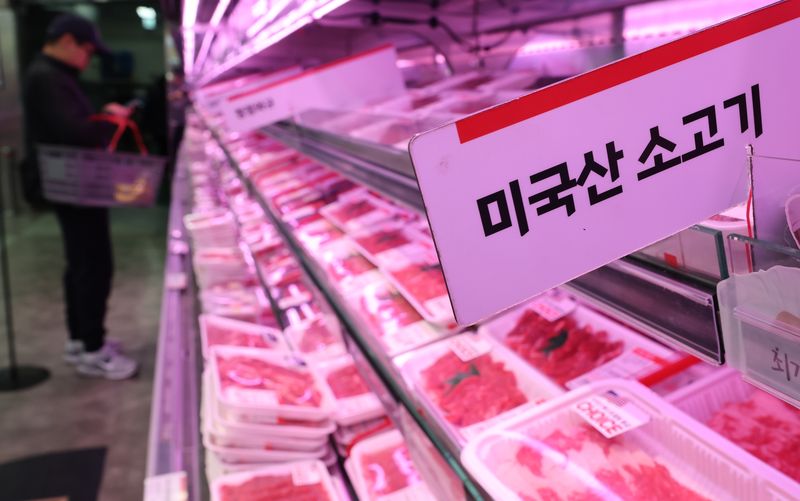
Australia accounted for most of the July expansion. Australian shipments jumped 69.0% year on year to 34,000 tonnes, while imports from the United States declined 13.3% to 20,000 tonnes. The figures show that total foreign supply continued to grow despite a reduction in US volumes.
Import growth also persisted despite higher prices. The average July import price rose 13.2% year on year to $9.39 per kilogram. US beef averaged $10.86 per kilogram, up 11.7%, while Australian beef reached $8.30, an increase of 17.8%.
Tariff reductions intensify competition
The Korea Hanwoo Association argues that Brazilian access would add pressure to a market where tariffs on established suppliers are already disappearing. The tariff on US beef was eliminated this year, while Australian beef is subject to a 5.3% rate. The Australian tariff is scheduled to end in 2028, followed by tariffs on Canadian and New Zealand beef in 2029.
Domestic supply has meanwhile contracted. In July, 68,754 Hanwoo cattle were graded, 13.3% fewer than a year earlier. Reduced supply helped lift the wholesale Hanwoo price by 20.8% to 21,778 won per kilogram. Farmers say that persistent production costs and stronger competition from lower-priced imported meat could increase financial pressure even when domestic wholesale prices are rising.
Mercosur talks broaden the policy dispute
The government is discussing a restart of previously suspended trade negotiations with Mercosur. South Korea and Brazil have also adopted a four-year action plan covering wider cooperation in areas including critical minerals, defence and automobiles.
The sanitary review for Brazilian beef is proceeding separately from those trade discussions. The farmers’ association wants the government to assess the potential impact on Hanwoo producers and establish support measures before expanding market access. The dispute will therefore depend on two distinct decisions: whether Brazilian beef clears the import-health process and whether renewed Mercosur negotiations ultimately produce tariff concessions.