South Korea's carbon price tops 30,000 won, squeezing coal-fired power
South Korea's emissions allowance price has moved above 30,000 won, eroding the cost advantage of coal-fired generation, according to Hans Economy. The power sector's paid-allocation ratio is also set to rise in stages during the fourth planning period of the national emissions trading scheme. The substitute fuel, LNG, has become more expensive as well, leaving the cost of replacement unresolved.
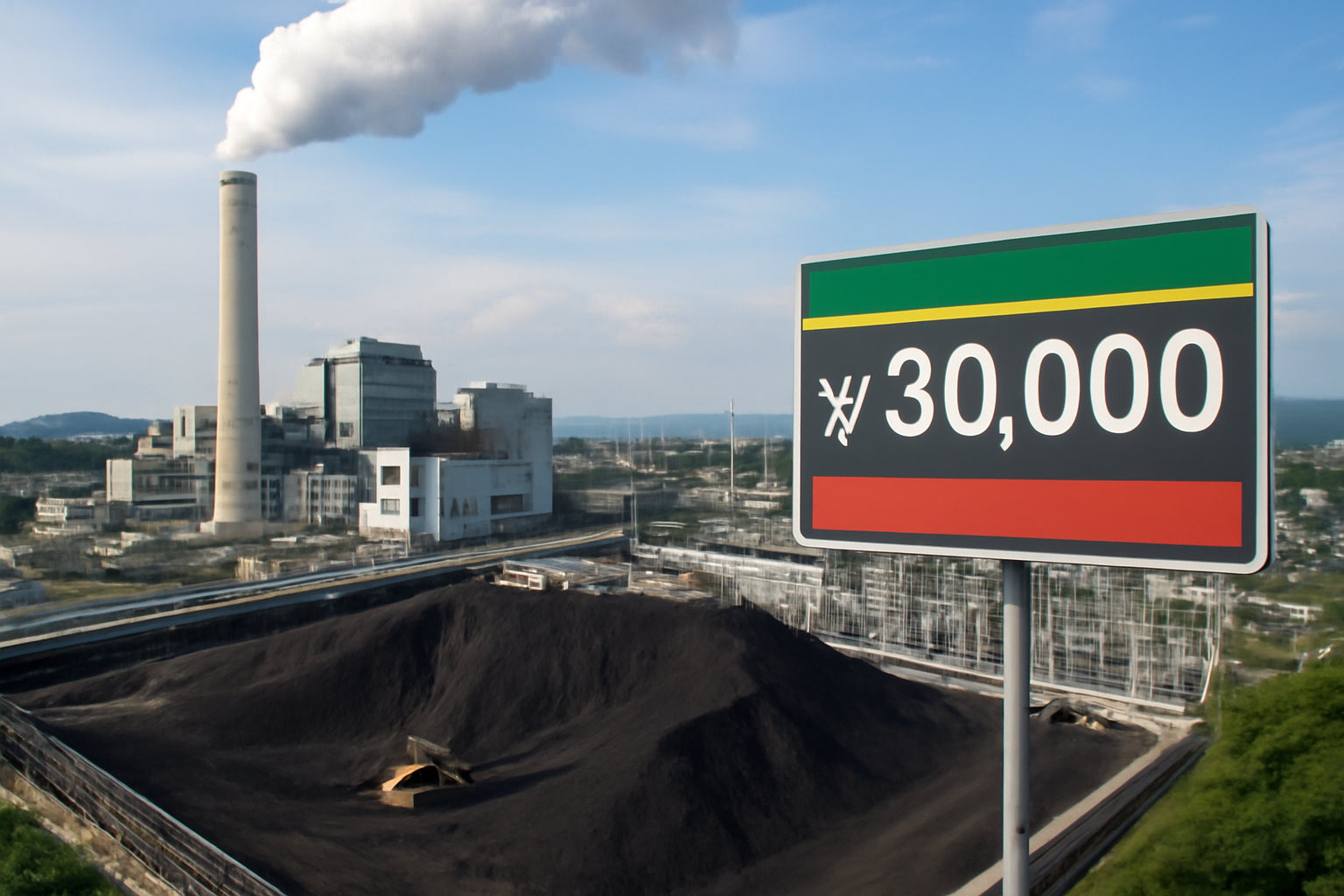
South Korea's carbon allowance price has climbed above 30,000 won, a threshold at which coal-fired generation starts to lose the cost advantage that has underpinned its place in the country's power mix. Hans Economy reports that the pressure will build further as the power sector's paid-allocation ratio rises in stages through the fourth planning period of the national emissions trading scheme (K-ETS).
Carbon cost lands hardest on coal
The mechanism is straightforward. Coal plants release substantially more carbon dioxide per unit of electricity than gas-fired units, so any increase in the allowance price widens the carbon cost gap between the two technologies. Because generators are dispatched broadly in order of variable cost, a carbon price high enough to close the fuel-cost gap moves coal down the merit order and gas up it. Above 30,000 won, according to Hans Economy, that pressure on coal's cost competitiveness is already visible.
The signal to cut coal output is unambiguous, the publication writes. The difficulty lies in what replaces it, and at what price.
Paid allocation rises in the fourth planning period
K-ETS distributes part of each covered company's allowances free of charge and requires the remainder to be bought. For power generators, the share that must be paid for is scheduled to increase in stages during the fourth planning period. The practical effect is that a growing portion of every tonne emitted becomes a cash outlay rather than a free entitlement, and the carbon price feeds directly into operating cost.
- a larger volume of allowances bought at market prices instead of received free;
- carbon expense embedded in the variable cost of every coal-fired megawatt-hour;
- greater exposure of generator earnings to allowance price swings;
- a stronger incentive to shift load toward lower-emitting plant where capacity allows.
The two factors compound: the price per tonne rises, and so does the number of tonnes that must be paid for.
The substitute is not cheap either
The obvious replacement for coal-fired baseload is liquefied natural gas, but Hans Economy notes that LNG prices have risen as well, so switching fuels does not automatically lower the cost of generation. South Korea imports virtually all of both fuels, and a durable move from coal to gas would shift purchasing volume from thermal coal suppliers to LNG suppliers rather than reduce the country's import dependence.
Fuel is not the whole bill. The transition also requires investment in energy storage systems and in the transmission network, the publication reports, because a power mix leaning more on gas and renewables needs flexibility and grid capacity that a coal fleet did not.
The unresolved question is who pays
Hans Economy frames the cost of replacement as the outstanding issue: the carbon price signal is working, but the bill for substitution — fuel, storage, networks — has no agreed owner. The candidates are the generators' margins, the electricity tariffs paid by industrial and household consumers, and the public budget.
For market participants, the variables worth tracking are the trajectory of the allowance price above 30,000 won, the pace at which the paid-allocation ratio rises through the fourth planning period, LNG procurement terms, and the timetable for storage and grid build-out. Each determines how quickly coal capacity moves from running to reserve, and how much of Korea's imported energy demand shifts from coal to gas.