South Korea secures $41.66 million in Australia food export consultations, targets halal markets
South Korean food suppliers recorded $41.66 million in export consultations at Fine Food Australia, where convenience foods, fermented products, sauces and fresh pears drew buyer interest. The government and Korea Agro-Fisheries & Food Trade Corporation are also expanding practical support for companies entering halal markets in the Middle East and Russia-CIS region.
Australian exhibition generates $41.66 million in consultations
South Korea is stepping up its food-sector expansion in Australia while preparing exporters for the certification, customs and distribution requirements of halal markets in the Middle East and the Russia-CIS region.
The Ministry of Agriculture, Food and Rural Affairs and the Korea Agro-Fisheries & Food Trade Corporation, known as aT, achieved $41.66 million in export consultations at the 2026 Fine Food Australia exhibition, according to Consumer Times. The event was held in Melbourne, Victoria, from August 31 to September 3.
The agencies operated an integrated Korean pavilion with 30 booths and 27 participating companies, including agricultural-food businesses and export organizations. Fine Food Australia attracted about 25,000 buyers, including participants from Sydney, Brisbane and Adelaide as well as neighboring New Zealand, the publication reported.
The consultations indicate broad commercial interest, although the reported figure represents prospective business discussions rather than confirmed export contracts. For Korean suppliers, the next test will be converting buyer inquiries into listings, distribution agreements and repeat orders across Australia’s retail and food-service channels.
Convenience foods and sauces match changing demand
South Korean authorities selected fermented foods, health-oriented products and convenience foods as strategic categories for Oceania this year. The approach reflects Australian demand shaped by high prices, the growth of single-person households and rising interest in premium prepared meals that combine convenience with flavor.
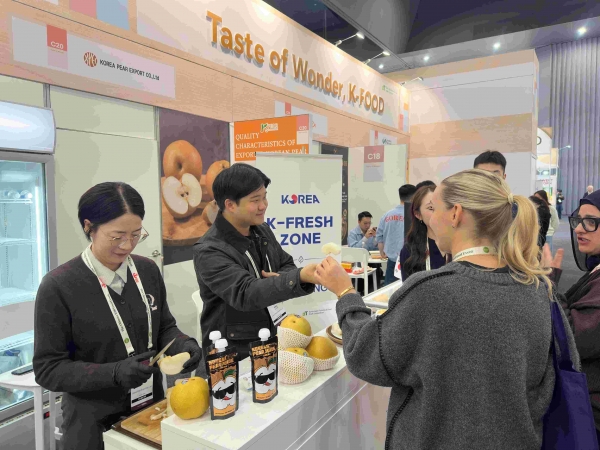
Products displayed at the K-food promotional zone included vegan fried rice, frozen gimbap, flower tea, tteokbokki, noodles and various sauces. The pavilion also featured a K-Fresh Zone organized with the Korea Pear Export Association, where visitors sampled South Korean pears.
Food-service purchasing managers showed particularly strong interest in ingredients that can be adapted to local recipes, Consumer Times reported. Traditional fermented pastes such as gochujang and ssamjang, alongside spicy sauces and sesame sauces, generated repeated consultation requests from buyers.
Charles Park, a local buyer attending the exhibition, said he encountered high-quality Korean foods suited to recent Australian trends. He also pointed to the K-Food Trade online platform as a useful way to review companies and products that were not represented at the exhibition.
Jeon Gi-chan, aT’s executive director for food exports, said K-food distribution was expanding beyond Sydney and Melbourne into other parts of Australia. The agency plans to identify products aligned with local consumer trends and connect suppliers with distribution networks to deepen access to Australia’s mainstream market.
Export support broadens to halal markets
In parallel, the ministry and aT are extending support to South Korean food companies seeking entry into fast-growing halal markets. Citing Dinar Standard, Consumer Times reported that the global halal food market is projected to increase from $1.434 trillion in 2023 to about $2.08 trillion in 2028, supported by a growing Muslim population and stronger purchasing power.
The agencies scheduled an online strategy seminar for companies targeting the Middle East and Russia-CIS region. The initiative follows four non-tariff-barrier briefings held since March covering major sales markets including China, the United States and Southeast Asia.
The seminar program covers K-food demand in the Middle East, marketing within regional distribution systems and customs precautions. It also addresses demand and market-entry rules in Russia and CIS countries. The Korea Food Research Institute is due to explain halal certification pathways and key compliance checks, which vary by country and certifying institution.
The combined initiatives show a two-track export strategy: matching products to established consumer trends in Australia while reducing regulatory and operational barriers in less uniform halal markets. In Australia, product fit and channel access are the immediate priorities. In halal markets, certification choices, customs preparation and country-specific distribution structures remain central to commercial execution.