South African sugar cane growers hit by labour shortage as migrant workers leave
Sugar cane farmers in South Africa face a shortage of harvest labour after migrant workers left farming districts amid anti-migrant sentiment and crackdowns. Cane is still cut largely by hand, so the loss of experienced crews feeds straight through to delivery volumes, cane quality and mill throughput.
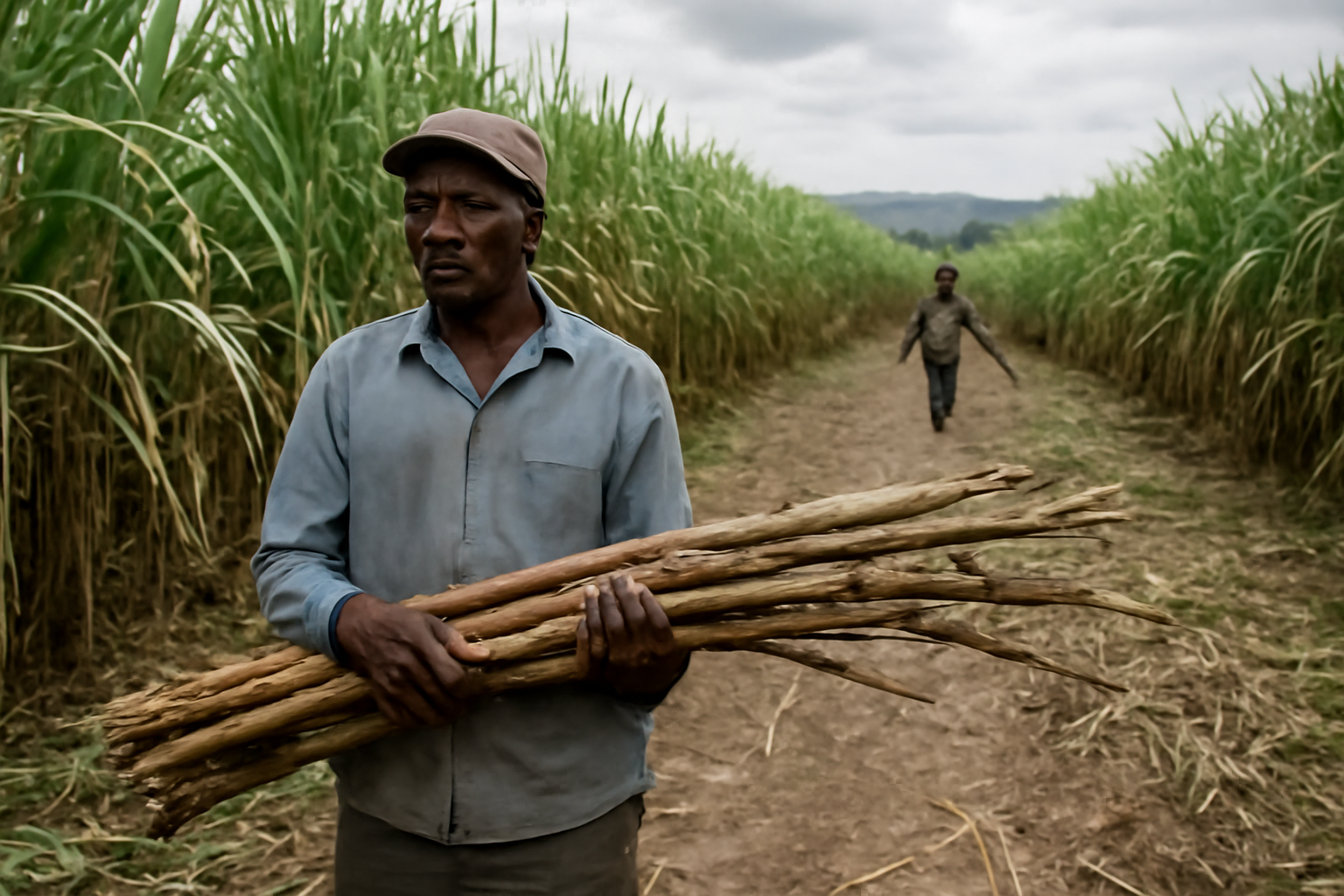
Sugar cane growers in South Africa are struggling to assemble enough harvest labour after migrant workers left farming districts amid anti-migrant sentiment and a series of crackdowns, thinning the workforce that one of the country's most labour-intensive crops depends on.
Why cane is exposed to a labour shock
Sugar cane in South Africa is still cut largely by hand. Harvest crews work to a tight calendar: cane is cut, loaded and delivered to the mill within a short window, and burnt cane in particular has to move quickly before the sucrose in the stalk begins to degrade. Labour is not an incidental cost in this system. It is the mechanism that moves the crop from field to mill.
Experience matters as much as headcount. A seasoned cutter clears more rows in a day than a newly recruited one and cuts closer to the base of the stalk, where sucrose concentration is highest. When established crews disperse, growers lose capacity and quality at the same time, and neither is rebuilt within a single season.
The squeeze reaches the mill
Mills are fixed-cost operations designed to run continuously through the crushing season. Their unit costs fall as throughput rises, which makes a steady daily flow of cane more valuable than a large but irregular one. A shortage of cutters shows up at the mill as under-utilised crushing capacity, a longer season and a higher processing cost per tonne of sugar produced.
Growers who cannot fill their crews face a narrow set of responses:
- raise wages or add incentives to draw workers from other districts, which lifts the cost base of a crop whose price they do not set;
- harvest a smaller area and leave the balance standing, carrying the risk into the following season;
- stretch the cut over a longer period, pushing work into less favourable conditions;
- hire contractors, where any are available in a market in which every grower is short at the same time.
Mechanisation is not a short-term answer
Mechanical harvesting is the obvious structural response and also the slowest one. Harvesters are capital equipment bought against multi-year payback, they need trained operators and a maintenance chain, and they perform poorly on steep and broken cane land. The constraint is tightest for small-scale growers, whose individual blocks are too small to justify a machine and who would need contractor or cooperative arrangements to reach one. Mechanisation also removes the jobs that make cane an important employer in rural districts, which carries its own cost where farm work is one of the few sources of formal wages.
A labour market question, not only a farm one
Migrant workers have long formed part of the agricultural workforce in southern Africa, and seasonal crops depend on that mobility. What changes the calculation for growers is not only the number of workers who have already gone, but the uncertainty that follows. Workers tend to withdraw ahead of enforcement action rather than wait for it, and the departures fall hardest on employers whose demand for labour is concentrated into a few months of the year.
For the sugar chain the consequences are cumulative rather than immediate. A single disrupted season shows up as lower delivered tonnage and weaker sucrose recovery. A shortage that persists across seasons reaches further: less replanting, ageing cane stands, reduced mill utilisation and a slower supply response when prices improve. Sugar produced in South Africa serves both the domestic market and regional buyers, so a sustained fall in cane deliveries would be felt first in local availability and then in the volumes left over for export.