South African apple and pear exports hit record levels as planted area stays flat
Hortgro's 2025 Key Deciduous Fruit Statistics show record export volumes for South African apples and pears, achieved on a planted area that remained largely stable. Behind the flat headline area sits a significant shift in crop mix and continuing orchard replacement. Rising input costs are the counterweight to the volume record.
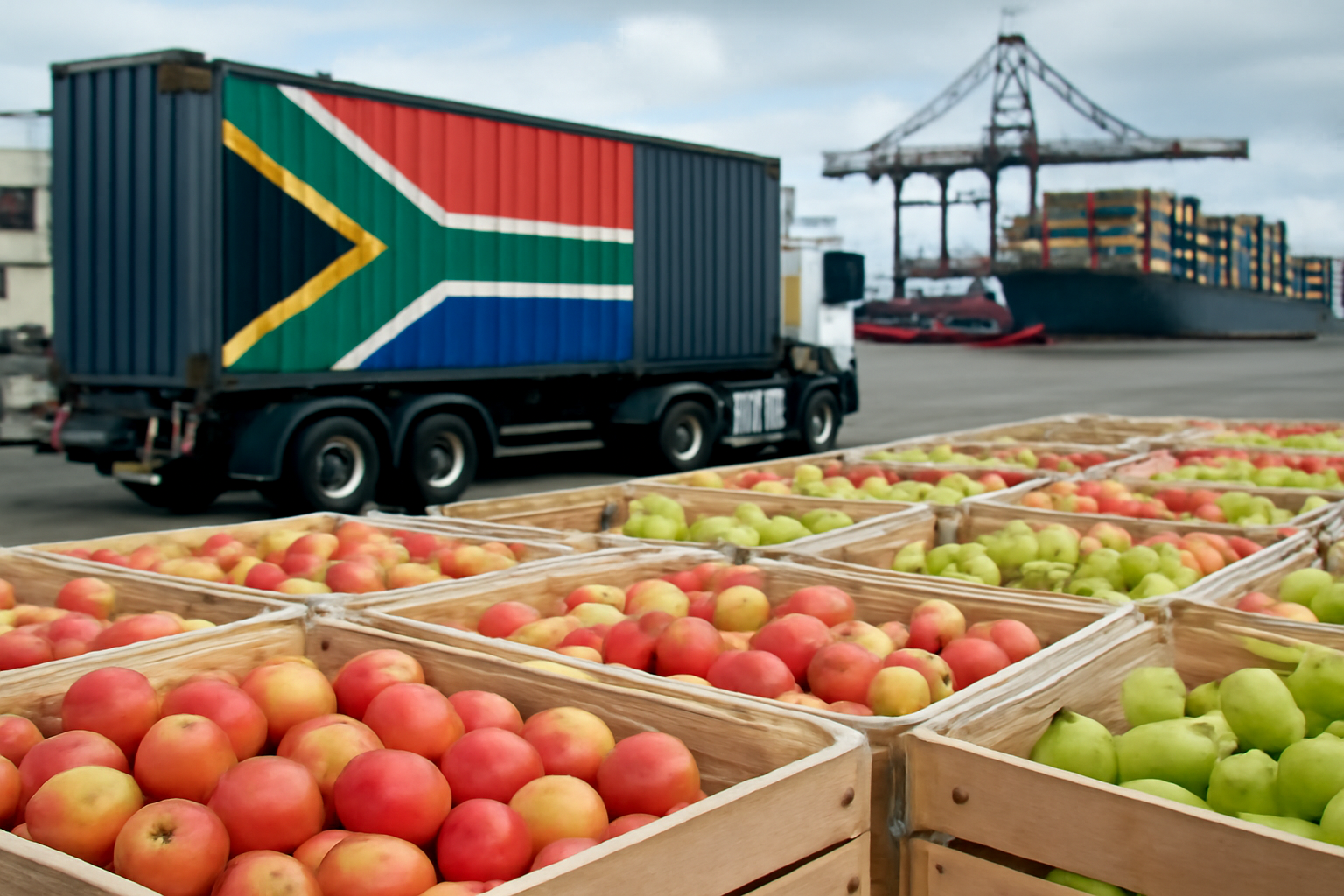
South African apple and pear growers exported record volumes, according to Hortgro's 2025 Key Deciduous Fruit Statistics, as reported by Farmer's Weekly. The annual release is the reference dataset for the country's pome and stone fruit sector, covering planted area, crop composition, production and export performance.
The record was set against a planted area that Hortgro describes as largely stable. That combination of flat hectares and higher export volumes points to productivity gains inside existing orchards rather than to an expansion of the production base.
Record volumes on an unchanged footprint
Apples and pears are South Africa's two largest deciduous export categories, and both delivered record export volumes, Hortgro's statistics show. Because the industry supplies Northern Hemisphere markets during their domestic off-season, the additional volume lands in a window where South African fruit competes mainly with other Southern Hemisphere origins and with stored Northern Hemisphere crop.
Growth without net new plantings is achieved in a specific way: older, lower-yielding orchards are removed and replaced with higher-density plantings and newer cultivars that carry more fruit per hectare and pack out at a higher export percentage. Hortgro's data point to exactly that process, with orchard replacement identified as one of the main movements behind an otherwise unchanged national total.
Stable hectares, shifting crop mix
The headline stability in area conceals significant reallocation between crops and cultivars, according to Hortgro. Removals in one category are offset by new plantings in another, leaving the aggregate figure flat while the composition of the orchard base changes underneath it.
- record export volumes for both apples and pears
- a total planted area that remained largely stable
- significant shifts in the crop mix within that stable total
- continuing orchard replacement, with older blocks giving way to new plantings
- rising input costs across the production chain
For growers, replacement is a capital decision with a long payback. A new block takes several seasons to reach full bearing, and the cash-flow gap has to be funded while the removed orchard stops earning. The pace of replacement is therefore a useful indicator of how much confidence, and how much financing capacity, sits in the sector.
Input costs move against growers
Hortgro's statistics also record rising input costs, the counterweight to the export record. Deciduous fruit is a high-input crop: the cost base runs through orchard establishment, labour for pruning, thinning and picking, plant protection, fertiliser, irrigation and energy, then through packing, cold storage and logistics before the fruit reaches a port.
Because most of the crop is sold abroad, revenue per carton depends on export prices and on the exchange rate, while a large share of the cost base is incurred domestically. Record volumes therefore do not automatically translate into record margins. The outcome depends on whether realised prices in destination markets keep pace with cost inflation.
What it means for buyers
For importers and programme buyers, the practical signal is supply reliability rather than a step change in availability. A stable planted area caps how quickly South African volumes can grow, so the record season should be read as the output of a maturing, better-yielding orchard base rather than of new capacity coming on stream. The shifting crop mix matters at cultivar level: as replacement continues, the varieties available out of South Africa in future seasons will differ from today's line-up, which affects programme planning for retailers and category managers.