Sicily Begins 2026 Grape Harvest with 2.69 Million Hectolitres of Wine in Storage
Sicily has started its 2026 grape harvest while regional wineries hold 2,690,094 hectolitres of wine. The regional government is preparing €20-25 million for crisis distillation as weak demand, high costs and abundant stocks put pressure on grape prices.
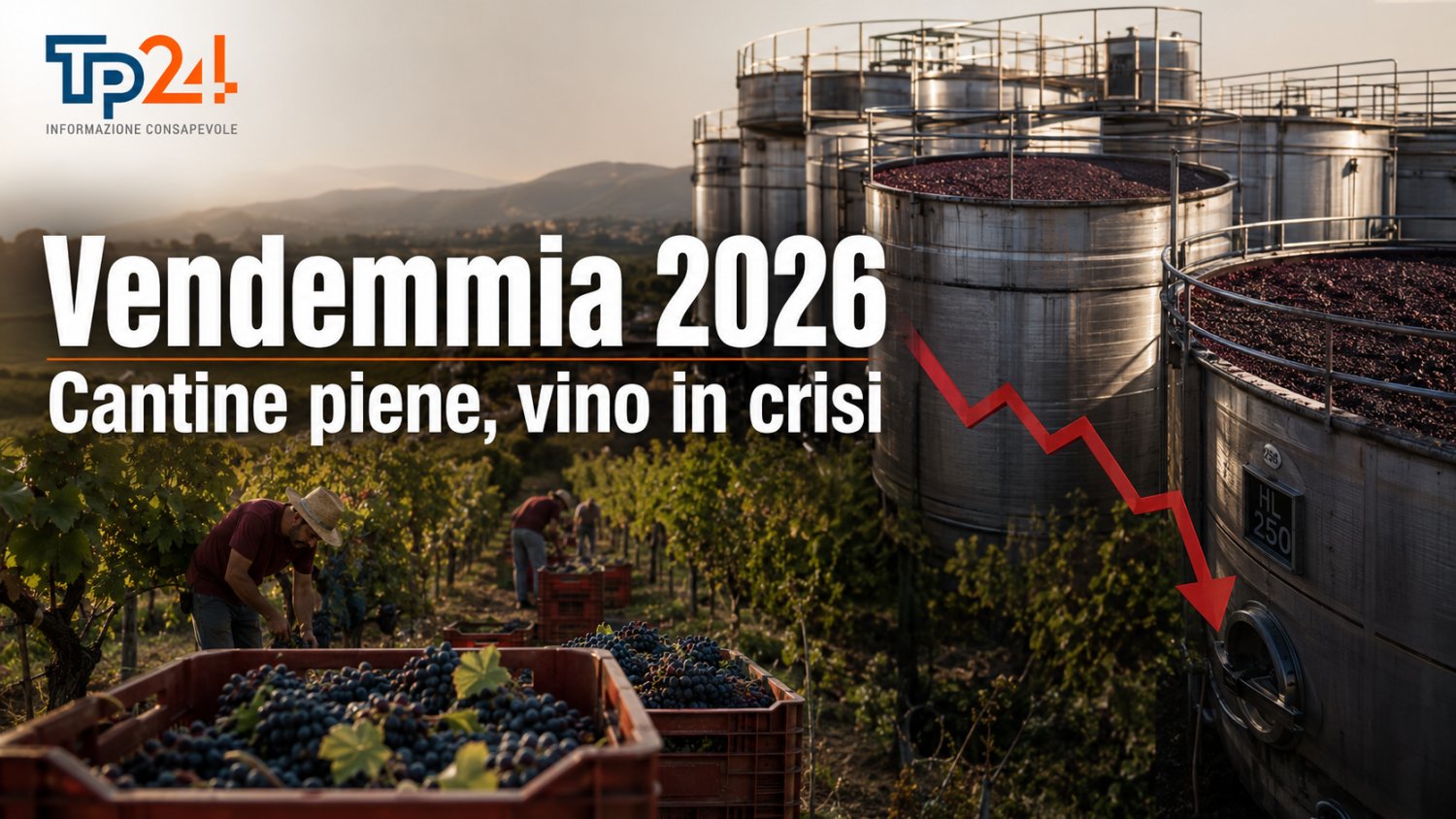
New grapes arrive as stocks rise
Sicily’s 2026 grape harvest began in the province of Trapani in July, starting with early white varieties. Initial reports cited by TP24 indicate healthy grapes and good quality prospects, although yields may be below those of a normal season. The commercial backdrop is considerably weaker: Sicilian wineries entered the harvest with 2,690,094 hectolitres of wine in storage.
Official figures reported by TP24 show that Italian winemaking facilities held 42.52 million hectolitres on July 31, 2026, up 6.9% from the same date in 2025. Trapani alone accounted for 1,406,607 hectolitres, more than half of Sicily’s stocks, making it Italy’s seventh-largest province by wine held at production facilities.
Stocks do not necessarily represent unsold wine. They include ageing products, certified lots, wine awaiting bottling and volumes already covered by commercial commitments. Nevertheless, inventories rising faster than market absorption increase storage requirements, restrict winery liquidity and intensify downward pressure on prices just as growers deliver the new crop.
Trapani faces the sharpest pressure
Trapani is Sicily’s principal wine-producing area. According to the latest framework from the regional wine institute Irvo, the province produced an average of about 2.12 million hectolitres of wine and must annually between 2021 and 2024, equal to 42.3% of regional output. Agrigento supplied 32% and Palermo 11.6%, leaving the three western provinces with about 86% of the island’s production.
Trapani’s current stocks are therefore equivalent to roughly two-thirds of its average annual production, although the comparison includes wine at different commercial stages. The volume creates an immediate risk for grape suppliers: wineries struggling to sell last season’s output have less cash and storage capacity, strengthening their incentive to reduce raw-material costs.
The pressure reflects a broader demand problem. TP24 cites the International Organisation of Vine and Wine as recording a further weakening of global consumption in 2025, alongside declines in international trade by both volume and value. Consumption patterns are changing in mature markets, with younger buyers drinking differently, occasional consumption increasing and some still wines—particularly reds—losing ground. That is especially relevant for Sicily’s major red-grape sector and its large cooperative industry.
Crisis distillation offers temporary relief
On July 7, Legacoop Sicilia, Confcooperative, Unci and Unicoop Sicilia met regional agriculture councillor Luca Sammartino. The regional government committed to finding €20-25 million in its next budget package for extraordinary crisis distillation. The measure would remove wine from the market and convert it into alcohol for industrial or energy use, freeing tanks and limiting further price declines.
The money has not yet reached wineries: the allocation must be included in the regional budget and approved by the Sicilian Regional Assembly. Sicily had already allocated €10 million for green harvesting in the 2025/2026 campaign, paying for grapes to be removed before ripening to help balance supply and demand.
Emergency measures may create space and liquidity, but they do not resolve the underlying mismatch. Energy, transport, fuel, fertiliser, labour and financing costs have increased while producers remain weak in price formation. Sicily has 96,903 hectares of vineyards, representing 14% of Italy’s vineyard area, and leads the country in organic vineyards with 33,823 hectares. For wineries and growers, the 2026 campaign will test whether that production base can generate more value in a contracting market rather than repeatedly relying on subsidised volume removal.