Seedless reaches 43% of Italian table grape listings as private label doubles to half the shelf
A September store check in Parma by the IFN-Agroter monitoring programme found Italian retailers cutting table grape listings from 13 to 10 per outlet and display area from about 6 to just over 4 square metres. Seedless varieties rose to 43% of listings, while private label and supplier brands together jumped from 23% to 50% in two years. Seedless keeps a price premium of more than 4 euros per kg against 3.5 euros for white seeded grapes.
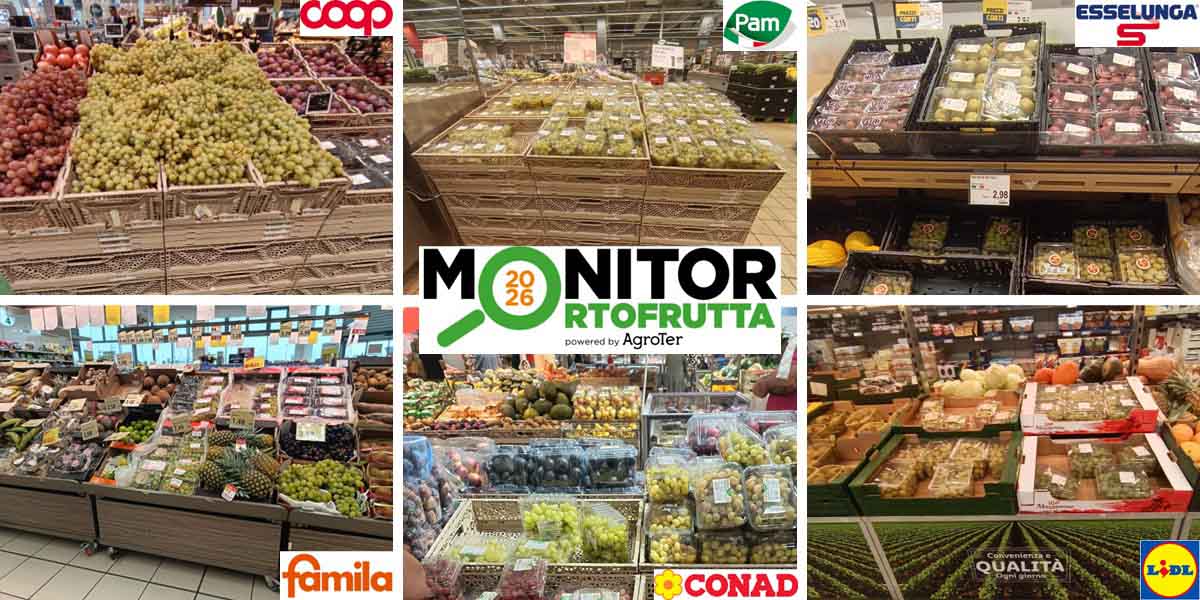
Italian supermarkets are giving table grapes less shelf space than a year ago, but what remains on display is increasingly seedless and increasingly branded, according to a store check published by italiafruit.net. The survey was carried out on 9 September in Parma as part of the IFN-Agroter retail monitoring programme and covered six outlets of different sizes and formats — Ipercoop, Pam, Esselunga, Famila, Conad and Lidl — with sales areas between 1,300 and 4,500 square metres.
Assortment narrows back to 2024 levels
After the wider ranges recorded in 2025, the average number of table grape listings per store has fallen to around 10, against 13 last year, essentially returning to the 2024 level. The contraction is far from uniform across the chains:
- Coop: down from 18 to 12 listings
- Esselunga: down from 16 to 13
- Conad: down from 14 to 11
- Famila: down from 11 to 6
- Pam: up from 9 to 10, the only increase in the panel
Display space was cut more sharply than the assortment itself. The average area devoted to table grapes fell from about 6 square metres in 2025 to slightly more than 4 in 2026, the lowest reading in the three-year series. Pam was the only retailer to clearly expand its grape display, while Coop, Esselunga, Famila, Conad and Lidl all reduced it, in some stores substantially. italiafruit.net raises the question of whether fear of shrinkage and waste lies behind the cuts.
Because space contracted faster than the number of listings, the shelf has become more crowded. Average space per listing slipped from about 0.48 to 0.44 square metres, after exceeding 0.60 square metres in 2024. In just two seasons each individual reference has lost a significant share of its visibility, and grapes now compete not only with other categories in the produce department but also within the category itself.
Seedless takes 43% of listings as promotions ease
Within the shorter assortment, seedless grapes continue to advance, moving from 39% of listings in 2025 to 43% in 2026, above the 40% recorded in 2024. italiafruit.net notes that seedless is not necessarily growing through a higher absolute number of listings, but by capturing a larger share of the space available.
Promotional pressure eased at the same time. Listings on promotion accounted for 32% of the total, against 42% in 2025 and 37% in 2024.
By colour, white grapes still account for the large majority of listings in every chain, although the overall depth of the offer has narrowed against 2025. Two long-established products are losing ground: Vittoria and Red Globe. The first is affected by the shift towards more modern white seedless varieties, while the traditional seeded red faces a market increasingly segmented between new varieties, colours and seedless offers. Black grapes remain a niche, and red grapes keep a significant but shallower presence than last year.
Private label and supplier brands reach half the shelf
The sharpest change concerns branding. In 2024, 77% of listings carried no highlighted identifier; two years later that share is down to 50%, meaning half the assortment is now attributable to a brand. Private label rose from 13% in 2024 to 24% in 2025 and 28% in 2026, while supplier brands more than doubled from 10% to 22%, although italiafruit.net stresses that none of these supplier brands is yet strong or distinctive in consumers eyes. Taken together, private label and supplier brands moved from 23% to 50% of listings in two seasons, a significant shift for a category historically tied to bulk product and variety names.
Seedless holds its price premium
Prices separate the two segments clearly. In 2026 white seeded grapes average around 3.5 euros per kg, with a low near 1.5 euros and peaks above 6 euros per kg, particularly on organic private-label lines. White seedless averages more than 4 euros per kg, with a minimum already around 2.4 euros and maximums of about 6.5 euros per kg. The premium therefore holds at the entry price point as well as on the average. Compared with the 2025 peaks, when some organic listings approached 8 to 9 euros per kg, the spread has narrowed, but seedless retains the ability to sustain the higher positioning.