Scientists race to protect Cavendish bananas from disease and genetic vulnerability
The Cavendish supplies 99% of global banana exports but is highly exposed to Tropical Race 4, a soil-borne fungal disease. Researchers are testing resistant plants, gene editing and wild banana genetics as they seek commercially viable replacements.
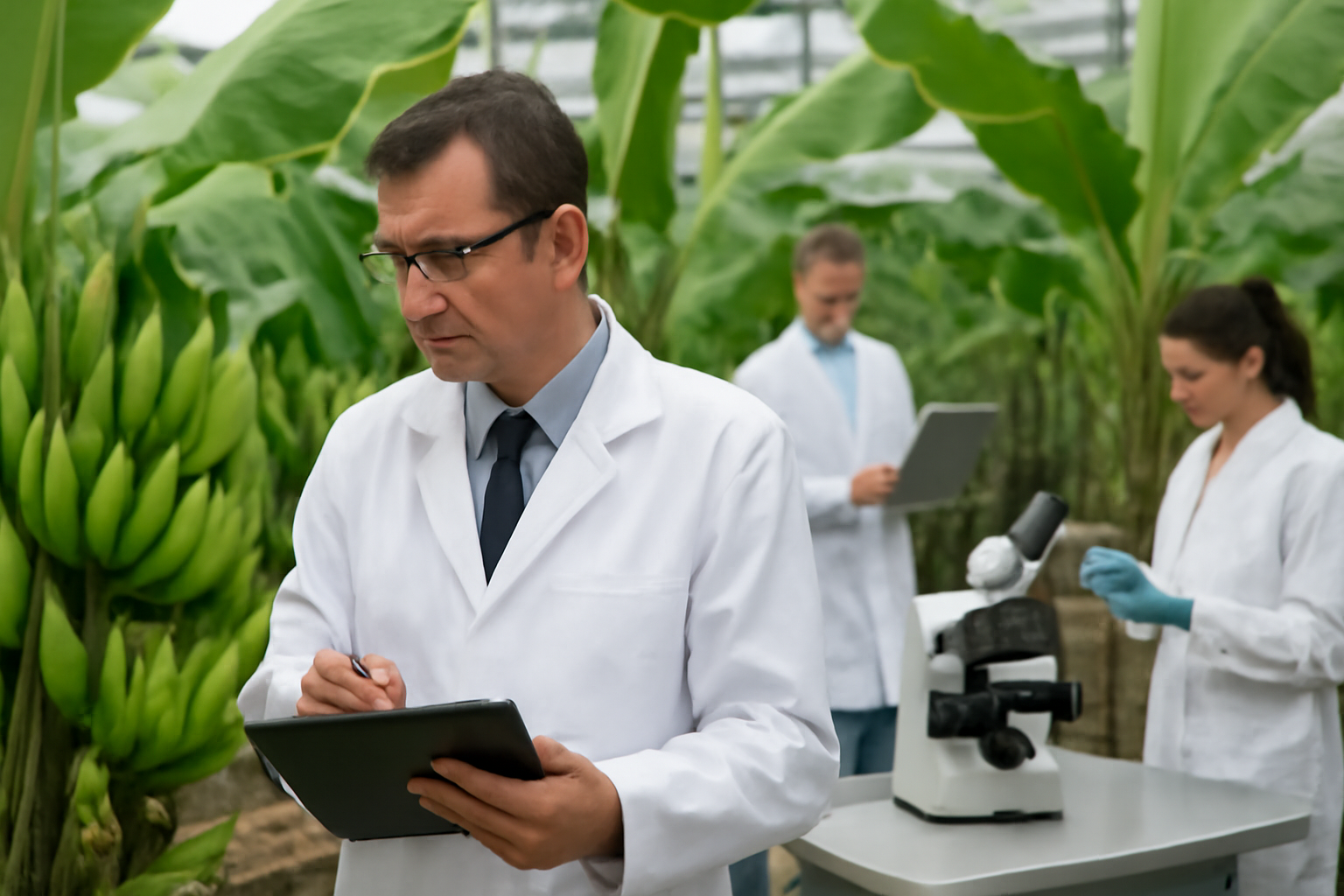
A global market built around one variety
The international banana trade depends overwhelmingly on the Cavendish. WIRED reported, citing the UN Food and Agriculture Organization, that the variety represents 47% of global banana production, or about 50 million tonnes a year, and 99% of global banana exports. That concentration gives growers, packers and retailers a uniform product suited to large-scale distribution, but it also leaves the supply chain exposed to a disease capable of attacking genetically similar plants.
The industry has faced this problem before. Gros Michel dominated European and American markets until Tropical Race 1, a strain of the Fusarium fungus, spread through Latin American plantations. WIRED estimated the damage at $2.3 billion in current terms. Standard Fruit Company, now Dole, began switching to Cavendish in 1947, followed by United Fruit Company, now Chiquita, in 1960. Gros Michel disappeared from US supermarket shelves in 1965, while the TR1-resistant Cavendish became the foundation of the export business.
TR4 exposes the weakness of cloned crops
Tropical Race 4, or TR4, now threatens the replacement that rescued the industry. The fungus lives in soil, blocks plants from taking up water and nutrients and cannot be controlled with conventional pesticides. The Washington Post reported that it can remain dormant for decades. Once a plantation is infected, removing the plants does not provide producers with an immediate route back to Cavendish cultivation.
Commercial Cavendish bananas are sterile and propagated as clones, so they cannot acquire useful traits through ordinary reproduction. Genetic uniformity supports consistent quality and handling, but it also means that plants share the same susceptibility. WIRED reported that TR4 had reached virtually all banana-growing areas of Australia’s Northern Territory, where many plantations remained closed. Earlier outbreaks also damaged production in Southeast Asia, Africa and the Middle East.
Researchers pursue several lines of defence
At Queensland University of Technology, James Dale’s team isolated the RGA2 resistance gene from the wild banana Musa acuminata malaccensis and inserted it into Cavendish plants. Field work near Humpty Doo in Australia’s Northern Territory produced TR4-resistant plants while surrounding bananas succumbed. The Washington Post reported that four of six plant lines in an initial three-year trial showed resistance, although researchers said testing in different environments was still needed to assess yield and other commercial characteristics.
Scientists are also preserving wild genetic material for future breeding. ABC News reported that researchers collected banana relatives in Papua New Guinea, including endangered plants reaching 15 metres and Musa balbisiana, which has strong water-use efficiency. Samples are stored at the world’s largest banana gene bank in Leuven, Belgium. The work addresses two connected risks: cultivated bananas lack genetic diversity, while deforestation and fires could destroy wild plants carrying resistance to disease, drought and other stresses. For producers and traders, success will depend not only on laboratory resistance but also on yield, taste, transport performance, regulatory approval and consumer acceptance.