Sapio inaugurates Italy's first renewable hydrogen plant at Porto Marghera
Sapio has opened what it calls Italy's first certified renewable hydrogen plant at Porto Marghera, with a maximum capacity of 750 tonnes per year. Backed by roughly €17 million in PNRR funding, the site has already signed supply deals for 50 tonnes by the end of 2026, mainly for public transport.
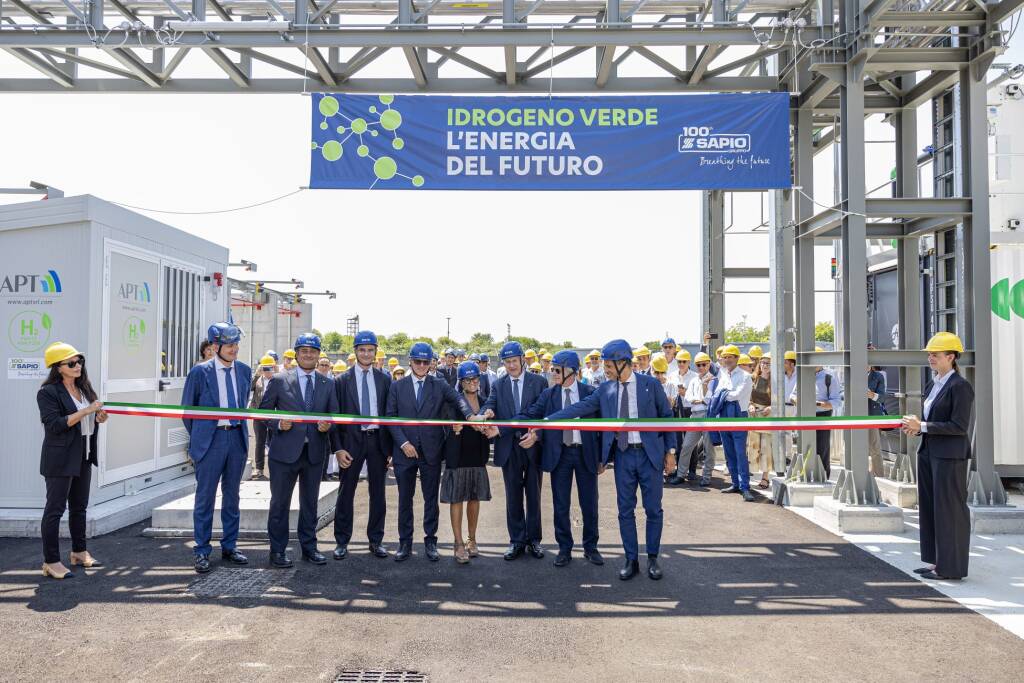
Italy's first certified renewable hydrogen plant comes online
Industrial gases group Sapio has inaugurated what it describes as Italy's first plant producing certified renewable hydrogen compressed to 500 bar, at its Porto Marghera site near Venice. According to mbnews.it, the facility opened one year after the laying of the first stone and is one of the largest of its kind in the country. It has obtained renewable hydrogen certification and carries a maximum production capacity of 750 tonnes per year.
The company said it has already signed commercial agreements to supply 50 tonnes of hydrogen by the end of 2026, destined mainly for decarbonising the automotive sector and, in particular, local public transport. The project was completed within the timelines set by Italy's PNRR recovery plan.
PNRR funding and the Hydrogen Valley scheme
The plant was built under the PNRR tender for Hydrogen Valleys in disused industrial areas and received total financing of roughly €17 million. That sum covered Sapio's electrolysis and 500-bar compression unit as well as a photovoltaic plant built by ECO+ECO, part of the Veritas group, the Veneto-based multiutility that supplies renewable power to the site.
Alberto Dossi, president of the Sapio Group, framed the opening as the start of a new phase. He said the priority in recent years had been carrying out investment and building plants, whereas the challenge now is to develop the market and create demand for renewable hydrogen. Dossi argued that the question is no longer whether renewable hydrogen can be produced at industrial scale, but how to create the conditions for it to be adopted and used in growing volumes. He added that continuity in industrial policy would be essential to support the sector.
Chief executive Mario Paterlini said Porto Marghera has the conditions to make Venice a European reference point for the energy transition, arguing that industry, tourism and quality of life can form part of a single development model rather than competing objectives.
Public transport as anchor demand
Environment and Energy Security Minister Gilberto Pichetto Fratin, speaking in a video message, said the plant showed the capability and foresight of Italian industry and that hydrogen, integrated with renewables, could prove decisive. Venice Mayor Simone Venturini said the city had made a deliberate choice by buying a fleet of official cars and 90 hydrogen-powered buses, positioning it at the forefront of mobility. Also attending were Fabrizio Penna, head of the PNRR mission unit at the environment ministry (MASE), Roberto Mantovanelli of the Northern Adriatic port authority, Laura Besio of the Veneto Region and Stefania Crotta of MASE, who addressed the public funding and incentives needed to stimulate hydrogen demand.
About Sapio
Founded in 1922 in Monza, Sapio is an Italian multinational controlled 51% by the Dossi and Colombo families and 49% by Air Products and Chemicals of the United States. The group operates in industrial and medical gases and home care across Italy, France, the United Kingdom, Germany, Slovenia, Turkey, Spain, Portugal and the United States, with more than 3,500 employees. It is an active member of the national hydrogen association H2IT, Hydrogen Europe and the Clean Hydrogen Alliance.