Russian grain prices fall 24% as Black Sea terminal shutdowns restrict exports
Russian grain prices have fallen 24% year on year after four major Azov-Black Sea terminals stopped operating, leaving more supply on the domestic market. The government is redirecting cargoes, subsidizing rail transport and considering duty relief and grain purchases.
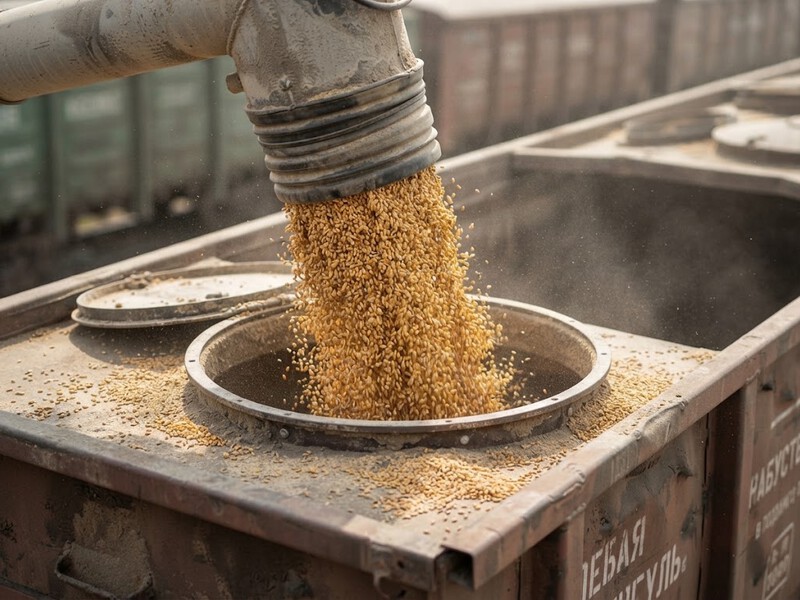
Terminal shutdowns remove key export capacity
Russian grain prices have fallen 24% year on year as shutdowns at major terminals in the Azov-Black Sea basin restrict exports and leave more supply in the domestic market, TKS reported, citing Forbes. The decline contrasts with a roughly 6.5% monthly rise in world wheat prices to two-year highs as less grain becomes available from the region.
The disruption began on 30 July, when the 5.5-million-tonne-a-year grain terminal complex in Taman stopped operating. Three deepwater terminals in Novorossiysk subsequently halted work in August: NZT, with annual capacity of 8.5 million tonnes; NKHP, with 7.1 million tonnes; and KSK, capable of handling as much as 10.5 million tonnes.
Together, the four facilities previously handled as much as 88% of Russia's seaborne grain exports and had combined design capacity of about 30 million tonnes a year. Experts estimate August shipments could fall to 1.8-2.5 million tonnes, among the lowest levels of the past decade. Vladimir Poklad estimates that only 11 of 27 exporters remain operational. The large terminal still working at Tuapse can receive only about 160,000-250,000 tonnes per month.
Alternative routes cannot match southern ports
The Agriculture Ministry has established an operational task force to redirect agricultural exports through Caspian and Far Eastern ports, Baltic terminals at Vysotsk and Ust-Luga, the Big Port of St Petersburg and land border crossings. These routes have less capacity and require transport chains to be reorganized. Vysotsk, for example, can receive about 3 million tonnes annually, compared with NZT's 8.5 million tonnes.
Eastward diversification was already under way. In the first half of 2026, rail grain deliveries increased 63% to China, 75% to Iran and threefold to Kazakhstan. Costs remain a constraint: rail transport to Iran is estimated at $40-50 per tonne, compared with approximately $15-20 for sea shipments from Novorossiysk.
The government is allocating more than 9.5 billion rubles to subsidize rail shipments toward Black Sea, Baltic and Far Eastern ports. Preferential rail tariffs for agricultural cargoes have existed since 2019, but their quotas had been exhausted by August 2026.
Domestic prices come under pressure
With fewer export outlets, grain is accumulating faster than buyers can ship, process or store it. Between 10 and 16 August, fourth-class wheat fell 3.1% to 11,000 rubles per tonne, while barley dropped 5.6% to 9,700 rubles. By late August, grain in the Rostov region was quoted at about 5,000-6,000 rubles per tonne, a weekly decline of 25-37%.
The government will consider suspending export duties on wheat, barley and corn through the end of 2026. From 2 September, the wheat duty stands at 787.5 rubles per tonne and the corn duty at 406.5 rubles, while the barley duty is already zero. Experts estimate that removing the duties could add $11-13 per tonne to exporters' margins and support another 1-2 million tonnes of exports during the year's remaining four months. Physical capacity, however, would continue to limit shipments.
Interventions could establish a price floor
The Agriculture Ministry has proposed state purchases of 1-3 million tonnes through the United Grain Company. Minimum intervention prices were set at 13,970 rubles per tonne including VAT for fourth-class wheat and 14,630 rubles for third-class wheat, above current prices in some southern regions.
Experts disagree over the likely effect. Supporters say purchases could reduce pressure in port regions and establish a reference price for farmers. Critics argue that 1-3 million tonnes would have to be purchased every month, rather than over the whole season, to have a material market impact. Authorities are also considering extended preferential lending and regional subsidies covering no more than 50% of producers' actual costs for each tonne sold.