Russian grain exports slow as 140-141 million tonne harvest builds domestic surplus
Russia's 2026 grain harvest may reach 140-141 million tonnes including the new regions, but shipments in the first quarter of the season came to only 8-8.5 million tonnes against 14 million a year earlier, according to ProZerno estimates published by Rossiyskaya Gazeta. Limited use of Azov-Black Sea export capacity could leave 14-20 million tonnes unexported and push carry-out stocks to 28-35 million tonnes by July 2027.
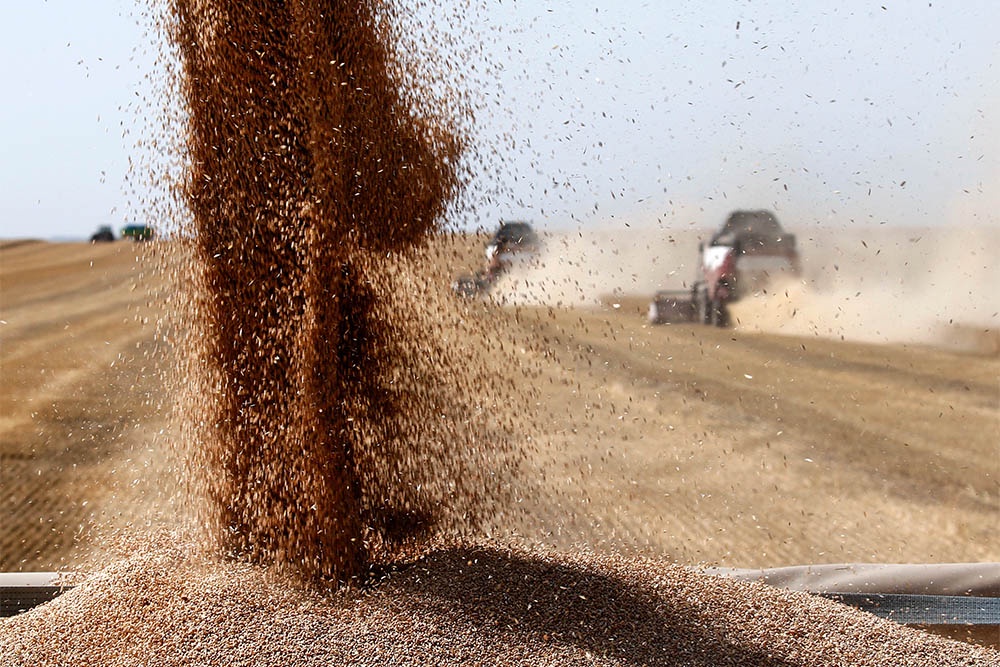
Russia's 2026 grain harvest may reach 140-141 million tonnes including the new regions, according to Vladimir Petrichenko, general director of the analytical company ProZerno, who presented the estimate at an industry conference. As Rossiyskaya Gazeta reports, yields are no longer the main source of risk for the grain market: the central question has shifted to where the grain already produced will go.
In a normal year Russia exports around 60-70 million tonnes of grain against domestic consumption of roughly 82 million tonnes. The opening of the new season has fallen well short of that pace.
Shipments at little more than half of last year's rate
By the end of September - the season starts in July - Petrichenko expects exports of about 8-8.5 million tonnes, compared with 14 million tonnes in the same period a year earlier. The gap of roughly 5.5-6 million tonnes has emerged in the three months that normally set the tone for the whole marketing year.
The main constraint is the Azov-Black Sea basin, where export capacity is only partly in use. Individual cargoes continue to move, but volumes are currently lower than usual, according to the analyst.
Alternative routes offer limited capacity
Part of the lost volume is being redirected. Iran has become the main buyer: via the Caspian and the Volga ports, up to 9 million tonnes could in theory be shipped. Petrichenko cautions that this capacity cannot automatically be counted as a full substitute for Black Sea exports, because a significant share of Iranian demand sits in destinations that are less convenient to serve via the Caspian. Last season Iran accounted for about 6.15 million tonnes of Russian supplies.
- Caspian and Volga ports, serving Iran: theoretically up to 9 million tonnes
- Baltic: about 9.5 million tonnes, with further volumes via Baltic-state ports, by rail and through the Far East
- Total with the Azov-Black Sea basin effectively switched off: around 39 million tonnes, rising towards 45 million tonnes if port operations improve
- Export resource with normally functioning logistics: 59 million tonnes
Wheat is the most exposed crop. Under an optimistic scenario Russia could ship about 33 million tonnes, but Petrichenko considers 27 million tonnes the more likely outcome. Across all grains, the shortfall in exports could amount to 14-20 million tonnes, volumes that would move into carry-out stocks and add to supply on the domestic market.
Purchase prices back at 2018 levels
Price pressure is already visible. Petrichenko notes that purchase prices in a number of regions have fallen to levels last seen in 2018, with feed wheat available at farm level for 5,000-6,000 rubles per tonne excluding VAT. For producers that means lower revenue precisely as they finish the harvest campaign and begin building the economics of the next season.
Domestic demand offers only partial relief. Compound feed output depends on poultry and pig numbers at agricultural enterprises, while grain consumption by the milling industry is so far expected to show no more than a weak recovery. Carry-out stocks at 1 July 2027 could reach about 28 million tonnes under the optimistic scenario and up to 35 million tonnes under the pessimistic one. The surplus is expected to accumulate gradually, with the market beginning to feel its effects in January. Intervention purchases are one way to ease the pressure, but by Petrichenko's calculation even a notional 3 million tonnes bought by the state would not fully resolve the overhang, and a significant gap has already opened between current prices and the potential starting price of such purchases.
Pulses contract and winter sowing lags
Pulses are a separate problem. The 2026 harvest may come in at slightly more than 5 million tonnes against 7.9 million tonnes a year earlier, of which around 4 million tonnes will be peas, compared with 5.7 million tonnes last year. Rosstat recorded a reduction in the area under pulses from 4.1 million to 2.9 million hectares, and under peas from 2.25 million to 1.79 million hectares. Petrichenko links the contraction to unfavourable production economics.
A further signal for the coming season is the slowdown in winter sowing. On Petrichenko's preliminary estimate, the area could shrink by around 1 million hectares; he currently records a lag of about 800,000 hectares against last season, and sowing in the South, where the price situation is most difficult, has not yet begun.