Russian fish output falls 2.5% to 2.85 million tonnes as fillet production climbs 11%
Russia's fishing and fish processing industry produced 2.85 million tonnes in the first eight months of 2026, down 2.5% year on year, according to a study by the Association of Fishing Fleet Shipowners. Fillet output rose more than 11% and fishmeal 10.3%, while frozen mince and surimi production fell by a quarter.
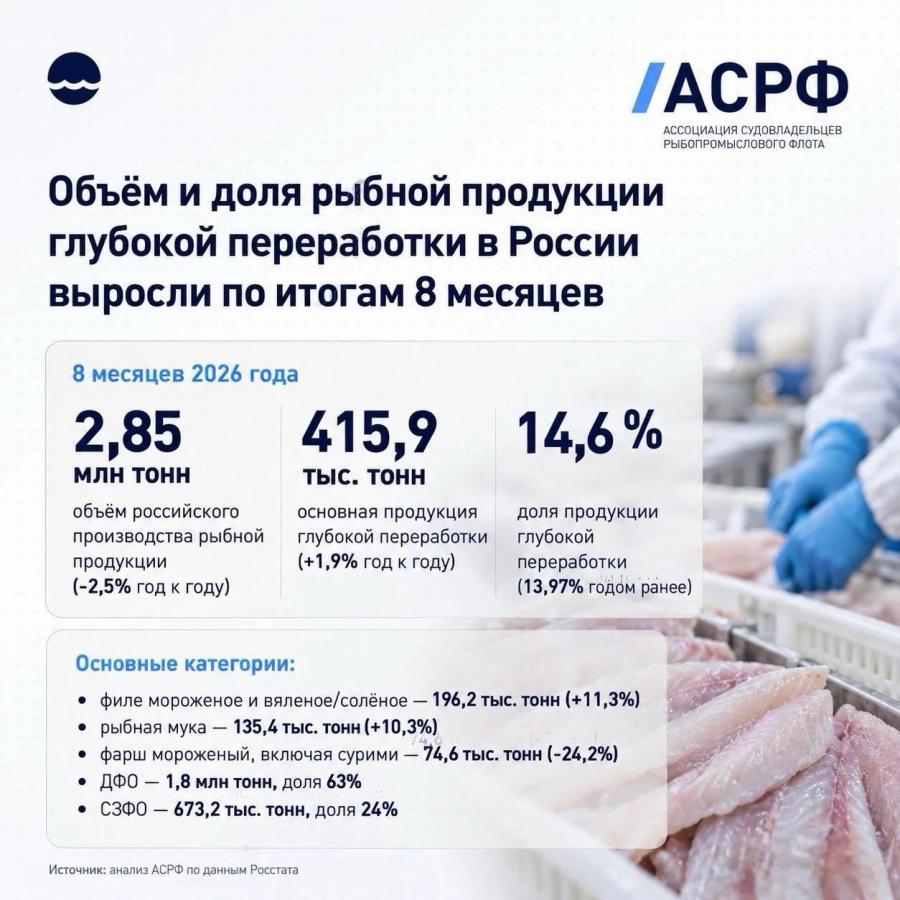
Russia's fishing and fish processing industry turned out 2.85 million tonnes of product in the first eight months of 2026, 2.5% less than a year earlier, while output of higher-value goods increased. The figures come from a study by the Association of Fishing Fleet Shipowners (ASRF), reported by konkurent.ru.
Combined production of fillet, mince and fishmeal rose by almost 2% to 415,900 tonnes. With the overall base shrinking, the share of these products in total output climbed to 14.6%. ASRF treats the move as evidence that producers are steering raw material toward higher-margin lines rather than chasing tonnage.
Fillet and fishmeal lead the growth
Fillet production grew by more than 11%, the strongest result among the product groups covered by the study. Frozen fillet, the largest category by volume, added 10.9%. Dried and salted fillet expanded fastest in relative terms, with output up by almost 1.5 times. Fishmeal production rose 10.3%.
- Total output: 2.85 million tonnes, down 2.5%
- Fillet, mince and fishmeal combined: 415,900 tonnes, up almost 2%, or 14.6% of total output
- Fillet: up more than 11%, with frozen fillet up 10.9% and dried and salted fillet up almost 1.5 times
- Fishmeal: up 10.3%
- Frozen mince and surimi: down by a quarter
Surimi and frozen mince give up volume
The counterpart to fillet growth is a sharp contraction in less processed goods: output of frozen mince and surimi fell by a quarter. Surimi and fillet are made from the same whitefish raw material and compete directly for it on board factory vessels and at shore plants. A drop of that size in one category alongside double-digit growth in the other points to reallocation of raw fish rather than a shortage of it, since the overall decline in output was only 2.5%.
Far East dominates, North-West adds share
By region, the Far East remains the main source of fish at 1.8 million tonnes, despite a slight decline in volumes. The North-Western Federal District strengthened its position, lifting production by 7.4%. Together the two regions account for 87% of Russia's catch and processing. That concentration leaves the national product mix dependent on investment and fleet decisions in a small number of ports, with the North-West the only large region adding volume over the period.
What the shift means for the market
For industrial buyers the practical consequence is a narrower offer of Russian frozen mince and surimi and a wider one of fillet, both frozen and dried-salted. Surimi processors draw on whitefish blocks from Russian producers, and a quarter less output from those lines has to be sourced elsewhere or absorbed through higher prices. Importers of frozen fillet, by contrast, face more available tonnage from the same suppliers.
The 10.3% rise in fishmeal points to fuller use of trimmings, which is the normal by-product of expanding filleting capacity. Falling total tonnage combined with a rising value-added share also changes how the industry's performance should be read: headline volume understates revenue if the product mix keeps moving toward fillet. ASRF frames the eight-month data as a change in producer focus. Whether it holds depends on relative prices for fillet and surimi through the rest of 2026, which the study does not address.