Russia Targets Full Municipal Waste Sorting and 25% Reuse by 2030
Russia plans to sort all municipal solid waste by 2030 and use at least 25% of waste as secondary raw material. The nationwide BumBattle campaign has collected 697,800 tonnes of recovered paper over six years, highlighting both the available fiber supply and the need for stronger collection capacity.
Target covers municipal waste, not paper alone
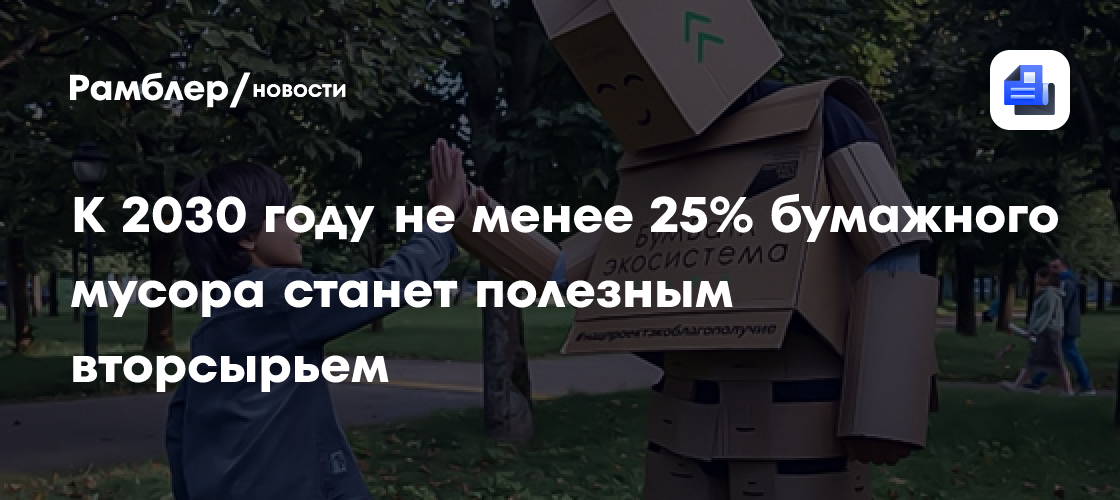
Russia plans to send all municipal solid waste through sorting facilities by 2030 and use at least 25% of waste as secondary raw material, according to Rossiyskaya Gazeta. More than 57% of the country’s municipal solid waste is currently sorted. The target applies to the broader waste stream rather than setting a specific 25% recovery rate for paper.
For the paper industry, the policy could increase the volume of recovered fiber available to mills, but its effect will depend on how effectively sorting facilities separate clean paper and cardboard from mixed household waste. Collection points, transport, grading and contamination control will determine how much sorted material can actually become a usable papermaking input.
BumBattle provides a nationwide collection channel
A new stage of the nationwide BumBattle recovered-paper campaign began in August in support of the national Environmental Wellbeing project. Participants can deliver waste paper throughout the year and record their results on the campaign’s website. The current competition will conclude on World Recycling Day on 15 November.
Over six years, 11.6 million people have participated in BumBattle and 697,800 tonnes of recovered paper have been sent for recycling, Rossiyskaya Gazeta reported. The scale indicates that public campaigns can mobilize substantial volumes, although sustained industrial supply requires regular collection beyond individual events.
The initiative involves households, educational institutions and companies across Russia. Accepted material includes old notebooks, cardboard, newspapers and paper cores. This broad collection base matters to recyclers and paper producers because commercial and institutional sources can provide larger and more consistent batches than individual households.
Regional results show concentrated supply
Altai Territory placed fourth in the nationwide ranking during the previous stage. More than 400 educational organizations and over 15,000 people took part, collecting about 77 tonnes of recovered paper. Altai State University contributed 29.6 tonnes, while the Altai Regional Children’s Environmental Center delivered 800 kilograms for recycling.
In Chelyabinsk, residents, schools, universities, kindergartens and companies are again being invited to participate. Residents of Moscow and Moscow Region are also joining through collection and educational activities. The geographic spread can help develop local recovery networks, but the commercial value of the material still depends on proximity to processors and paper mills.
Sorting capacity is only the first step
The 2030 targets imply additional demand for sorting, storage and processing infrastructure. For waste operators, higher collection volumes create an opportunity to supply a marketable secondary material. For paper mills, a larger domestic recovered-fiber pool could broaden input options where quality and logistics meet production requirements.
Public participation remains central to the current model. BumBattle combines collection with demonstrations of paper, plastic and glass recycling, including an environmental festival in Lipetsk Region. Sergey Bundesov, chairman of the regional branch of the Ecosystem movement in Lipetsk Region, said the events are designed to let participants handle secondary materials themselves and see what those materials can become.
The headline 25% objective does not by itself guarantee an equivalent increase in recovered-paper use. The industry outcome will be determined by the share of paper captured separately, the quality of recovered fiber and the capacity of domestic processors to absorb it. The campaign’s 697,800-tonne cumulative result provides a measurable base, while the gap between the current sorting rate of more than 57% and universal sorting defines the infrastructure challenge through 2030.