Russia suspends grain export duties through December 2026
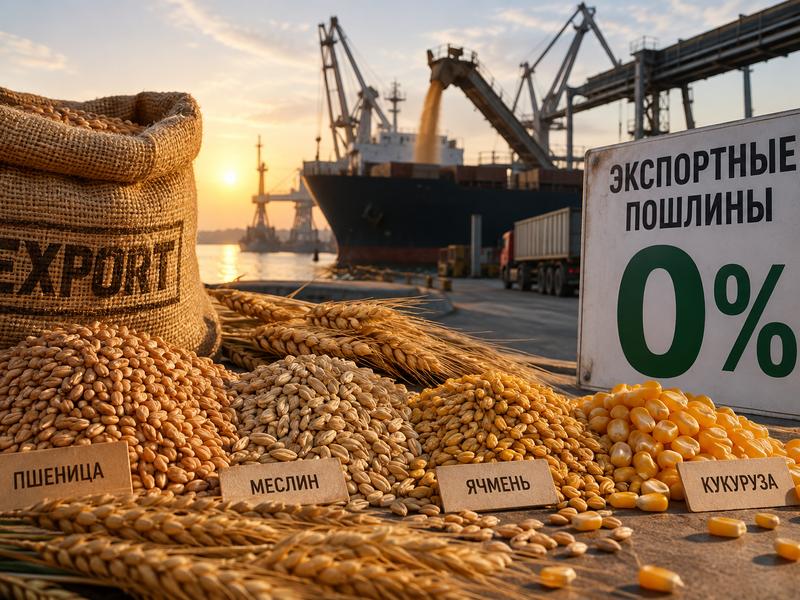
Russia has set export duties on wheat, meslin, barley and corn at zero through 31 December 2026 for shipments outside the Eurasian Economic Union. Duties remain on sunflower oil and meal, but their maximum rates have been capped at August levels.
Zero rate replaces the grain duty formula
Russia has suspended export duties on wheat, meslin, barley and corn for shipments to countries outside the Eurasian Economic Union through 31 December 2026. The measure applies retroactively to relevant transactions from 1 September under government Resolution No. 1194, signed on 19 September and officially published on 21 September, according to TKS.
The four grains will carry a duty of 0 rubles per tonne regardless of the result produced by Russia’s floating-duty formula. This is therefore a temporary suspension of the grain damper introduced in 2021, rather than an adjustment to a single weekly rate. Trade within the EAEU is outside the measure.
The change removes a direct cost that was still material for some crops in September. TKS reported that the rate published on 11 September was 1,146.3 rubles per tonne for wheat and 617.5 rubles per tonne for corn, while the barley duty had already fallen to zero.
Logistics remain the main constraint
The decision comes as reduced capacity in the Azov-Black Sea basin complicates the movement of Russia’s new harvest. Citing Reuters, TKS said exporters have started redirecting grain through Baltic and Arctic ports, including terminals previously focused on fertilizers and other cargoes. Baltic capacity, however, is substantially smaller than the southern export corridor.
Railways have given grain shipments priority, partly offsetting the loss of southern port capacity but increasing transport distances and logistics costs. SovEcon estimated, in data cited by Reuters, that Russian grain exports totaled 4.4 million tonnes in July and August, about 31% below the previous year, with a further decline expected in September. Pravda.ru separately reported that shipments during the first ten days of September were almost six times lower year on year.
Zero duties can leave exporters with more funds to cover additional freight and insurance expenses, but they cannot create terminal, rail or vessel capacity. Dmitry Rylko, chief executive of IKAR, was cited by Agroinvestor as linking the duty cancellation to the need to support the sector while also emphasizing the requirement for new export channels and additional assistance.
Sunflower tariffs capped, not removed
Russia has taken a more limited approach to processed sunflower products. From 1 September through 31 December, the sunflower oil duty will be either the rate generated by the existing formula or 7,748 rubles per tonne, whichever is lower. The ceiling equals the August rate, which had risen almost 2.4 times from 3,294.2 rubles per tonne in July.
The same principle applies to sunflower meal, with the lower of the calculated rate and 312 rubles per tonne. The oil formula, in operation since 2021, uses a base price of 90,750 rubles per tonne and a duty equal to 70% of the relevant difference with the indicative price. The caps give processors and exporters a maximum payment for planning while preserving the possibility of a lower duty.
The rules contain a safeguard for declarations using the temporary rates. If the goods are not fully exported, accepted for carriage by Russian Railways or covered by a maritime loading instruction by 31 December, the declaration will be treated as not submitted. The measure may support farmgate prices by improving export economics, but physical bottlenecks will determine how much additional grain can actually reach foreign buyers.