Russia Plans to Buy Up to 3 Million Tonnes of Grain for State Stocks in 2026-2027
Russia plans state purchases of up to 3 million tonnes of soft wheat and rye in 2026-2027. The intervention is intended to support domestic producers facing sales, logistics and port infrastructure problems, while actual annual volumes will depend on market conditions and available financing.
Purchases will cover wheat and rye
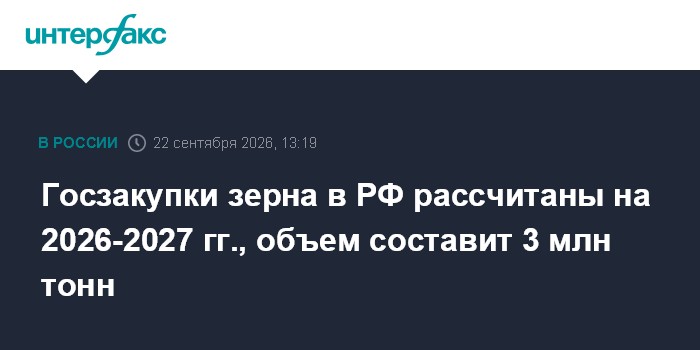
Russia plans to conduct state grain purchasing interventions in 2026-2027 with a total target of 3 million tonnes, Interfax reported, citing a Ministry of Agriculture protocol for selecting the bank that will finance the operation. The eligible grain will be soft wheat of classes 3 and 4 and rye.
Rosselkhozbank will provide the credit for the purchases, according to the protocol. The state intervention agent will sign the relevant agreements with the bank. The document does not divide the 3 million tonnes between wheat and rye or specify a fixed annual schedule. Actual purchases in each year will depend on market conditions for the relevant crops and must remain within the available financing.
Intervention aims to support farm prices
The purchasing program is intended to support Russian producers that have encountered difficulties selling grain because of logistics constraints and damage to port infrastructure. Agriculture Minister Oksana Lut had previously said that state purchases could range from 1 million to 3 million tonnes. The protocol therefore sets the planned stock volume at the upper end of that range, although yearly buying may be lower.
Under Russia's intervention system, the government buys grain when excess supply is putting downward pressure on prices. This removes part of the available volume from the commercial market and provides an additional outlet for producers. When prices rise sharply, grain can be sold from the intervention fund to increase supply and restrain the increase. The mechanism has operated since 2001, and trading takes place on the National Mercantile Exchange.
Storage network spans key producing regions
The United Grain Company, acting on instructions from the Agriculture Ministry, has started selecting facilities to store the state grain. The process covers 14 regions, including the Krasnodar and Stavropol territories and the Voronezh, Kursk, Lipetsk, Tambov, Ryazan, Volgograd, Rostov, Orenburg, Penza, Samara, Saratov and Ulyanovsk regions. This footprint includes major grain-producing areas in southern, central and Volga Russia.
The intervention fund currently contains 3.7 million tonnes of grain. More than 3.6 million tonnes is food wheat, while the fund also holds rye and barley. Its main inventories are stored in Siberia and the Volga region, with additional stocks in the Urals, Central and Southern federal districts. In total, the grain is held at 147 specialized facilities across 22 regions.
The timing will determine the program's market effect. Faster purchases during periods of heavy farmer selling could help establish a price floor and reduce pressure on local elevators, but they would also remove grain from commercial circulation. That may affect the volume readily available to processors and exporters, especially in regions where logistics and port capacity are already constrained. The last purchasing auctions were held in the first half of 2024. Commodity interventions, involving sales from the state fund, ran from August 2024 through June 2025.