Russia’s Large, High-Quality Grape Harvest Runs Into Sales and Logistics Bottlenecks
Russian growers expect a large, high-quality 2026 grape harvest after favorable weather in Krasnodar, Rostov and Crimea. Weak winery demand, expensive logistics and purchasing restrictions could leave part of the crop unsold despite expectations of lower grape prices.
Favorable weather lifts crop expectations
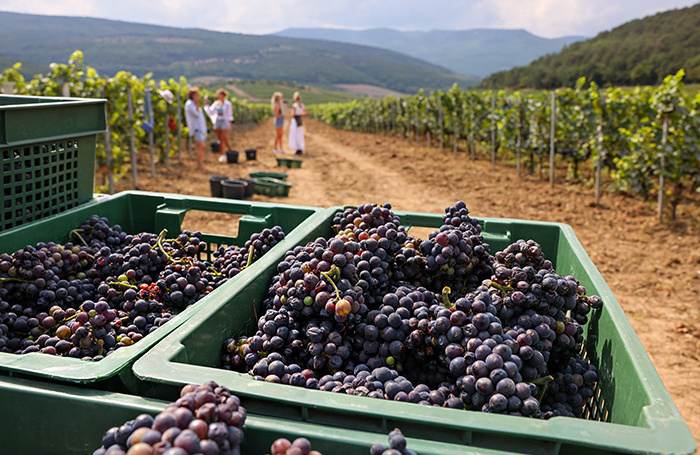
Russian vineyards are harvesting an unusually large and high-quality grape crop, but growers are struggling to place all available volumes with wineries. Business FM reports that harvesting is under way in Krasnodar Territory, Rostov Region and Crimea after a mild summer provided favorable ripening conditions. Winemakers expect the slower maturation of the berries to produce wines with stronger aromatic and flavor characteristics than in previous years.
In Krasnodar Territory, growers had collected 5,000 tonnes by the end of August for the first time. That figure represents only the beginning of the harvest. The regional crop is forecast to exceed the previous season’s record of 305,000 tonnes, while vineyards in Rostov Region and Crimea are also reporting a productive year.
The weather was less hot than in recent seasons, allowing grapes to ripen over a longer period. Andryus Yutsis, owner of the Andryus Yutsis winery in Sevastopol and the Kultura cidery in the Moscow Region, told Business FM that this prolonged maturation would be important in shaping the style of Crimean wines. He said Krasnodar was experiencing a similar trend.
Supply growth meets weaker winery demand
The size of the crop has prompted expectations that grape prices could fall by about 30%, or possibly more. Table grape prices are also forecast to decline, although no estimate was provided. The pressure is not coming from supply alone: wineries have experienced fewer visitors and lower on-site purchases during the summer, reducing their need for additional raw material.
Some producers anticipated weaker sales and limited vineyard work at the start of the season. Dmitry Litavshchuk, winemaker and head of the Litavshchuk family winery in Anapa, said his business reduced the load on its vines to obtain a smaller crop and make less 2026 wine. The winery expects the lower yield per vine to produce more complex and concentrated wine with stronger organoleptic qualities.
For growers selling grapes rather than processing their own crop, this strategy is less accessible. Expanding vineyard output is colliding with finite winery demand and processing capacity. Yutsis warned that some farms may fail to sell their grapes even though the fruit is abundant and of good quality.
Logistics and purchasing rules restrict the market
Crimean suppliers face an additional obstacle in the cost and difficulty of transporting grapes. According to Yutsis, freight rates have risen almost fourfold as vehicles face attacks and longer, more difficult journeys from Crimea. These costs affect large enterprises and force price adjustments, complicating deliveries of a perishable crop that must reach processing facilities quickly.
Legal restrictions further narrow the pool of potential buyers. Yutsis said licensed farm wineries cannot simply purchase grapes on the open market: the vineyards supplying them must be owned or leased by the producer. He called for licensed farms with processing capacity to be allowed to buy grapes directly, arguing that the industry currently lacks a simple mechanism for moving surplus fruit to available facilities.
Vineyard expansion nevertheless continues. Sevastopol is due to add 180 hectares of new vineyards this year. Krasnodar Territory already has more than 34,500 hectares, with further growth planned but not yet quantified. Without broader purchasing options, sufficient processing capacity and workable transport routes, additional acreage could deepen the mismatch between grape production and winery demand. For producers, the 2026 season therefore combines strong quality prospects with lower prices and a material risk of unsold output.