CREA: oil price cap fails to durably curb Russian crude revenues
In its April 2026 monthly review, the Centre for Research on Energy and Clean Air says the G7 oil price cap has not imposed a durable limit on Russian crude earnings, with ESPO trading well above the cap. An EU maritime services ban that would target export volumes is on hold after the closure of the Strait of Hormuz spiked global oil prices.
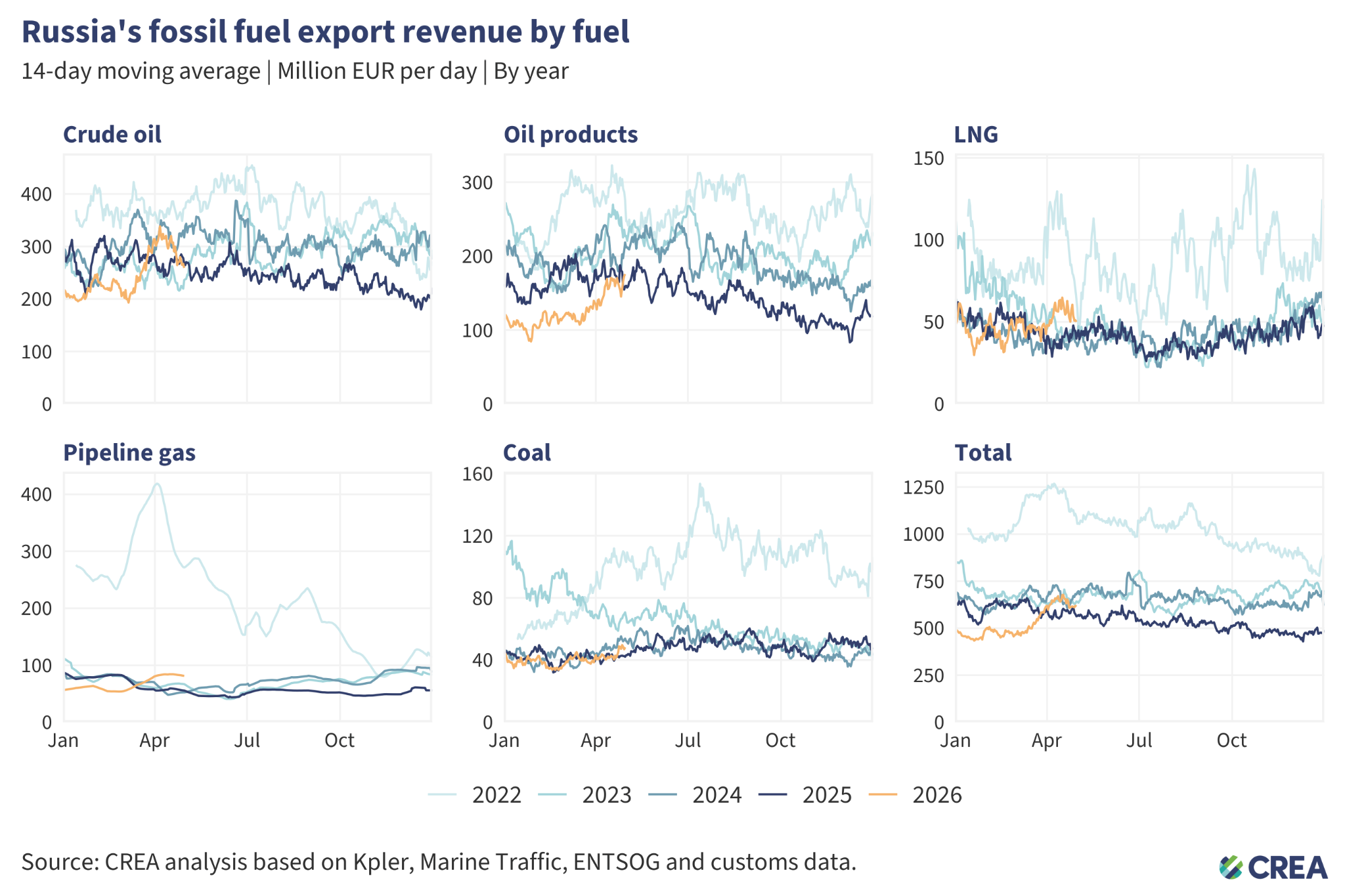
Price cap fails to durably curb Russian oil revenues
Russia's fossil fuel export revenues have declined since Western sanctions took effect, tightening the funding available for the Kremlin's war in Ukraine, according to the Centre for Research on Energy and Clean Air (CREA) in its April 2026 monthly analysis. The report, authored by Luke Wickenden and Isaac Levi with data scientist Panda Rushwood, argues that the constraint remains incomplete and that further measures are needed to limit Moscow's earnings.
CREA finds that the G7 oil price cap has not imposed a durable limit on Russian crude export earnings. The mechanism worked only briefly and selectively for Urals crude, while other grades and export routes were largely unaffected. Urals prices dipped below the USD 60 per barrel cap only for short periods. The crude oil price cap was lowered to USD 44.1 per barrel as of 1 February 2026.
ESPO and the Pacific channel
ESPO crude has consistently traded well above the cap, CREA reports, reflecting its structural orientation toward China and Pacific markets. That divergence underscores how the cap's reach depends on the buyer and the shipping route rather than on Russian barrels overall. For Asian importers, ESPO has remained a supply available outside the cap's effective grip.
G7+ sanctions have deliberately focused on Russian revenues rather than on restricting export volumes. The approach aims to keep Russian barrels flowing into global markets and to ease fears of supply shortages. The price cap in particular is designed to reduce the price at which Russia can sell its oil rather than the quantity it ships.
The EU's maritime services ban
In January 2026, as Russian oil prices fell sharply amid market oversupply, the EU proposed a ban on maritime services that facilitate Russia's crude oil exports. In April 2026 the bloc adopted its 20th sanctions package, which includes the basis for a future maritime services ban on Russian crude oil and petroleum products. That ban will take effect only if an agreement is reached with the G7 and the members of the Price Cap Coalition.
The measure would, for the first time, target Russian oil export volumes rather than prices, aiming to shrink the tanker capacity required to move Russian oil worldwide. For importers and shipowners, that marks a shift from a revenue-focused regime toward one that could constrain physical flows.
Hormuz shock forces a rethink
A sharp spike in oil prices following the closure of the Strait of Hormuz has prompted a reconsideration of the volume-focused approach, CREA notes, as policymakers seek to avoid deepening supply crunches in global markets. Against the backdrop of the 2026 energy crisis, CREA recommends that the Price Cap Coalition either fix the price cap at a base level that severely restricts Russian revenues, or introduce a value-based sanction — such as a tax on the use of Western maritime services for transporting Russian fossil fuels.