Romanian gas prices nearly double in two months, overtaking the Vienna hub
Gas quotations on the Romanian Commodities Exchange rose from 273.78 lei/MWh on 20 July 2026 to a peak of 511.18 lei/MWh in mid-September, and now sit near 460 lei/MWh, above the roughly 380 lei/MWh equivalent at the Baumgarten hub. Households are shielded by a price cap until March 2027, with Romgaz supplying more than 80% of residential demand at regulated prices. Industrial consumers remain fully exposed to European price formation.
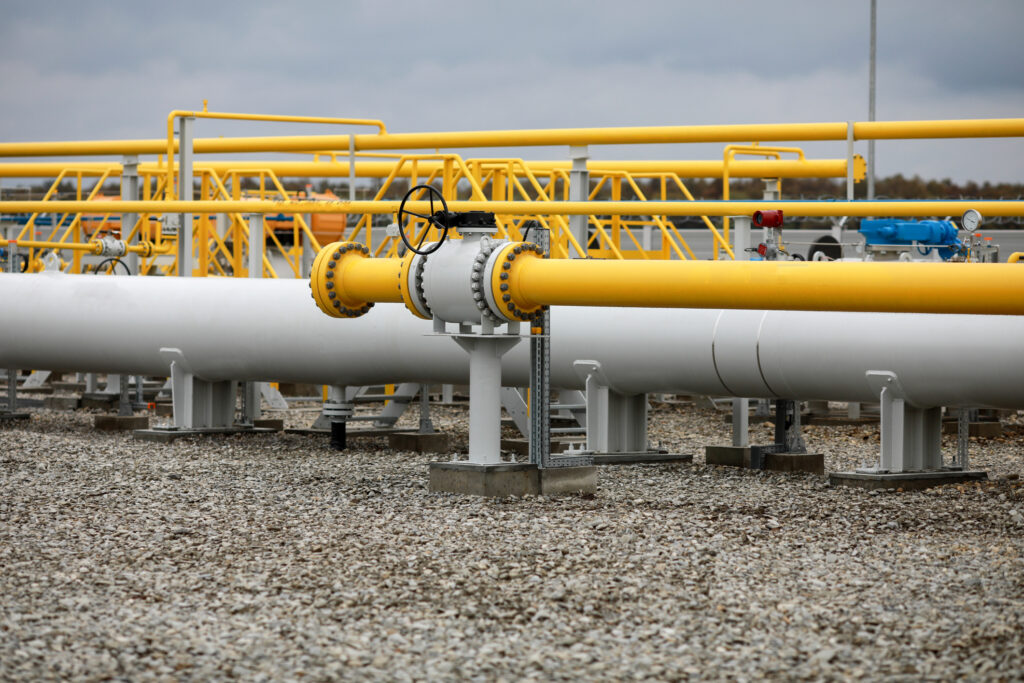
Natural gas prices in Romania have nearly doubled in two months, with quotations on the Romanian Commodities Exchange (BRM) rising from a low of 273.78 lei/MWh on 20 July 2026 to a peak of 511.18 lei/MWh in mid-September, according to an analysis published by Economedia. Pressure has eased slightly in recent days, with prices holding around 460 lei/MWh, still well above the main regional benchmark.
The move splits the market in two. Households are protected by a state-imposed price cap running until March 2027, and Romgaz covers more than 80% of residential demand at a regulated price, chief executive Răzvan Popescu said at the Eurogas Annual Regional Conference 2026 in Bucharest, as reported by Realitatea. Industrial buyers have no equivalent protection.
A near-doubling on the BRM
Economedia attributes the surge to pressure to build the highest possible storage level before the cold season, high acquisition costs and speculation over the availability of volumes from domestic production. Stocks had been drawn down substantially after last winter, which was unusually harsh, leaving suppliers and producers to refill from a low base.
Romania has reached a storage fill level of 81%, among the better positions in Europe. Austria stands at 68%, consistent with the relaxed minimum of 80% set by the European Commission for 2026, down from the 90% required for 2025. The obligation on major suppliers and on producers Petrom and Romgaz to buy large volumes between April and now, regardless of prevailing exchange quotations, artificially stimulated demand on the BRM and lifted prices, Economedia reports.
Why Vienna trades lower
At the Baumgarten hub near Vienna, gas is currently changing hands at approximately 75 euros/MWh, the equivalent of about 380 lei/MWh — roughly 80 lei/MWh, or around 21%, below the current Romanian level. Economedia points to structural, logistical and regulatory reasons for the spread:
- Liquidity and market integration: Baumgarten is the most important and most liquid gas exchange in Central and Eastern Europe and the regional reference, with large volumes from multiple sources traded by dozens of international players, large traders and producers. The Romanian market has far lower liquidity and a restricted number of active participants.
- Source diversity: Vienna is connected to multiple flexible corridors, including liquefied natural gas imported through western European terminals, North Sea gas and alternative flows, allowing buyers to select the cheapest offer on the continent.
- Import dependence: Romania relies largely on its own production and on a single import source — Turkey via Bulgaria.
Households capped, industry exposed
Popescu said final household consumers are covered by gas produced in Romania and that he sees no supply problem for them this winter. «Indeed, for non-household consumers, for industry, it is a problem that has existed for several years. We are simply tied to European prices. There is currently competition between South-East Asian prices and European prices», he said, according to Realitatea.
The result is a two-tier market heading into the heating season: residential supply secured from domestic output at regulated rates, and industrial consumers exposed to European price formation and to competition between external markets. Economedia notes that the rising market cost will eventually reach households as well once the cap expires.
Permitting and the production cost base
Popescu identified the duration of permitting procedures as one of the main obstacles to developing gas projects. Drilling a deep onshore well can take up to six months, while obtaining the necessary permits can take as long as three years. He pointed to the absence of a single window for filing documentation and of clear response deadlines from ministries and authorities, adding that surface infrastructure after drilling requires a further round of approvals before production can start.
Romgaz invests more than 200 million euros a year simply to keep output at an adequate level, as most of the fields in its portfolio are mature and have been exploited for decades. The company has restarted the Caragele project and re-drilled the deepest wells in its portfolio in order to slow natural decline. Popescu said Neptun Deep is being delivered in a shorter timeframe than expected, and described time, alongside market price volatility, as the biggest enemy of energy projects.