Soil drought spreads across Romania as corn and sunflower cross heat-damage threshold
Pedological drought of moderate to extreme intensity is affecting large parts of Romania, with unirrigated corn and sunflower the most exposed crops, agrometeorologist Daniel Alexandru said on Antena 3 CNN. The National Meteorological Administration warns of maximum temperatures up to 41 degrees Celsius between 6 and 11 August, well above the roughly 30-32 degree biological resistance limit of the two crops.
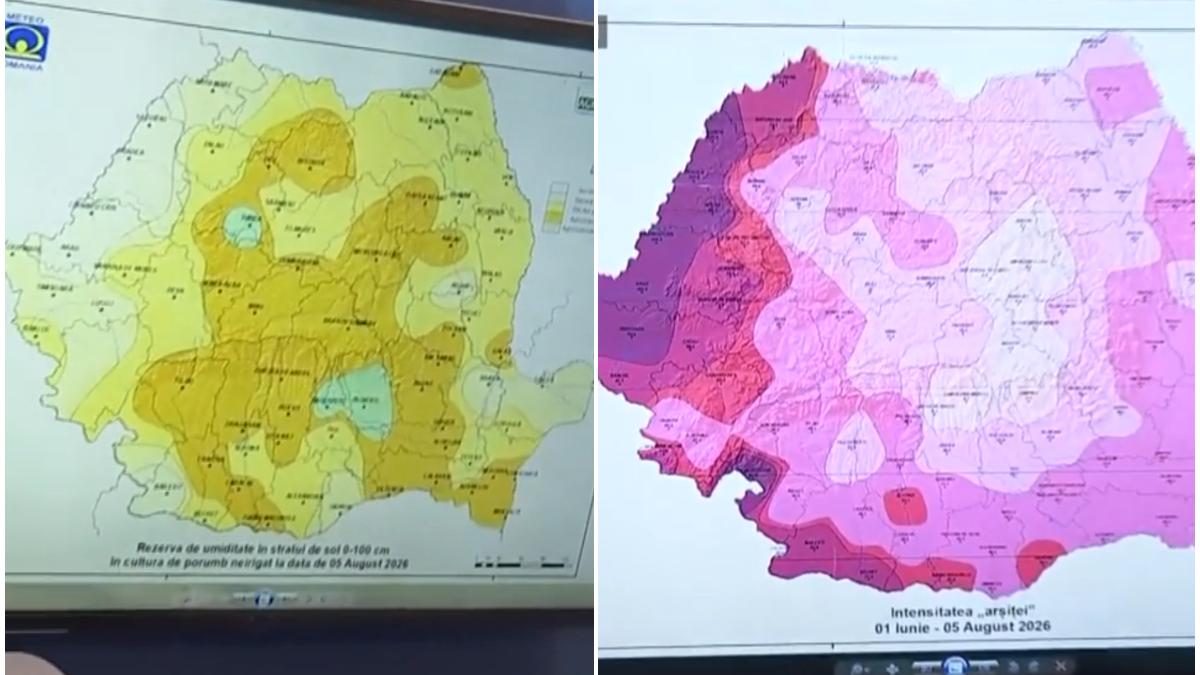
Soil drought is affecting extensive areas of Romania and unirrigated corn and sunflower crops face the heaviest damage in the period ahead, agrometeorologist Daniel Alexandru said on Thursday on Antena 3 CNN, where he presented the national agricultural drought map.
Where the moisture deficit is concentrated
The map of soil water reserves shows numerous zones shaded in yellow at varying intensities, indicating moderate, strong or extreme pedological drought, according to the presentation carried by Antena 3 CNN. “From an agricultural point of view, the map shows pedological drought in different degrees of intensity in Maramureș, Banat, Crișana, in most of Moldova, in the south of Muntenia and Oltenia, and also in Dobrogea. There is a significant water deficit for corn and sunflower crops,” Alexandru said.
Rainfall in the forecast period will not correct the situation. “Based on the forecast for precipitation amounts, these will not be significant for agriculture. Plants are suffering from both water stress and heat stress,” the agrometeorologist said.
Temperatures above the biological limit
Alexandru also presented a heat-intensity map, on which the darkest colours appear over Banat, Crișana, Maramureș, Oltenia and Muntenia. High temperatures add further pressure on crops given that the biological resistance limit of the plants is approximately 30 to 32 degrees Celsius. Exceeding that threshold leads to wilting, leaf curling and prolonged periods of stress, with stronger effects on corn and sunflower at their various stages of maturity.
The National Meteorological Administration warns that unirrigated row crops will be affected by extreme temperatures in the period from 6 to 11 August, when maximum temperatures will reach up to 41 degrees Celsius. Against the background of the heatwave and the soil moisture deficit, plants will show temporary wilting and leaf curling during midday hours, particularly in areas already hit by pedological drought.
What the heat does to the crops
The largest problems are expected in unirrigated corn and sunflower. Temperatures above the biological resistance limit will favour yellowing and premature drying of the leaves at the base of the plants, as well as an acceleration of the maturation process.
- Temporary wilting and curling of leaves in the midday hours, concentrated in drought-affected areas.
- Yellowing and premature drying of the lower leaves, reducing the working leaf area of the plant.
- Accelerated maturation, shortening the time the crop has to complete grain and seed filling.
The acceleration of maturation is the commercially relevant signal in the forecast. Crops pushed through the final filling stages in less time have fewer days to accumulate dry matter, which weighs on kernel and seed weight at harvest. Neither the agrometeorologist nor the National Meteorological Administration put a figure on expected losses at national level in the material presented.
Regions still holding reserves
The country is not in a uniform position. According to the agrometeorological forecast, satisfactory soil water reserves for the corn crop are still maintained across extensive areas of Oltenia, Muntenia and Transylvania, as well as locally in Dobrogea and Moldova. At the same time, moderate, strong and extreme pedological drought continues to affect areas of Banat, Crișana, Maramureș, most of Moldova, and also regions of Dobrogea, Muntenia, Transylvania and Oltenia.
Several regions therefore appear on both lists, which points to a fragmented picture rather than a uniform national shortfall. For buyers, processors and traders, the practical consequence is that condition assessments made at county or field level, and the availability of irrigation, will matter more than any single national average this season.