Polish cement industry warns end of free EU carbon allowances could halt production
At a parliamentary hearing in the Sejm on 16 September 2026, Polish cement producers said that if free EU ETS allowances disappear in 2039 without CO2 storage in place, domestic cement production will no longer be possible. About 63% of plant emissions are process emissions, and capture installations for the whole sector are estimated at up to 20 billion zlotys.
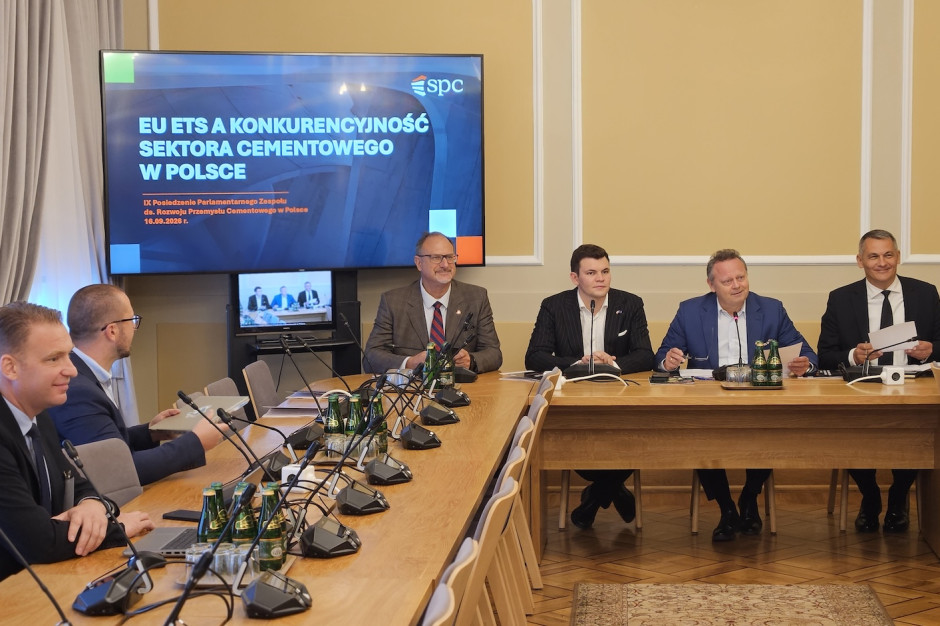
Poland's cement producers have told lawmakers that the withdrawal of free EU carbon allowances, combined with the absence of CO2 storage capacity in the country, could make domestic cement production impossible. The warning was presented at a meeting of the Parliamentary Team for the Development of the Cement Industry in Poland, held in the Sejm on 16 September 2026, according to the industry portal wnp.pl.
As wnp.pl reported, participants described cement as a strategic industry for Poland while pointing to the effect of climate policy on the sector's competitiveness. The immediate battleground is the revision of the EU Emissions Trading System, whose shape is being worked out in working groups at the Council of the European Union. Producers argue they face a radical scenario of allowance withdrawal: if free allowances cease to function in 2039 and there is no possibility of storing CO2, cement production will not be possible either.
Poland's negotiating position
Pawel Rozycki, deputy director of the Department of Air Protection and Climate Negotiations at the Ministry of Climate and Environment, set out the demands Poland is bringing to the talks. They include increasing the pool of free CO2 allowances, lowering the linear reduction factor (LRF) from 3.7% to 2-2.5%, and halting the reduction of free allowances until the effectiveness of the Carbon Border Adjustment Mechanism (CBAM) has been verified.
The sector's own list of conditions for a revision that permits decarbonisation without further eroding competitiveness includes:
- the longest possible access to free allowances;
- abandoning the conditionality criterion;
- recognition of the specific character of "hard to abate" sectors with high process emissions;
- dedicated funds for decarbonisation investment in energy-intensive industries;
- an exemption from ETS charges for cement produced for defence purposes;
- the inclusion of waste incineration plants in the EU ETS, and recognition of negative emissions and international credits.
Process emissions and the cost of capture
The Polish cement industry has already cut CO2 emissions by more than 30% against 1990 levels and is implementing further measures, but wnp.pl noted that a technological barrier now stands in the way. About 63% of the CO2 released by a cement plant is process emission: during clinker production, calcium carbonate breaks down into calcium oxide and CO2, and that reaction cannot be eliminated.
"We have to be aware that we are an industry burdened with process emissions. We are not able to eliminate it without the possibility of capturing and storing CO2," said Andrzej Reclik, president of Heidelberg Materials Polska and a board member of the Cement Producers Association (SPC). Capital expenditure on capture installations for the entire sector is estimated at as much as 20 billion zlotys. Deployment also requires national regulation, infrastructure to transport CO2 and onshore storage. Michal Glowacki, vice-president of Holcim Polska, pointed to the need to designate an operator for the carbon dioxide transmission network.
Imports, CBAM and the demand side
Cement imported from outside the EU is a further competitive threat, and CBAM is still at the implementation stage, with charges due only from 2027. Janusz Miluch, president of CRH Materials Polska and an SPC board member, said the mechanism's tightness and effectiveness must be confirmed, and that free allowances for industry should not be reduced until that happens.
Producers also raised a demand-side element of the Green Deal: mechanisms that encourage the use of low-emission products, including cements and concretes. Green public procurement currently accounts for only a few percent of the investment projects carried out, and the sector is seeking tax reliefs and incentives to widen the market for lower-carbon materials.