Polish agri-food exports reach €24.1 billion as trade surplus widens
Poland exported €24.1 billion of agri-food products in the first five months of 2026, up 1.6% year on year. Imports fell 1% to €16.3 billion, lifting the sector’s trade surplus by 7.5% to €7.8 billion.
Exports rise while imports contract
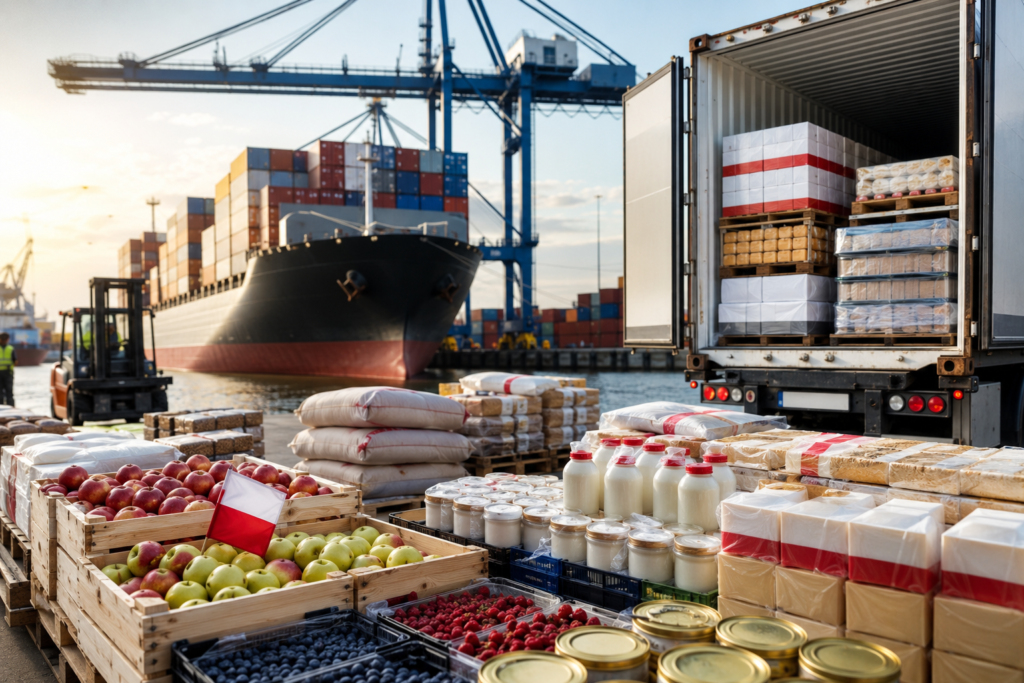
Poland’s agri-food exports reached €24.1 billion, or approximately 102 billion zloty, in the first five months of 2026, according to AgroNews, citing data from the National Support Centre for Agriculture. Export value increased by 1.6% compared with the same period of 2025, despite weaker conditions in parts of the food industry.
Imports moved in the opposite direction, falling by 1% year on year to €16.3 billion, equivalent to approximately 69 billion zloty. The resulting agri-food trade surplus rose by 7.5% to €7.8 billion, or around 33 billion zloty. The figures reinforce the sector’s role as a positive contributor to Poland’s external trade balance.
Meat, meat products and live animals remained the largest export category, generating €5.2 billion and accounting for 22% of total agri-food exports. Poultry meat exports increased by 6% to €1.7 billion. Beef sales declined by 4% to €1.1 billion, while exports of fish and fish products fell by 1% to €1.2 billion.
Fruit preparations grow as dairy exports weaken
Performance varied sharply across product groups. Dairy exports exceeded €1 billion but were 16% lower than a year earlier, the steepest decline among the main categories covered by the data. By contrast, exports of fruit preparations rose by 21.9%, the strongest growth rate reported.
Alcoholic beverage exports increased by 10.6%, while grain exports grew by 7.6%. These results, together with the expansion in fruit preparations, indicate that Poland’s export base includes both agricultural commodities and processed products capable of generating greater value added.
Stronger foreign sales do not automatically translate into higher farmgate prices or improved income for every producer. Transport, processing and storage costs, intermediary margins and domestic supply conditions all affect how export revenue is distributed through the supply chain.
EU dominates, but non-EU markets grow faster
The European Union remained the principal destination, taking €17.8 billion of Polish agri-food products, approximately 75.5 billion zloty. Sales to EU countries rose by 0.4% and represented 74% of total exports. Germany was the largest individual market at €5.8 billion, although shipments there declined by 3%. Tobacco and tobacco products were important within EU trade, with sales approaching €2 billion after a 5% increase.
Exports outside the EU grew more quickly, rising by 5% to €6.3 billion, or approximately 26.5 billion zloty. These markets accounted for 26% of Poland’s agri-food exports. The United Kingdom remained the largest non-EU destination with purchases of €1.7 billion, down 4%. Sales to Ukraine decreased by 3% to €488 million, while exports to the United States rose by 1% to €364 million.
Turkey recorded the most prominent expansion among the specified destinations. Polish agri-food exports to the country surged by 61% to €348 million, driven primarily by an 88% increase in beef shipments. Outside the EU, exports of meat and meat products other than poultry rose by 10% to €738 million. Results were weaker in several other markets: exports to the United Arab Emirates fell by 29%, Guinea by 28%, Senegal by 27% and Israel by 19%. The divergence highlights both the opportunity and volatility involved in expanding beyond Poland’s established European customer base.