Poland's illegal alcohol trade estimated at 3.2% of the market in 2025
Poland's Ministry of Finance says ethyl alcohol in illegal circulation equalled about 3.2% of supplies to the legal consumer market in 2025, down from about 3.8% in 2024, citing estimates by the National Revenue Administration. Strefabiznesu.pl put the volume at around 23 million litres and said budget losses may run into billions of zlotys. The ministry stressed the methodology was built solely for internal trend monitoring.
Ethyl alcohol in illegal circulation in Poland was equivalent to about 3.2% of supplies to the legal consumer market in 2025, down from about 3.8% in 2024, the Ministry of Finance said in a written reply to a parliamentary interpellation, citing estimates prepared by the National Revenue Administration (KAS). The reply was reported by portalspozywczy.pl and bankier.pl.
Strefabiznesu.pl put the volume associated with that share at around 23 million litres of alcohol and said the resulting shortfall for the state budget may run into billions of zlotys.
A ratio built for internal monitoring
The ministry was explicit about what the figure is and is not. “In reference to the methodology for estimating the size of the illegal alcohol market, I explain that the National Revenue Administration has developed — solely for its own needs, in order to observe changes in current trends — a methodology for estimating the ratio of the volume of ethyl alcohol that may be in illegal circulation to the volume of supplies of ethyl alcohol to the legal consumer market,” the ministry wrote.
Three features of that wording matter for anyone using the number commercially. It is a ratio to legal supply rather than a standalone measurement of illegal volume, so the percentage moves when legal sales move. It covers alcohol that “may be” in illegal circulation, which makes it an exposure estimate rather than a count of seizures or confirmed cases. And it was designed for internal trend observation rather than as official statistics, which makes the year-on-year direction — 3.8% to 3.2% — more informative than the absolute level.
Four channels of illegal supply
The ministry listed the sources of ethyl alcohol that may end up in illegal circulation:
- denatured ethyl alcohol contained in products not intended for human consumption, including biocidal products;
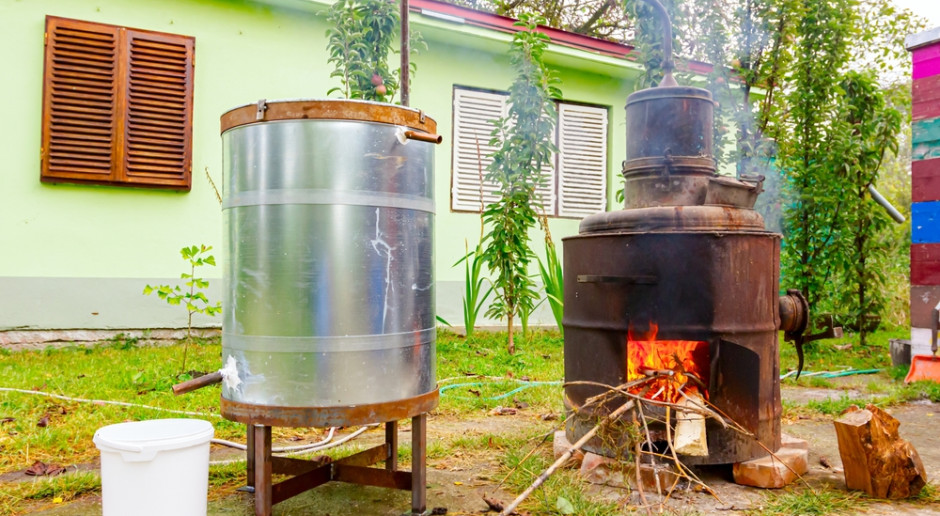
- a portion of illegal domestic production, known in Poland as bimber, or moonshine;
- alcohol from smuggling, including undeclared imports by individuals above permitted allowances;
- other undiagnosed forms, such as possible theft.
Bankier.pl grouped the same categories under moonshine, smuggling and household chemicals — a shorthand that captures how differently the channels behave. Denatured alcohol sold as a biocide or cleaning product moves through legitimate retail and wholesale networks and is limited mainly by how easily it can be re-purified. Moonshine is dispersed, small-scale and the hardest segment to measure. Smuggling responds to price and excise gaps with neighbouring markets and to the intensity of border enforcement.
What the budget is exposed to
Spirits in Poland carry both excise duty and VAT, collected when alcohol is released for consumption through legal channels. Any litre that reaches drinkers outside those channels carries neither. The ministry's reply, as reported, did not attach a zloty figure to the loss; strefabiznesu.pl described the potential shortfall as reaching into billions of zlotys, a framing that follows from the estimated volume rather than from an official calculation.
The direction of the estimate is favourable for the treasury. A shadow share falling from 3.8% to 3.2% implies that a larger part of consumption was captured by taxed supply in 2025 than in 2024. Because the indicator is a ratio, part of that improvement may also come from growth in legal supply rather than from a contraction in illegal volume; the published material does not separate the two effects.
Read-across for the legal trade
For distillers, bottlers and distributors operating in Poland, the practical significance is competitive rather than statistical. Legal producers carry excise, VAT, labelling and traceability costs that illegal supply avoids entirely, which compresses the price floor at the value end of the vodka and flavoured-spirits segment, where most Polish volume sits. A shadow share of roughly one litre in thirty is small in aggregate, but it is concentrated where legal margins are thinnest.
The biocidal-products channel has implications beyond alcohol producers. It links the spirits market to the chemicals trade, where denatured ethanol is a routine input, and turns the classification and control of denaturing formulations into a commercial issue for both sectors. For importers and exporters of ethanol and ethanol-based preparations, tighter monitoring of that channel is the most direct lever available if the ratio stops falling.