Plastic was the only EU packaging material to gain volume between 2011 and 2025
Plastic packaging volumes increased by 11% between 2011 and 2025, making plastic the only material category with an upward trend in the EU analysis. The study covered glass, plastic, metals, paper and board, and composites across 19 member states representing more than 97% of the EU population.
Plastic diverges from other packaging materials
Plastic was the only packaging material to record an upward trend in an EU analysis covering the period from 2011 to 2025, according to Dutch industry publication Kunststof & Rubber. The material’s volume increased by 11% in absolute terms, despite sustained regulatory and commercial pressure to reduce plastic use and encourage alternative packaging.
The study was conducted by the European Commission’s Joint Research Centre and examined flows of glass, plastic, metals, paper and board, and composite packaging. It covered 19 EU member states accounting for more than 97% of the bloc’s population. The findings provide a broad measure of the materials placed on the consumer packaging market, although consumption patterns differ substantially between countries.
Plastic packaging reaches 5.9 million tonnes
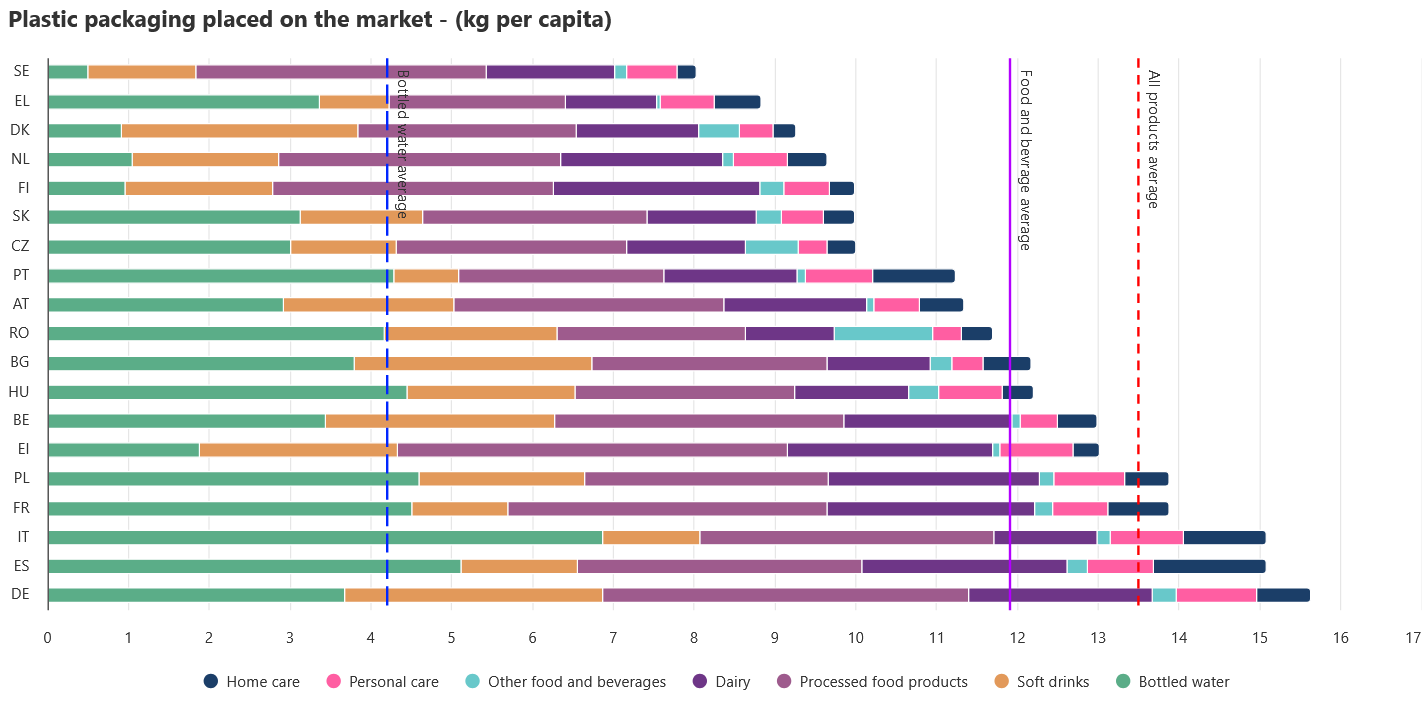
The volume of plastic packaging placed on the market in 2025 was 5.9 million tonnes, equivalent to 14 kg per person across the 19 countries. Bottled water, dairy products and carbonated soft drinks were the largest represented product groups within plastic packaging. These categories generate recurring, high-volume demand and remain central to decisions over polymer selection, collection systems and recycled content.
Water and soft-drink bottles are generally made from polyethylene terephthalate, or PET, which holds the largest share of plastic consumer packaging. The pattern differs in Finland, Ireland, the Netherlands and Sweden, where PET volumes are lower and can fall below those of polypropylene. PP is used across a wider range of food and beverage products. Kunststof & Rubber linked the lower use of PET in the Netherlands partly to the country’s high-quality tap water.
National markets show different consumption paths
Plastic packaging volumes remained relatively stable in Belgium, the Netherlands and France over the period studied. Ireland, Romania and Poland, by contrast, recorded increases in plastic packaging consumption. Per-capita figures also varied sharply: Germany placed 16 kg of plastic packaging per person on the market in 2024, while Sweden recorded only half that amount. The average for the 19 countries was 14 kg.
Total packaging placed on the market amounted to 98 kg per person in 2024. Food and beverages accounted for 97% of packaging material by weight. Glass represented 75% of the 98 kg total, reflecting its greater density. Reusable and single-use glass bottles formed the largest packaging flow, with beer leading at approximately 16.5 million tonnes. The weight-based figures therefore show glass dominating overall material tonnage, while the longer-term trend identifies plastic as the only category still expanding.
Data sharpen the material-substitution debate
The results underline the difficulty of replacing plastic in beverage and food applications where low weight, durability and broad product compatibility influence packaging choices. For polymer producers, converters and recyclers, the 11% increase indicates that demand has persisted even as individual national markets have followed different paths.
For regulators and packaged-goods companies, the contrast between rising plastic volumes and the much heavier glass stream is also relevant. A shift between materials can reduce one type of packaging use while increasing total weight and changing transport, collection and processing requirements. The JRC data do not resolve those trade-offs, but they establish the scale and composition of the market against which future packaging rules and investment decisions will be assessed.