Peru's anchovy catch drives a $1.41 billion fishmeal and fish oil export chain
Peru's second 2024 anchoveta season landed 2.42 million tonnes and generated over 680,000 tonnes of fishmeal and fish oil, worth more than US$1.41 billion in exports. China absorbed nearly 90% of Peru's fishmeal shipments, underlining how climate, quotas and a single dominant buyer shape a globally significant industry.
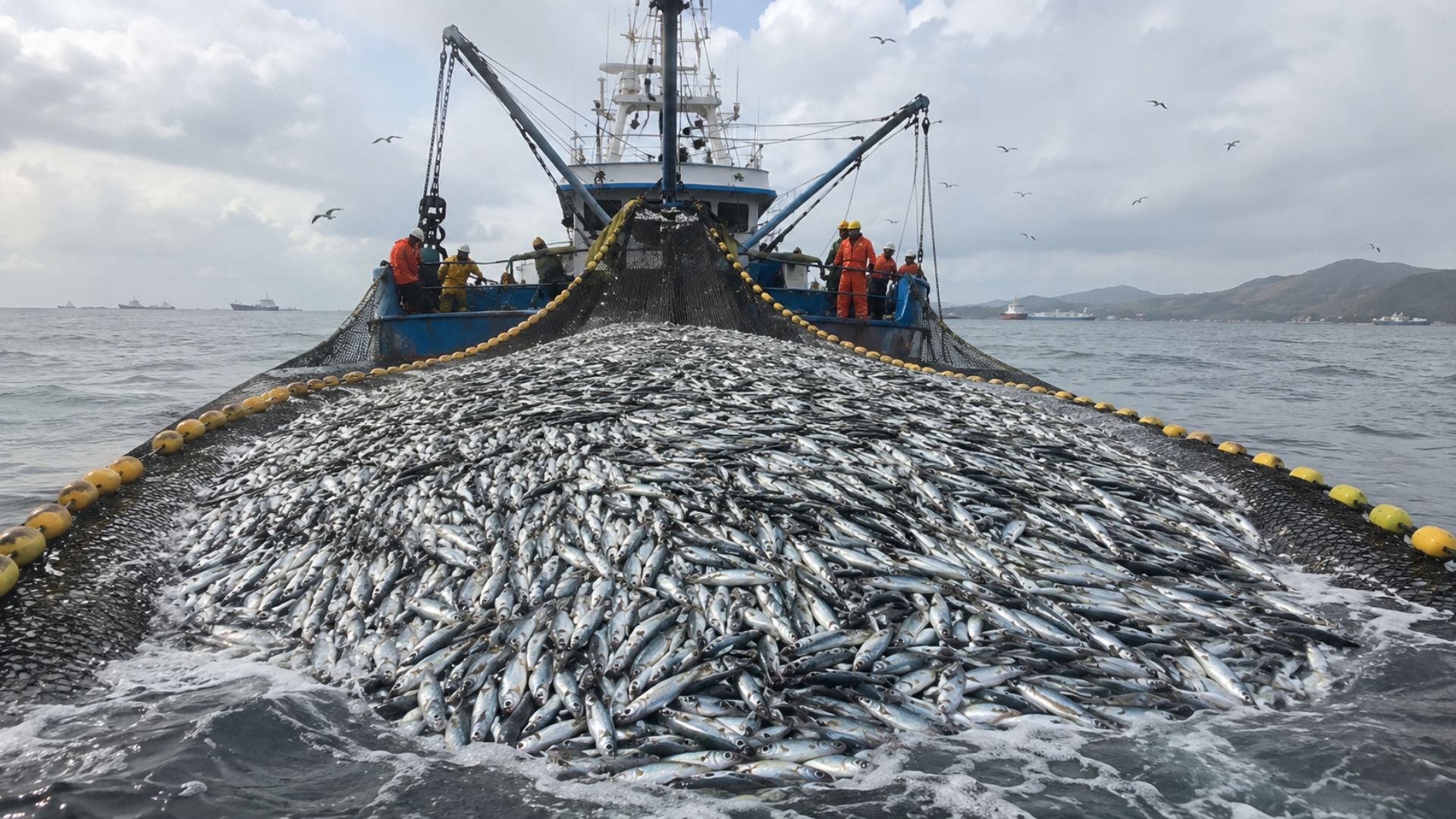
Peru has consolidated its position at the center of the global market for fishmeal and fish oil, ingredients made almost entirely from the anchoveta, a small Pacific fish rarely eaten by Peruvians but processed in bulk for export. According to the Brazilian outlet ClickPetroleoeGas, the country combines an abundant marine resource with an industrial structure built around processing, controlled fishing seasons and output that responds directly to ocean conditions and official catch authorizations.
Record season lifts fishmeal output
During the second fishing season of 2024, carried out in the center-north region of the Peruvian coast, vessels landed 2.42 million tonnes of anchoveta, equivalent to more than 95% of the 2.51-million-tonne quota. Figures from Peru's Ministry of Production show that the season generated more than 680,000 tonnes of fishmeal and fish oil.
The same harvest moved more than US$1.41 billion in exports, while the Peruvian government estimated it supported roughly 49,000 direct and indirect jobs. The million-tonne scale appears mainly in the volume of anchoveta pulled from the sea; the exported quantity corresponds to the processed products, a distinction that matters when reading catch, production and trade figures.
China absorbs nearly 90% of exports
Peru's weight in world trade became especially visible after the 2024 recovery. Fishmeal exports reached 885,000 tonnes in the first nine months of the year, against 460,000 tonnes in the same period of 2023. According to analysis published by the Food and Agriculture Organization (FAO), China received 771,000 tonnes of the Peruvian product in that window, more than double the 360,000 tonnes it imported a year earlier.
That advance left the Chinese market absorbing almost 90% of Peru's fishmeal exports for the period, above the roughly 80% China typically takes in normal years. China also accounted for about 40% of world fishmeal imports in 2024. The concentration offers large-scale demand but ties the Peruvian chain closely to a single dominant buyer, especially when recovering catches quickly expand available supply.
Climate and quotas set the ceiling
The industry's economic strength coexists with permanent exposure to environmental conditions, because shifts in Pacific water temperature and circulation can alter where the anchoveta is found and cap the volume available for industrial seasons. In 2023, weak catches in Peru contributed to a 23% drop in world fishmeal production and a 21% decline in fish oil output, according to the FAO's survey of international trade in these products.
Unfavorable conditions persisted into early 2024 but eased as El Niño weakened, allowing operations in the center-north to recover and the quotas for both seasons to be heavily used. With Peruvian supply back, international stocks stabilized and price pressure diminished, though fish oil production stayed limited by reduced yields in both Peru and Chile. The FAO identifies the anchoveta as the world's main raw material for fishmeal and fish oil, so swings in Peru's fishery cross national borders.
To manage the resource, the government sets catch limits and specific operating windows, as in the season that opened on 1 November 2024, when the fleet was authorized to take up to 2.51 million tonnes. The effective catch of 2.42 million tonnes showed high quota use, and the Ministry of Production said decisions rest on scientific studies and continuous monitoring of stock conditions.