Perlen Papier brings Pulpex fiber bottles to the Italian market
Perlen Papier has introduced Pulpex molded-fiber bottles in Italy for wine, spirits, still beverages, oils, dairy products and personal care goods. The recyclable containers are available in three sizes, while the Swiss group is considering local production from late 2027.
A fiber-based alternative to glass and plastic
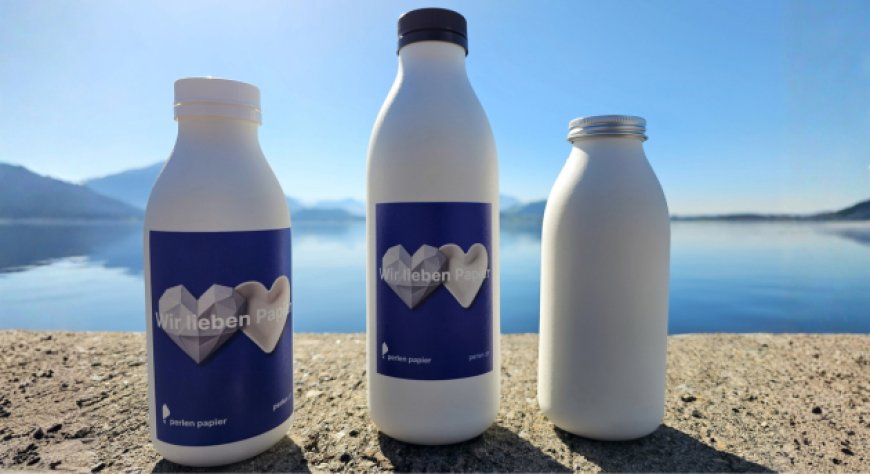
Swiss paper producer Perlen Papier has brought Pulpex molded-fiber bottles to the Italian market, extending its business beyond graphic paper and into three-dimensional packaging. Developed by British company Pulpex, the containers are intended as an alternative to conventional glass and plastic bottles for wine, spirits, water and other still beverages, dairy products, oils, cosmetics and personal care products.
Perlen Industrieholding and its subsidiary Perlen Papier hold exclusive production rights for the Pulpex technology in Italy, Switzerland, Austria and southern Germany. The bottles are already commercially available, according to HorecaNews and Italia a Tavola. Perlen is also evaluating production at its plant in Perlen, in the Swiss canton of Lucerne, from late 2027, which would create a geographically closer supply source for Italian customers.
Three sizes and more than 24 months of shelf life
The bottle body is formed as a single piece through wet molding of cellulose fibers and then dried. A thin, odorless, food-contact-safe barrier is applied to the inside to protect the contents from moisture and oxygen. The barrier contains no plastic, and the manufacturing process uses no adhesives. Depending on the product and closure system, the packaging can provide a shelf life of more than 24 months and can be stored in refrigerators or humid environments.
Standard bottles are currently offered in 300, 500 and 750 milliliter formats. Perlen plans to expand the range to capacities between 200 and 1,000 milliliters. The molding process also permits customized shapes, while surfaces can be finished using inline digital printing or labels. The bottles are compatible with standard filling processes and can generally be integrated into existing bottling infrastructure, an important consideration for wine and spirits producers seeking to avoid a separate production system.
Carbon claims and the challenge to established packaging
The fibers can come from certified sustainably managed forests or recycled paper. Under the Confederation of European Paper Industries’ 4evergreen testing method, the bottles can enter existing paper-recycling streams without requiring a dedicated collection system. Based on figures supplied by Perlen Papier, their cradle-to-gate carbon footprint is approximately 90% lower than that of an equivalent glass bottle and about 30% lower than that of a PET bottle.
Lower weight than glass could also reduce transport requirements and logistics costs, particularly in wine distribution, where packaging contributes materially to the weight moved through the supply chain. However, adoption will depend on more than environmental claims. Producers and bottlers will assess product protection, filling-line reliability, economics and consumer acceptance. Perlen, which has operated in central Switzerland for more than 150 years, is applying its fiber-processing experience to several molded-fiber packaging lines already operating or being commissioned at its site. The Italian launch will therefore test whether paper-fiber bottles can gain a practical foothold in applications long dominated by glass and plastic.