Panama rice purchase faces $1.44 million overcost claim and import scrutiny
A direct purchase of 600,000 quintals of paddy rice by Panama’s IMA has triggered allegations of a $1.44 million overcost and unlawful import procedures. The agency disputes the price comparison, citing differences in origin, quality and additional costs, and has ordered an audit and technical inspection.
Direct purchase draws price comparison
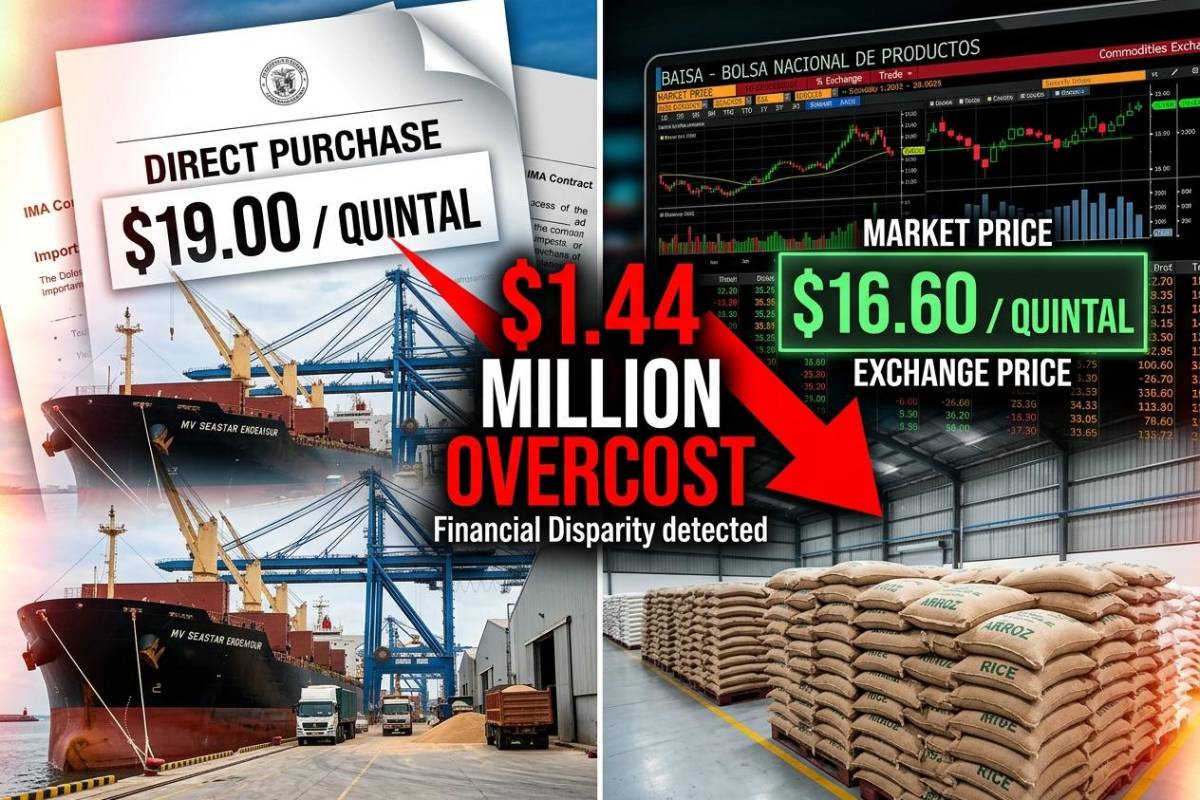
Panama’s Agricultural Marketing Institute, known as IMA, is facing scrutiny over a direct purchase of imported paddy rice after La Estrella de Panamá calculated that the transaction cost the state an estimated $1.44 million more than a deal completed through the country’s formal commodity exchange. The dispute centers on whether the two purchases involved genuinely comparable rice and delivery costs.
In July 2026, the IMA bought 600,000 quintals of paddy rice from TRC Trading Corporation at $19.00 per quintal through a direct contract. On July 22, private mills purchased rice from the same supplier through the Bolsa Nacional de Productos, S.A., or BAISA, at a closing price of $16.60 per quintal. La Estrella reported that both transactions carried CIF delivery terms. Applying the $2.40-per-quintal difference to the IMA volume produces the reported $1.44 million gap.
Agency disputes like-for-like comparison
IMA director general Nilo Murillo Robles rejected the overcost estimate. He said the exchange transaction involved rice from the United States, while the IMA bought Brazilian-origin grain. According to Murillo, the state purchase was for a special grade delivering 84% whole kernels and therefore represented a higher-quality product. He also argued that the private mills’ rice became more expensive after costs not included in the initial exchange closing price were added.
The disagreement leaves origin, quality specifications and the full landed cost as central issues for auditors. On August 21, Murillo sent official note DG-NMR-694-2026 to Pedro Acosta, president of Panama’s National Union of Consumers and Users, reporting that an audit and technical inspection had been ordered for imported rice stored in suppliers’ mill silos. The checks are intended to confirm that grain for Agroferias, Tiendas del Pueblo and Agrodistribuidoras meets required quality standards before distribution.
Producers question timing and procedure
Rice producers are also challenging the import process. The IMA may buy food directly for social-assistance programs under Cabinet Decree 23 of 2007, but Omar Spiegel, president of the Federation of Rice and Grain Producer Associations of Panama, said the shipment should have been coordinated with the Rice Agri-Food Chain. He argued that bypassing that consultation was contrary to the purpose of Law 47 of 2017, which was designed to protect domestic grain marketing during the pre-harvest and harvest periods.
Official figures presented by the producers’ group put physical stocks at 2,621,842 quintals on June 19, 2026. Including pending World Trade Organization quotas, volumes authorized by the chain and the IMA shipment, total availability reached 4,221,842 quintals. Against monthly consumption of 779,000 quintals, that inventory would cover demand through the end of November 2026, even before a projected domestic crop of 2.65 million quintals is counted.
Harvest pressures raise market stakes
Producers in provinces including Chiriquí have faced El Niño-related pressure. Initial yields fell below 70 quintals per hectare, while operating costs increased by $300 to $400 per hectare. Farmers nevertheless reported that fields now being harvested were yielding more than 100 quintals per hectare, strengthening their demand for an end to extraordinary imports conducted outside established institutional channels.
The Cabinet has separately approved Resolution 85-26, granting the IMA an additional $22.1 million for purchases of rice and other basic-basket products for fairs and community stores. Sector representatives said part of the funding should cover outstanding commitments and debts from previous imports. For producers, processors and public buyers, the audit’s findings will be important in determining whether the disputed premium reflected superior specifications or avoidable procurement costs.