Oil and rubber buying lifts MXV Index to three-month high above 2,900 points
The MXV Index rose more than 0.8% to 2,909 points on August 20, extending its advance to a second session and reaching its highest level since late May. Crude oil led the rally on supply concerns linked to Iran and the Strait of Hormuz, while natural rubber gained on tightening Asian output.
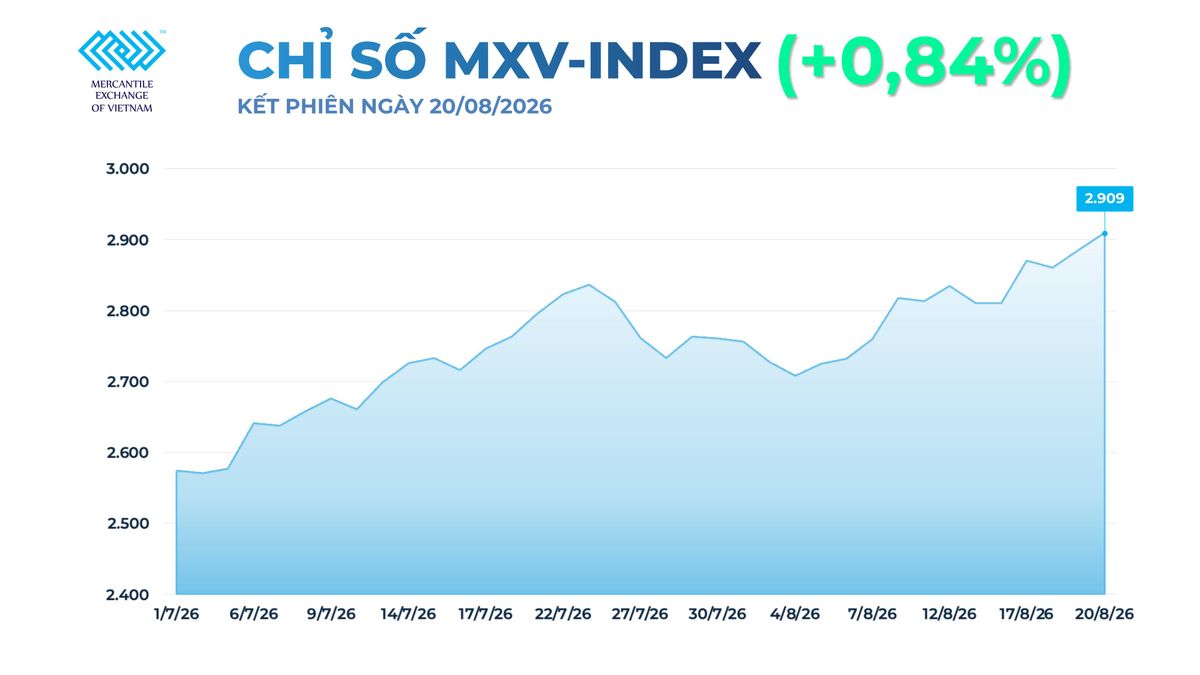
Commodity benchmark reaches 2,909 points
Broad buying across global raw-material markets pushed the MXV Index above 2,900 points on August 20. The benchmark gained more than 0.8% to close at 2,909 points, extending its rise for a second consecutive session and reaching its highest level since late May, according to the Vietnam Commodity Exchange (MXV).
Energy and natural rubber provided the clearest support. Four of five energy commodities closed higher, while both benchmark crude contracts advanced for a fifth consecutive session. Brent rose 2.36% to $93.78 a barrel and West Texas Intermediate gained 2.33% to $87.83 a barrel. Rubber contracts also strengthened, with RSS3 adding 0.59% to $2,710 per tonne and TSR20 rising 1.24% to $2,286 per tonne.
Iran and Hormuz risks support crude oil
The oil rally reflected concern that supplies could tighten if the United States imposes stronger sanctions on Iran and countries or companies supporting Tehran. On August 20, US President Donald Trump threatened economic warfare and unprecedented isolation against Iran, while warning of serious economic consequences for those continuing to assist the country.
China is the largest buyer of Iranian crude, accounting for more than 80% of Iran's seaborne oil exports. Secondary sanctions could therefore reduce the volume reaching international markets and create additional friction between the United States and China. Tanker demand has also increased as Gulf exporters seek alternatives to disrupted traffic through the Strait of Hormuz. Ship-to-ship transfers and longer voyages are reducing fleet availability and have pushed tanker charter costs to record levels, according to the source report.
Supply concerns extend beyond the Middle East. Norway's July crude production fell by almost 200,000 barrels per day year on year to about 1.78 million barrels per day. US data offered a partial counterweight: refinery utilization rose to 97.2%, with plants processing 17.4 million barrels per day, while crude stocks increased by 4.4 million barrels to 428.8 million. However, inventories at Cushing declined to 21.252 million barrels, indicating tighter physical availability at the WTI delivery hub.
Natural rubber reaches multiyear highs
RSS3 remained near its highest level in more than five years, while TSR20 held around a nine-year high. MXV said seasonal production in Thailand, Vietnam and Indonesia is expected to narrow as the peak tapping period approaches its end in late September. Intermittent rain in Thailand, the world's largest rubber producer, is also disrupting tapping and restricting supply.
Higher crude prices are raising synthetic rubber production costs, improving natural rubber's relative cost position. Indian demand adds another source of support. The All India Rubber Industries Association estimates domestic consumption at about 1.41 million tonnes in the 2024-2025 season, with a deficit exceeding 500,000 tonnes. India is consequently diversifying procurement and expanding raw-material import channels.
Physical markets face higher costs
For oil importers and refiners, the immediate risk comes from the combination of higher crude prices, record tanker costs and longer delivery times. Vietnam raised domestic fuel prices from 15:00 on August 20: E5RON92 gasoline increased by 598 dong to 21,833 dong per litre, E10RON95 by 549 dong to 22,668 dong, and diesel by 1,310 dong to 28,543 dong.
Rubber processors face a different constraint. Seasonal declines and rain are limiting Southeast Asian supply just as India seeks more imported material. The two-session MXV rally therefore reflects several contract-specific pressures rather than a single demand shock: geopolitical and shipping risk in oil, and production seasonality, weather and import demand in rubber.