NongShim invests 200 billion won in Busan plant as rivalry with Samyang goes global
NongShim’s new export-focused factory in Busan will raise its annual Korean export capacity to 1.2 billion packs. The 200 billion won investment is central to its effort to regain overseas ground from Samyang Foods and double global noodle sales by 2030.
NongShim builds capacity for an overseas push
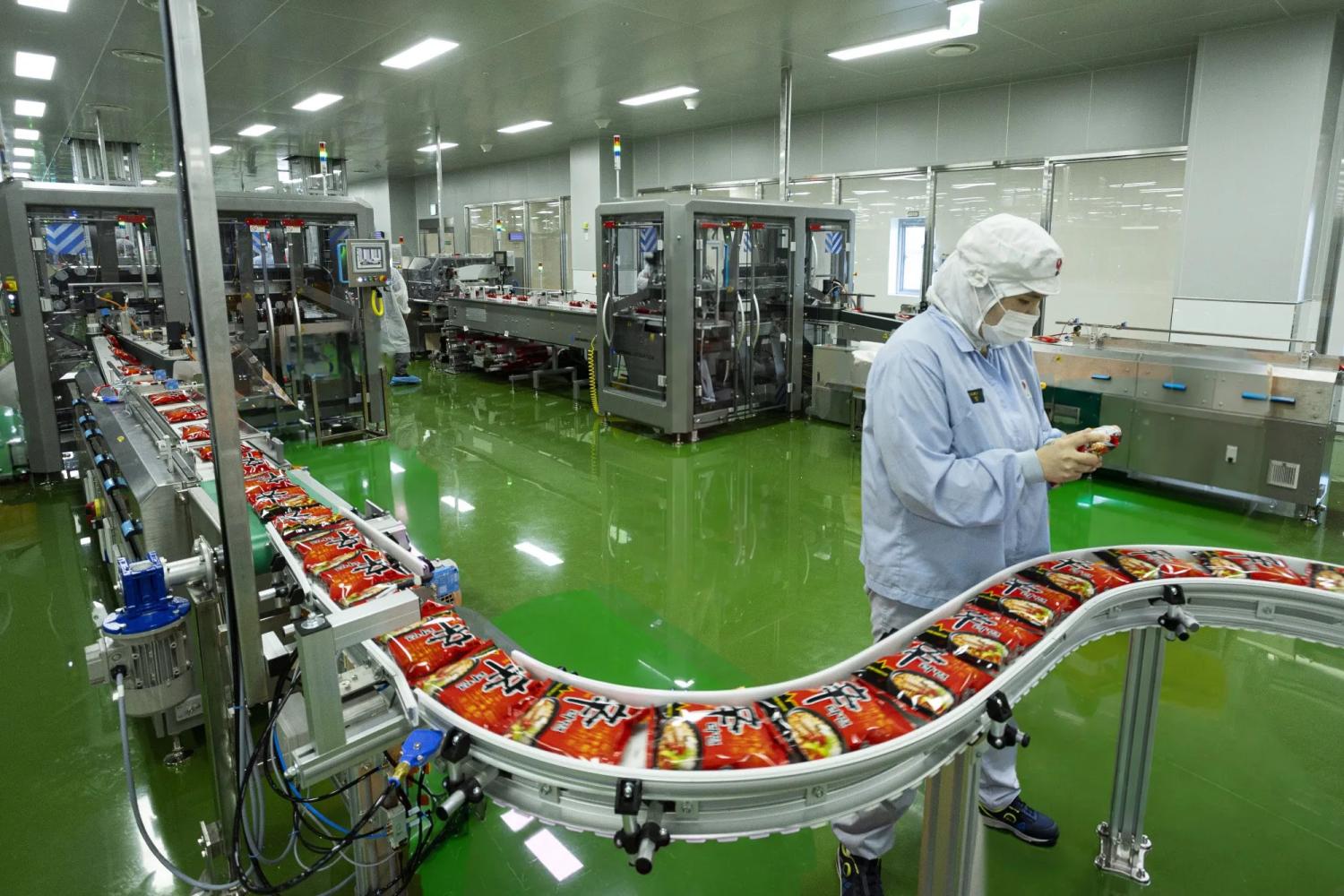
NongShim is putting a 200 billion won ($149 million) factory in Busan at the center of its attempt to narrow the international gap with Samyang Foods. Bloomberg Businessweek Vietnam reports that the six-story complex is NongShim’s first plant built specifically for exports and will increase the company’s export capacity from South Korea by 70%.
The factory, which began operating in October, is dedicated to NongShim’s flagship Shin Ramyun range. Each production line can make 600 packs per minute, twice the speed of conventional lines, while flour takes less than 7 minutes to become a finished pack. Artificial-intelligence sensors and automated mixers support the rolling, flash-frying and packaging process.
Samyang holds the stronger international position
NongShim dominated South Korea’s instant-noodle market for almost four decades, but Samyang captured more of the global Korean-noodle boom through its Buldak brand. Social-media videos of consumers trying the intensely spicy noodles helped turn Buldak into an international phenomenon. Overseas business now generates more than 80% of Samyang’s revenue, compared with 37% for NongShim, while Samyang’s market capitalization is almost four times larger.
Samyang has overtaken NongShim in important markets including China and Europe. Euromonitor International expects Samyang to become the third-largest instant-noodle seller in the United States this year, although it would still rank behind NongShim. The competitive pressure is rising as the global instant-noodle market is forecast to expand by about 23% to $63.3 billion by 2030.
Both companies accelerate investment
The Busan complex will almost double NongShim’s annual export capacity in South Korea to 1.2 billion packs. It will lift the company’s total global capacity to 6.2 billion packs across South Korea and four factories in the United States and China. Initial shipments from Busan will go to Japan, Europe, Australia, India and Southeast Asia.
NongShim aims to double global noodle revenue to 5.4 trillion won by 2030 and raise overseas sales to more than 60% of total revenue. Achieving that target would place it among the world’s five largest instant-noodle producers, alongside companies including Nissin Foods Holdings and Nestlé, the owner of Maggi. Early momentum is visible: international sales of Shin Ramyun increased 36% in the first half of the year.
Samyang is expanding at the same time. It announced an investment of more than 131 billion won in a new production line in Vietnam, while its first overseas factory, located in China, is expected to begin operating in January. Investors still assign Samyang the higher earnings multiple: its shares trade at 13.4 times forecast profit, against 11.4 times for NongShim.
New products and marketing will test demand
Additional capacity alone will not determine the outcome. Han Yujung of Hanwha Investment & Securities said NongShim’s valuation could receive support if US revenue recovers and output at the Busan facility increases. NongShim must convert faster production into stronger sales growth and improved profitability.
The company is also adapting Samyang’s consumer strategy. It has released a limited Shin Ramyun edition connected to Netflix’s K-Pop Demon Hunters and installed booths at fan conventions to reach overseas Gen Z consumers. A new stir-fried Shin Ramyun version is planned for next year, taking NongShim into the brothless-noodle segment that supported Buldak’s global success. NongShim global marketing head Songha Ji acknowledged that the company had initially responded slowly to worldwide demand and said it was studying what Samyang had done well.