Nigeria, Ivory Coast and Senegal drive West Africa’s rice import demand
Nigeria, Ivory Coast and Senegal are the leading drivers of rice imports in West Africa, according to a Crisil report cited by PresseAfrik. Their demand reinforces the region’s importance to the global rice market.
Three markets lead regional demand
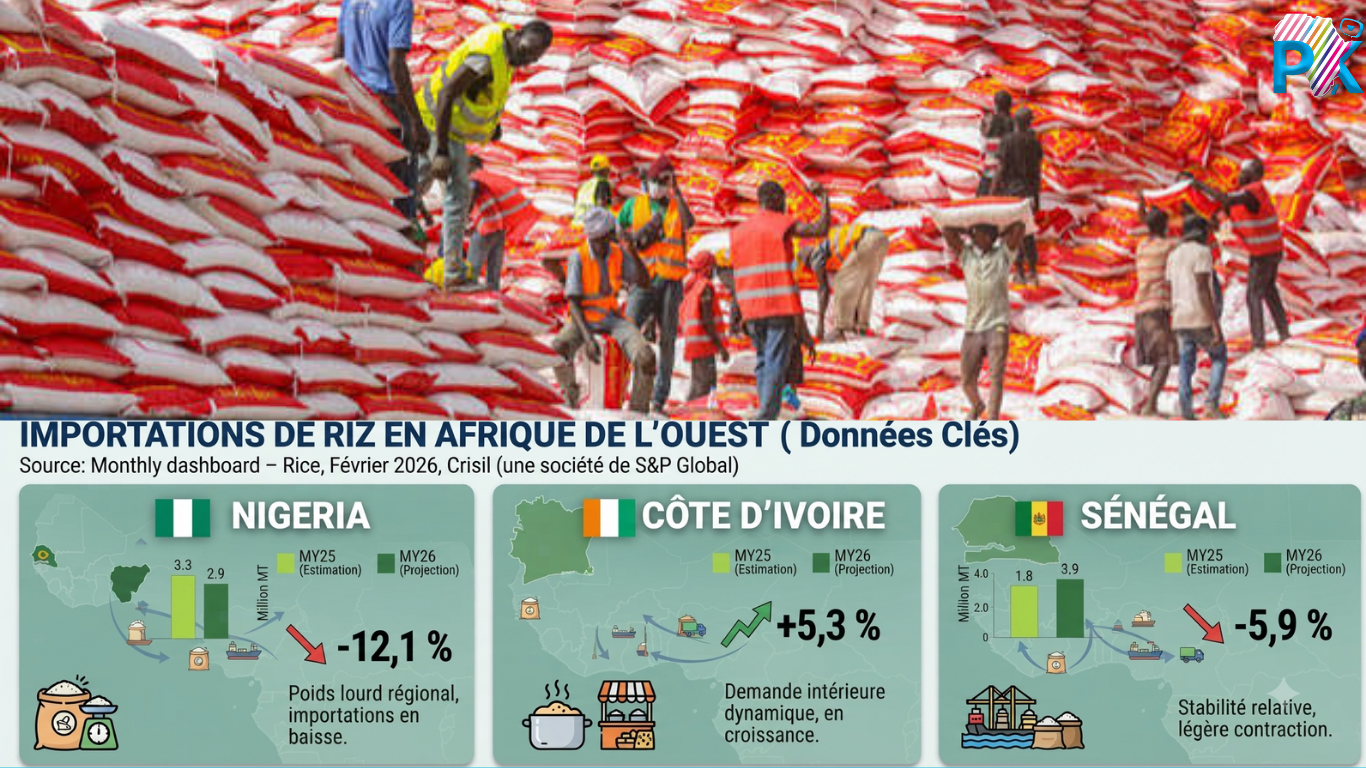
Nigeria, Ivory Coast and Senegal are at the forefront of rice import demand in West Africa, according to a report by Crisil, an S&P Global company, cited by PresseAfrik. The three countries’ purchasing requirements place them at the center of a regional market that has become an important pillar of global rice demand.
The report identifies the three markets as the principal drivers rather than treating West Africa as a single, uniform destination. That distinction matters to exporters and traders because import demand is concentrated in countries with their own procurement systems, commercial networks and domestic market conditions.
The available report details do not specify import volumes, growth rates, prices or supplier-country shares. They nevertheless indicate that purchasing decisions in Nigeria, Ivory Coast and Senegal carry particular weight for the direction of West African demand.
West Africa’s role in the global rice market
Rice exporters increasingly need to follow West Africa not only as a regional destination but also as a significant component of worldwide demand. When several major importing countries are located in the same region, changes in their buying activity can affect competition among suppliers and the allocation of exportable rice.
For international sellers, the concentration of demand creates both opportunity and exposure. Strong purchasing by the three leading markets can support sales into West Africa, while weaker or delayed procurement in one of them can alter the pace of regional trade. The impact will depend on the timing and scale of individual buying decisions, figures that were not included in the source material.
The findings are also relevant to importers and processors operating within the region. Companies must compete for available cargoes while managing procurement, logistics and distribution in their respective national markets. The identification of Nigeria, Ivory Coast and Senegal as demand leaders suggests that commercial developments in these countries deserve close monitoring across the rice supply chain.
Implications for producers and traders
Exporting-country producers and millers can use the report’s market ranking to prioritize customer relationships and track purchasing signals. However, the absence of detailed volume and price data means the findings should be read as an assessment of where demand is concentrated, not as a precise forecast of future imports.
Traders will also need to distinguish between the three markets. A regional headline can conceal differences in purchasing schedules and buyer behavior, so changes in one country should not automatically be applied to the others. Crisil’s identification of the leading import drivers provides a starting point for that country-level analysis.
For the wider market, the central message is that West African rice demand is being shaped heavily by Nigeria, Ivory Coast and Senegal. Their combined prominence gives the region greater relevance to producers, exporters, importers and market analysts assessing global rice flows.