Nigeria-Ghana onion dispute resolved, exposing gaps in West African free trade
Cheaper Nigerian onions may again be heading to Ghana after a dispute between traders was resolved last month. The episode interrupted one of West Africa's busiest overland food-trade routes without any government measure being involved, and it has highlighted a structural weakness in the region's growing free trade area.
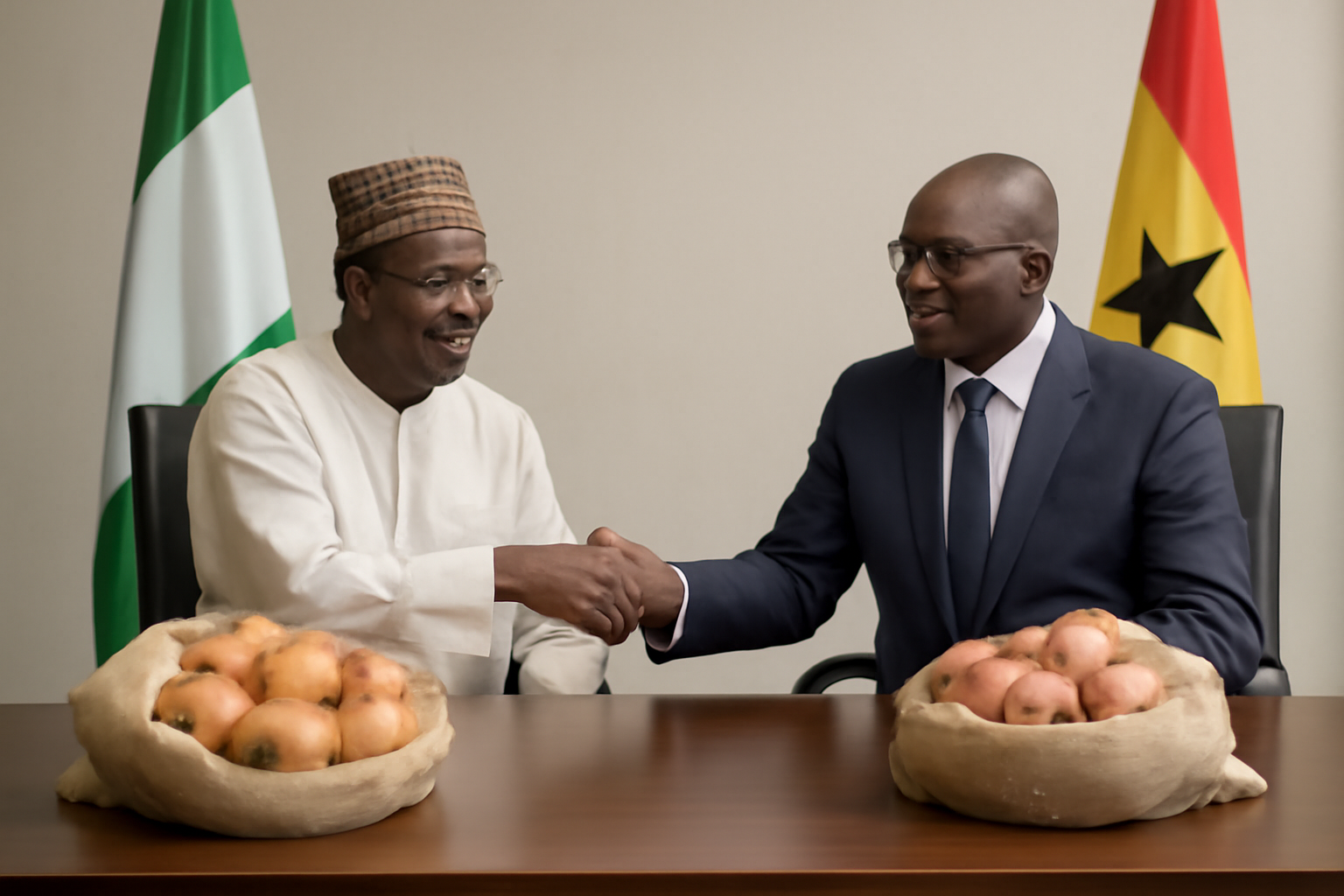
Cheaper Nigerian onions may once again be heading to Ghana after a dispute between traders was resolved last month, reopening one of West Africa's busiest overland food-trade routes. The quarrel disrupted normal commercial flows between the two countries while it lasted, and it was settled by the traders themselves rather than through any formal regional mechanism.
The available reporting does not specify the volumes involved, the value of the shipments or the precise terms of the settlement. What it does establish is the shape of the problem: a bilateral commercial quarrel was able to interrupt trade in a staple vegetable inside a bloc whose central promise is that such goods move across borders without obstruction.
A trader dispute, not a government ban
The interruption is described as a dispute between traders, not as an import ban, a tariff action or a sanitary measure imposed by either government. That distinction matters for anyone pricing risk on West African food corridors. Formal trade barriers are visible, published and open to challenge through regional institutions. Private disputes between trader associations are none of those things. They leave no paper trail, they show up in customs data only after volumes have already fallen, and they end on a timetable no importer can forecast.
Onions are a high-frequency, low-margin trade. The crop is perishable, it moves mainly by road, and it passes through long chains of intermediaries: aggregators in the producing areas, transporters, market unions and retail traders at the destination. Every link in that chain holds leverage over the cargo. When one of them withholds cooperation, the consignment stops long before any customs post becomes relevant, and the loss is absorbed by whoever owns the perishable goods at that moment.
Free trade on paper, negotiated in practice
West Africa's free trade area continues to expand on paper, with tariff liberalisation and simplified border procedures at its core. The onion case illustrates the distance between that legal architecture and commercial reality on the ground. For firms operating in the corridor, several features of the gap are now visible:
- Trade can stop without any government decision, which means there is no formal appeal route and no administrative counterparty to negotiate with.
- Dispute resolution defaults to trader associations, whose rulings bind their own members but carry no regional legal force.
- Resolution timelines are open-ended; this dispute ran until last month before a settlement was reached.
- The price effect lands on consumers in the importing market, where the cheaper supply simply disappears from the stalls.
None of this is unique to onions. The same structure applies to tomatoes, livestock, grain and other agricultural goods that move overland between Sahelian and coastal West Africa, where informal and semi-formal trading networks handle a large share of volumes and where associations, not ministries, set the operating rules at the market level.
What it means for the onion trade
The immediate commercial consequence is the return of cheaper Nigerian supply to Ghanaian markets. During the interruption, buyers in Ghana had to source from alternative origins or accept higher prices for a product that features in daily consumption. Those alternative suppliers now face renewed competition from the Nigerian product on price, and the traders who built positions during the gap will see margins compress as volumes normalise.
The open question is repetition. Nothing in the reported settlement describes a mechanism that would prevent a similar breakdown in the next season. For importers, processors and traders operating between Nigeria and Ghana, the practical conclusion is that counterparty and association risk on this route should be written into contracts and inventory planning rather than treated as a one-off event.