Morocco commits $75 million to expand supplemental irrigation for cereals
Morocco has launched a 700 million dirham ($75 million) irrigation project covering 5,000 hectares in Larache Province. The investment is part of a national program seeking to bring almost 1 million hectares of cereal and legume crops under supplemental irrigation by 2030.
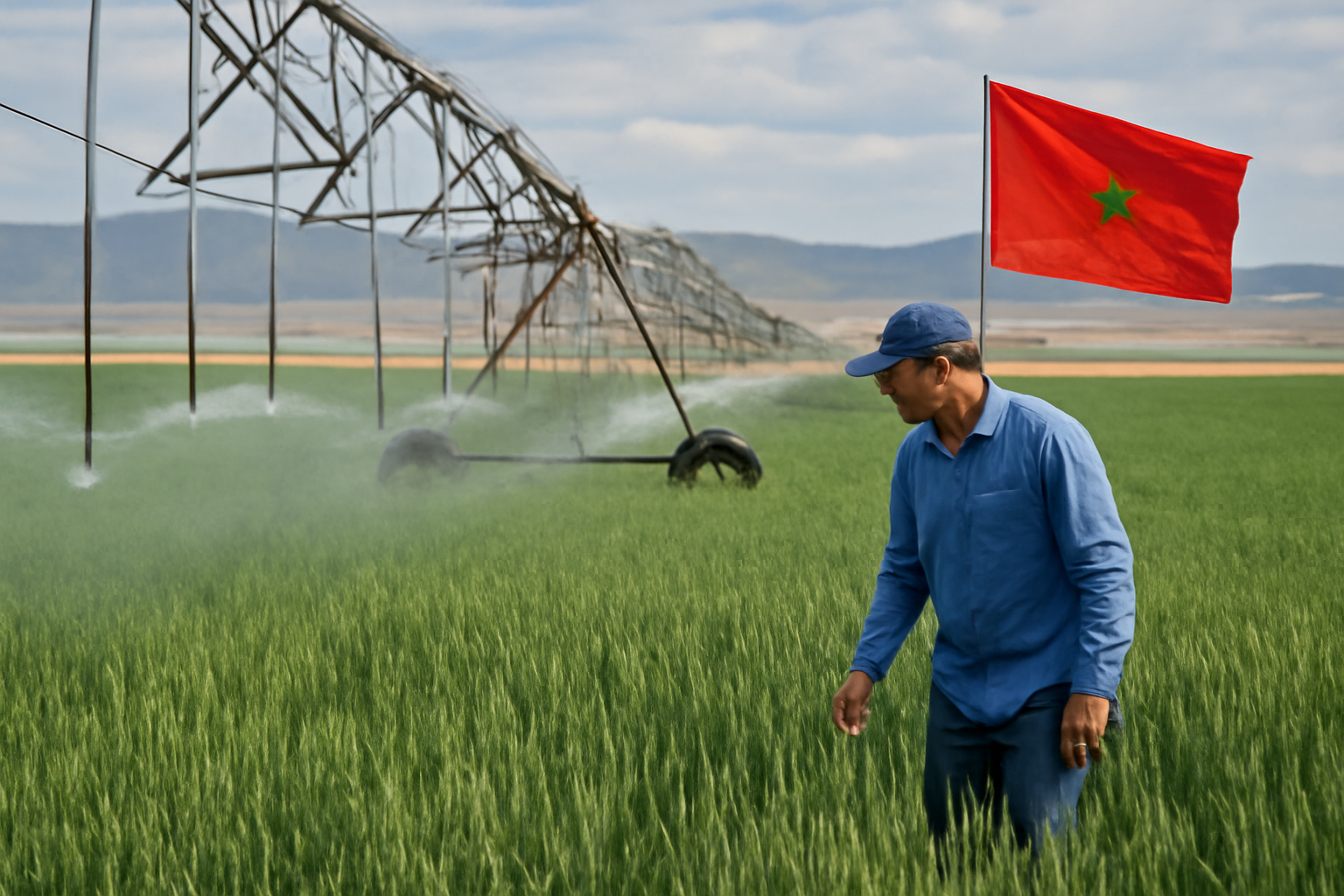
Project targets 5,000 hectares in Larache Province
Morocco has launched a 700 million Moroccan dirham project, equivalent to about $75 million, to expand supplemental irrigation for cereal crops in the Dar Khrofa area of Larache Province. According to Milling Middle East & Africa, the Ministry of Agriculture launched the hydro-agricultural project on July 18. It will cover 5,000 hectares across eight municipalities and is expected to benefit more than 7,000 farmers.
The investment will support infrastructure for storing and distributing water, as well as irrigation equipment for agricultural producers, Financial Afrik reported. Supplemental irrigation supplies limited amounts of water when rainfall is insufficient during critical stages of crop development, including emergence, flowering and grain filling. The approach is intended to stabilize output rather than replace rainfall as the primary water source.
National program aims for almost 1 million hectares
The Dar Khrofa development forms part of Morocco’s national supplemental irrigation program, launched in 2025. The government aims to extend the practice to almost 1 million hectares planted with cereals and legumes by 2030. Cereals occupy about 70% of Morocco’s cultivated agricultural land, according to Agence Ecofin, giving the program broad relevance for farmers, grain processors and buyers.
Moroccan cereal farming remains predominantly rain-fed and has been heavily exposed to repeated drought. Agence Ecofin reported that national cereal production fell to 3.3 million tonnes in 2022, down 68% from 10.5 million tonnes a year earlier. Output subsequently recovered to 5.5 million tonnes in the 2022/2023 season as weather conditions improved. The sharp movement between seasons illustrates the production volatility that supplemental irrigation is designed to reduce.
More stable harvests could affect import requirements
Wheat, barley and maize are central to Morocco’s food supply, while cereals are also the country’s largest category of food-import expenditure, Agence Ecofin reported. Improving harvest reliability could therefore give mills, feed manufacturers and grain traders greater visibility over domestic availability. It would not eliminate the need for imports, but more predictable local output could reduce the size of weather-driven supply gaps.
The project’s immediate scale remains limited compared with the national cereal area. Agence Ecofin has previously placed cereal cultivation at close to 4 million hectares, while the Dar Khrofa scheme covers 5,000 hectares. Its significance lies in its role within the larger 2030 program and in the concentration of infrastructure across eight municipalities, where more than 7,000 farmers are expected to gain access to supplemental water.
Execution will determine the commercial effect. Water-storage capacity, distribution reliability and access to irrigation equipment will influence whether farmers can deliver water at the crop stages where it has the greatest impact. For processors and traders, the relevant measure will be whether the program narrows annual fluctuations in cereal volumes and improves the predictability of domestic procurement.