Meiji deepens Ghana cocoa partnership as Accra targets 50% local processing
Ghana, Japan and Meiji Holdings signed a Letter of Intent in Accra on September 14 covering sustainable cocoa production, agroforestry and circular-economy projects. Ghana supplies nearly 70% of Japan's imported cocoa beans and sold about $146 million worth to the country in 2024. The agreements land as Accra prepares a directive requiring at least 50% of its beans to be processed domestically from the 2026/27 season.
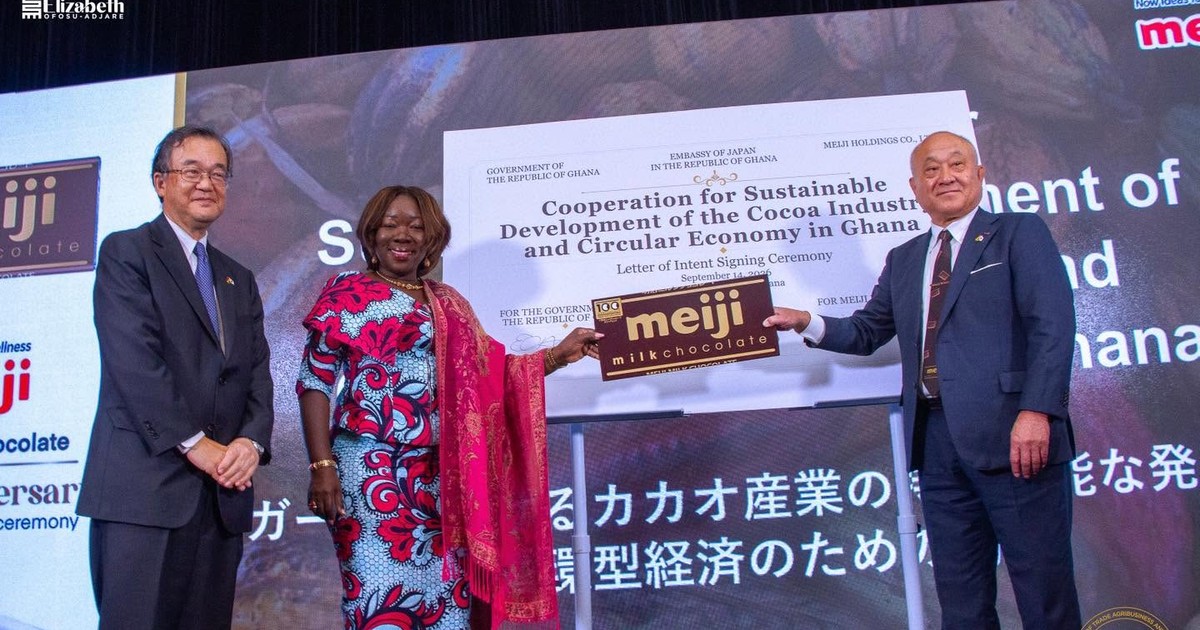
Japanese chocolate maker Meiji is widening its role in Ghana's cocoa industry through a set of agreements covering sustainable production, agroforestry and the conversion of farm waste into usable products, Business Insider Africa reported.
The Government of Ghana, Japan and Meiji Holdings signed a Letter of Intent in Accra on September 14 to strengthen cooperation on sustainable cocoa development and circular-economy initiatives. Ghana's Ministry of Trade, Agribusiness and Industry announced the agreement following a ceremony marking the 100th anniversary of Meiji Milk Chocolate.
Trade Minister Elizabeth Ofosu-Adjare signed on behalf of Ghana, Japanese Ambassador Hiroshi Yoshimoto signed for Japan, and Meiji's chief executive initialled the document for the company.
Japan's reliance on Ghanaian beans
The agreement rests on an established trade relationship. Ghana supplies nearly 70% of the cocoa beans imported by Japan, according to the Ghana Cocoa Board, making the West African country the anchor of Japanese chocolate manufacturing.
Trade data cited in the report show Japan imported about $146 million worth of cocoa beans from Ghana in 2024, with Ghana ranking as its largest supplier. That flow has historically moved as raw beans, with the processing margin captured outside the producing country.
Agroforestry and cocoa farm waste
A second agreement signed around the same event sets out how Meiji intends to expand its sustainability work on the ground. Ghanaian farm and forest-restoration company Afarinick signed a separate Letter of Intent with Meiji to jointly develop an agroforestry cocoa farm. The project would combine cocoa cultivation with agroforestry and seek productive uses for plant waste generated on the farm, in what the two companies describe as a circular agroforestry cocoa model.
Neither the size of the proposed farm nor its financial value or development timetable has been disclosed. Meiji has worked with cocoa-growing communities in Ghana for years, including through programmes aimed at traceability and sustainable production. At the centenary event, the company also presented Ghana with 10,000 ballpoint pens made using cacao-derived bioplastic, one demonstration of how material from the cocoa value chain can be reused.
- Letter of Intent signed in Accra on September 14 by Ghana, Japan and Meiji Holdings
- Separate Letter of Intent between Meiji and Ghanaian company Afarinick on an agroforestry cocoa farm
- 10,000 ballpoint pens made from cacao-derived bioplastic presented to Ghana
- No investment amounts, farm size or project timetable disclosed
The 50% domestic processing directive
The agreements come as Ghana seeks to extract more economic value from an industry that has traditionally exported much of its output as raw beans. The government has directed that at least 50% of Ghana's cocoa beans be processed domestically from the 2026/27 season, alongside plans to increase supplies to local processors and revive the state-owned Cocoa Processing Company. Partnerships that go beyond bean purchasing could support that strategy by bringing investment, processing capacity, technology and new uses for by-products closer to producing communities.
The latest agreements carry no disclosed investment commitments, which makes it too early to assess their financial impact. What they do change is the shape of the relationship: a Japanese chocolate industry that already depends heavily on Ghanaian cocoa is now formally engaged in farm-level production models and by-product use, rather than in the raw bean trade alone.