Lebanon’s Walnut Imports Exceed 6,600 Tonnes as $20 Million Bill Highlights Local Opportunity
Lebanon imported about 5,480 tonnes of in-shell walnuts worth $13.6 million and 1,150 tonnes of shelled walnuts worth $6 million. The total of more than 6,600 tonnes and nearly $20 million points to potential for domestic substitution, but competitiveness cannot be assessed without production-cost and yield data.
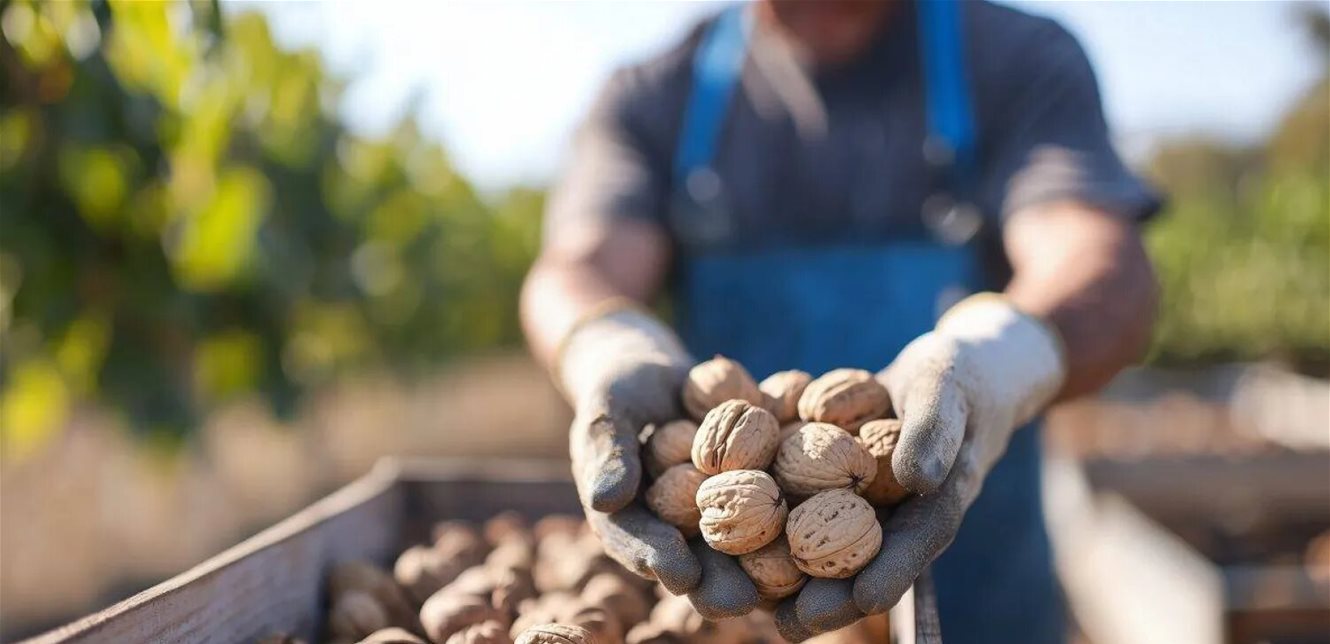
Imports exceed 6,600 tonnes
Lebanon imported more than 6,600 tonnes of in-shell and shelled walnuts for a combined bill approaching $20 million, according to figures reported by Lebanon24. The total consisted of about 5,480 tonnes of walnuts in shell valued at $13.6 million and approximately 1,150 tonnes of shelled walnuts worth $6 million.
In-shell walnuts represented the larger trade flow by both volume and value. Based on the reported figures, they accounted for roughly four-fifths of total walnut tonnage. Shelled walnuts formed a smaller segment, but their value was substantial because processing removes the shell and produces a more concentrated, ready-to-use product.
Import values set a benchmark for local supply
A calculation from the reported totals gives an average import value of about $2,480 per tonne for in-shell walnuts and about $5,220 per tonne for shelled walnuts. These are broad averages rather than market prices: the figures do not disclose origins, varieties, grades, shipment timing, freight costs or contractual terms. They nevertheless offer an initial benchmark for Lebanese producers and processors considering whether local supply can replace part of the imported volume.
The gap between the two average values also shows where processing may add commercial value. Domestic growers could target the in-shell market, while cracking, sorting and packing operations could compete in the higher-value shelled segment. However, the available source material contains no figures for Lebanon’s walnut acreage, harvest volume, farm yields, labor costs, processing capacity or wholesale prices. It is therefore not possible to determine from the import bill alone whether domestic walnuts would be cost-competitive.
Substitution depends on consistent commercial supply
The import volume establishes that Lebanon has measurable demand for walnuts across both product forms. Replacing even part of that flow would require growers and processors to supply the grades, quantities and delivery schedules currently met by foreign suppliers. Product quality, kernel recovery, storage performance and reliable sorting would matter alongside the farm-gate cost because buyers compare usable output, not simply the weight of walnuts harvested.
The nearly $20 million bill should consequently be treated as the maximum size of the reported import market, not as revenue that local producers could automatically capture. A credible substitution strategy would need more detailed data on import origins, seasonal purchasing, buyer specifications and domestic production economics. The figures reported by Lebanon24 identify the scale of the opportunity; they do not establish that every imported tonne can be replaced profitably. For growers, processors and investors, the immediate question is which portion of the 6,600-tonne market can be served consistently at a competitive delivered cost.