Latvia Builds Export-Led Optical Fiber Cluster Around Specialized Medical Applications
Latvia’s optical-fiber industry exports more than 90% of its output, supplying specialized products to customers in over 50 countries. A manufacturing cluster in Līvāni is expanding around medical devices and other precision applications as European demand grows.
An export industry built around specialized fiber
Latvia is developing a fast-growing optical-fiber industry whose reach extends well beyond the country’s relatively small domestic market. More than 90% of national output is exported, according to Euronews, placing the sector inside international supply chains for medical equipment, precision instruments and other technology products. Unlike standardized telecommunications fiber, much of the Latvian activity described by the publication centers on customized synthetic-quartz fibers designed for specialized applications.
The industry’s main cluster is in Latgale, the eastern Latvian region bordering Lithuania, Russia and Belarus. Several specialized businesses have emerged in the town of Līvāni through the European project known as Optical Fiber Valley. The concentration of manufacturers, technical expertise and product-development work gives Latvia a defined position in a segment where customization and production quality can matter more than mass-market scale.
Lightguide, one of the companies operating in Līvāni, manufactures close to 20 million meters of optical fiber annually. Its products are adapted to customer requirements and exported to more than 50 countries. These figures indicate that the cluster is not dependent on a single foreign market and has developed commercial links across a broad international customer base.
Medical devices drive high-value applications
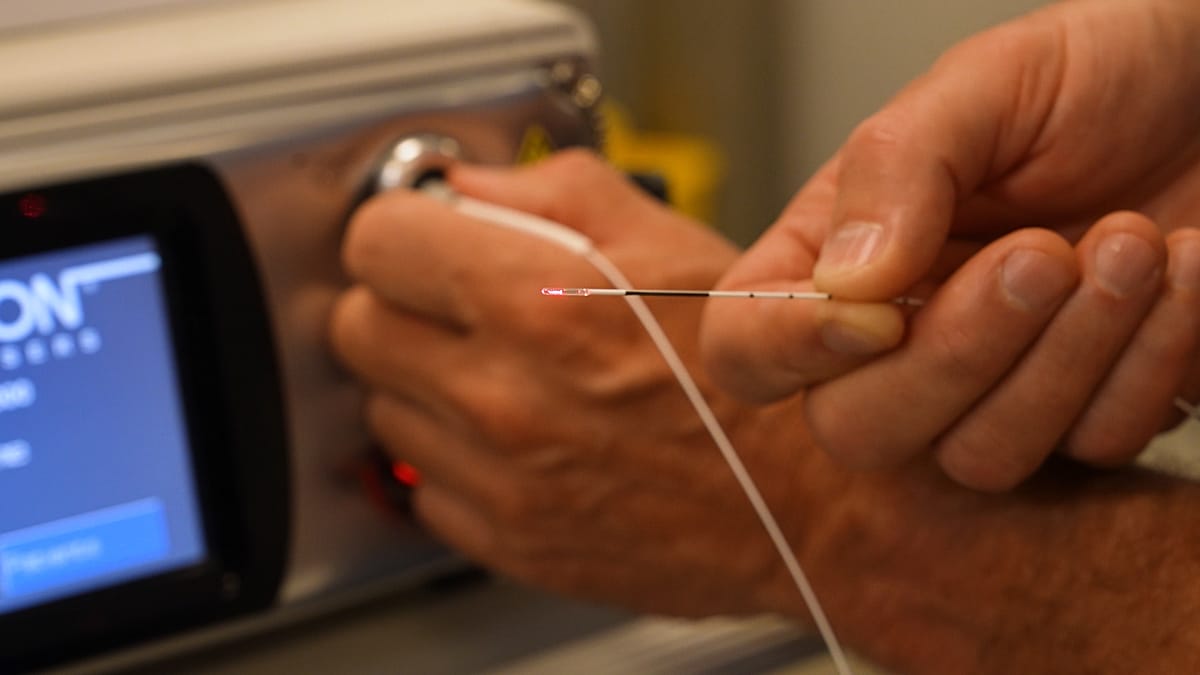
Medical technology is one of the industry’s most visible markets. Lightguide quality manager Santa Vucina told Euronews that the company makes approximately 1 million simple medical devices a year, each consisting of a single fiber and a basic connector. Applications cited by vascular surgeon and phlebologist Dr. Ints Ūdris include proctology, plastic surgery, liposuction, urology, ophthalmology and cardiology.
Ūdris has worked with a leading Latvian company in the sector since 2016 to develop catheters used in his operations. He said the fiber-optic catheters are thin and flexible, prevent heat from becoming concentrated at one point, support less invasive procedures and allow faster postoperative recovery. According to the surgeon, current devices also consume approximately four times less energy than comparable equipment did 25 years ago.
The fibers transmit light from one point to another with practically no loss, enabling the delivery of high-energy or highly precise signals. Some are as thin as human hair. Lightguide works with fibers whose core diameter is around 50 microns, or slightly less, rather than the smaller fibers commonly used in telecommunications. The company said it had no information indicating that its products had been used in military technology, although such an application is technically possible.
Investment supports a broader European supply role
The Optical Fiber Valley project has a total budget exceeding €5.4 million. European cohesion funding accounts for 40.40% of that amount, while companies and organizations connected with the project provide 59.59%. The funding structure combines public support for regional industrial development with a larger contribution from the participating private and institutional partners.
European demand for optical fiber is rising rapidly in medicine and other fields, Euronews reported. Latvia’s Investment and Development Agency is supporting the associated business activity, according to Vita Balode Andrews, director of the agency’s Export and Innovation Services Department. For manufacturers and investors, Latvia’s advantage lies in a specialized production base already selling into more than 50 countries. For medical-device buyers, the cluster offers customized components tied to clinical uses rather than only standardized communications products. Maintaining quality, application-specific engineering and access to international customers will determine whether Līvāni can turn its current export footprint into a durable European manufacturing hub.