Korean sunscreens gain global ground as Kolmar Korea expands US capacity
Korean indie brands are rising in Amazon sunscreen rankings, supported by Kolmar Korea’s formulation and manufacturing network. South Korean cosmetics exports reached $7 billion in the first half, while the company has built annual US capacity of about 300 million units.
K-beauty finds a global entry point in sunscreen
Sunscreen has become one of K-beauty’s most visible product categories in international online retail. Financial Review reports that products from Korean indie brands Round Lab, Beauty of Joseon and SKIN1004 have reached leading positions on Amazon, challenging the traditional perception of sunscreen as sticky and prone to leaving a white cast. Many of these products are manufactured by Kolmar Korea.
Kolmar Korea’s sun-care products began entering the US market in earnest in 2022. Its sunscreen export volume rose 88% last year, while the company continues to receive development requests from brands preparing to launch in the United States.
The expansion is part of a broader rise in South Korean cosmetics exports. First-half exports reached a record $7 billion, up 27.3% from the same period a year earlier. The United States remained the largest destination for a second consecutive year, accounting for $1.45 billion, or 20.7% of the total. Shipments to the US increased 41.5%, substantially faster than overall exports.
US regulation raises the barrier for manufacturers
Sunscreen is regulated in the United States as an over-the-counter drug rather than a cosmetic. Manufacturers must comply with rules covering permitted active ingredients and concentrations, SPF and broad-spectrum testing, and pharmaceutical good manufacturing practice requirements. These conditions make formulation and production infrastructure important competitive factors.
Financial Review identifies the addition of bemotrizinol to the US list of sunscreen active ingredients on August 9 as a major regulatory change. According to the publication, it was the first new ingredient admitted in more than 20 years and the first change to the list since the 1990s. A new active ingredient can require brands to redesign formulations and secure stable raw-material supplies.
Kolmar Korea already had experience with bemotrizinol because the ingredient has been used in South Korea, Europe and Australia since around 2000. That gives the manufacturer a base of existing formulation knowledge as brands prepare products for the US market.
AI moves into formulation development
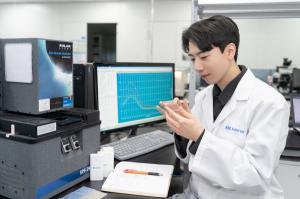
Kolmar Korea is developing an AI-based customized formulation system that analyzes climate, skin condition and ultraviolet exposure patterns. The system is intended to simulate thousands of variables and narrow the range of potential formulas before physical testing, reducing repeated experiments and development time.
The company has accumulated hundreds of thousands of formulations and experimental data points through 36 years of ultraviolet and sun-care research. It established the dedicated UV Tech Innovation Institute in 2022 and held about 110 cumulative sun-care patents as of June.
Its research pipeline includes a self-healing film designed to repair protection disrupted by sweat or friction, refraction-based technology that redirects light before it reaches the skin, and biodegradable vegan filters. Kolmar Korea is also examining connections with smartphones and wearable devices to notify users when sunscreen should be reapplied or protection adjusted.
Local capacity supports further US growth
Kolmar Korea operates Kolmar USA plants 1 and 2 in Pennsylvania, with combined annual capacity of about 300 million units. The production system used at its Sejong plant has been introduced at the second US facility, allowing formulations validated in South Korea to be manufactured under comparable conditions in the United States.
The investment coincides with stronger financial results. Kolmar Korea’s second-quarter consolidated revenue increased 17.9% year on year to 861.3 billion won, while operating profit rose 50.2% to 110.3 billion won. On a standalone basis, the company recorded its highest-ever performance for a second consecutive quarter. For Korean brands seeking international scale, the combination of formulation expertise, regulatory readiness and local US manufacturing offers a route from online popularity to sustained market presence.