Korean sauce exporters target wider use in Japan as import share slips
Japanese consumers are using Korean seasoned-chicken sauce with karaage, rice, tofu and stir-fries, creating opportunities beyond Korean restaurant menus. However, Japan’s imports from South Korea under the relevant broader sauce category fell 6.8% in 2025, highlighting the need for localized products and distribution.
Korean sauce moves into everyday Japanese meals
Korean seasoned-chicken sauce is moving beyond restaurant menus in Japan and into home cooking and school meals. The Korea Post reported that consumers familiar with Korean food through the Korean Wave are serving seasoned chicken with rice or adding its sauce to karaage, Japan’s established fried-chicken dish. In Osaka, seasoned chicken has also appeared on elementary school lunch menus, introducing the flavor to children and family consumers.
Japanese food companies are positioning the product as a multipurpose condiment rather than a sauce for one Korean dish. Suggested uses include French fries, chicken nuggets, stir-fries, tofu dishes, cheese tteokbokki and dak-galbi. This approach allows consumers to add Korean seasoning to familiar meals without learning a new cooking method. Buying prepared karaage and coating it with sauce offers an especially simple route into the category.
Market grows, but Korean import share declines
Data released by KOTRA’s Osaka office on the 20th put Japan’s relevant paste-type condiment market at ¥9.95 billion in 2025, up 0.5% from a year earlier. Fuji Keizai estimated the market at ¥9.9 billion in 2024 and said household products account for about two-thirds of sales. Higher food prices, consumer thrift and demand for shorter preparation times are supporting small bottles, tubes, pouches and single-use meal kits.
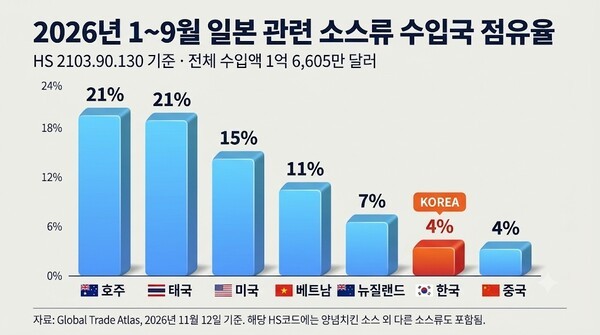
Import data present a more challenging picture for Korean suppliers. According to Global Trade Atlas figures cited by The Korea Post, Japan’s total imports under HS 2103.90.130 reached $217.24 million in 2025, up 1.3%. Imports from South Korea fell 6.8%, from $9.535 million in 2024 to $8.892 million, reducing its share from 4.4% to 4.1%. During January-September 2026, total imports rose 4.5% year on year to $166.05 million. Korean shipments increased slightly but lagged the overall market. The classification also includes products such as pasta sauce, so it does not measure seasoned-chicken sauce alone.
Local suppliers set the competitive benchmark
Thailand led the category’s imports in 2025 with $49.63 million and a 22.8% share, followed by Australia at $34.15 million, the United States at $32.82 million and Vietnam at $29.66 million. China’s shipments rose 27.0% to $6.596 million, narrowing the gap with South Korea. Korean exporters therefore face competition on price, flavor, pack size and convenience as well as country-of-origin appeal.
Domestic companies also hold strong positions. Fuji Keizai’s 2024 survey gave S&B Foods a 39.4% market share on sales of ¥3.9 billion and Youki Food 31.3% on ¥3.1 billion, a combined 70.7%. CJ Foods Japan held 4.7%. Retail formats range from S&B Foods’ 90-gram sauce priced at ¥305 before consumption tax and Youki Food’s 130-gram condiment at ¥380 to Daisho’s 90-gram cooking kit at ¥236. Ebara supplies a 595-gram foodservice sauce for ¥499.
Localization extends to packaging and distribution
KOTRA identified separate openings in household convenience products and foodservice sauces. Korean companies can specify uses for karaage, lunchbox side dishes and stir-fries, adjust sweetness and heat, and offer single-use pouches. Products can be placed not only in Korean-food or condiment aisles but also beside chicken in meat departments, as Daisho does with a kit containing sauce and frying powder. Other channels include supermarkets, online marketplaces, specialist Korean stores and foodservice distributors.
Exporters must also check classification and product requirements with Japanese importers and customs specialists because the applicable tariff code can vary with ingredients and format. With local companies already adapting Korean flavors, provenance alone is unlikely to secure growth. Japanese-language instructions, menu-specific applications, suitable pack sizes and partnerships with local distributors will determine whether wider consumer interest translates into higher Korean shipments.