Korean farming program lifts rice and orange incomes in Uganda
A Korean-backed agricultural technology program more than doubled rice harvests and raised participating households’ rice income by 132% in Uganda. Orange productivity among 140 demonstration households rose 186%, while income increased 309%.
Locally adapted technology raises farm returns
A Korean agricultural technology program has reported substantial productivity and income gains for rice and orange growers in Uganda. According to Herald Business, the Rural Development Administration said participating households more than doubled their aromatic rice harvests and increased rice income by 132%. In an orange demonstration program, productivity rose 186% and farm income increased 309%.
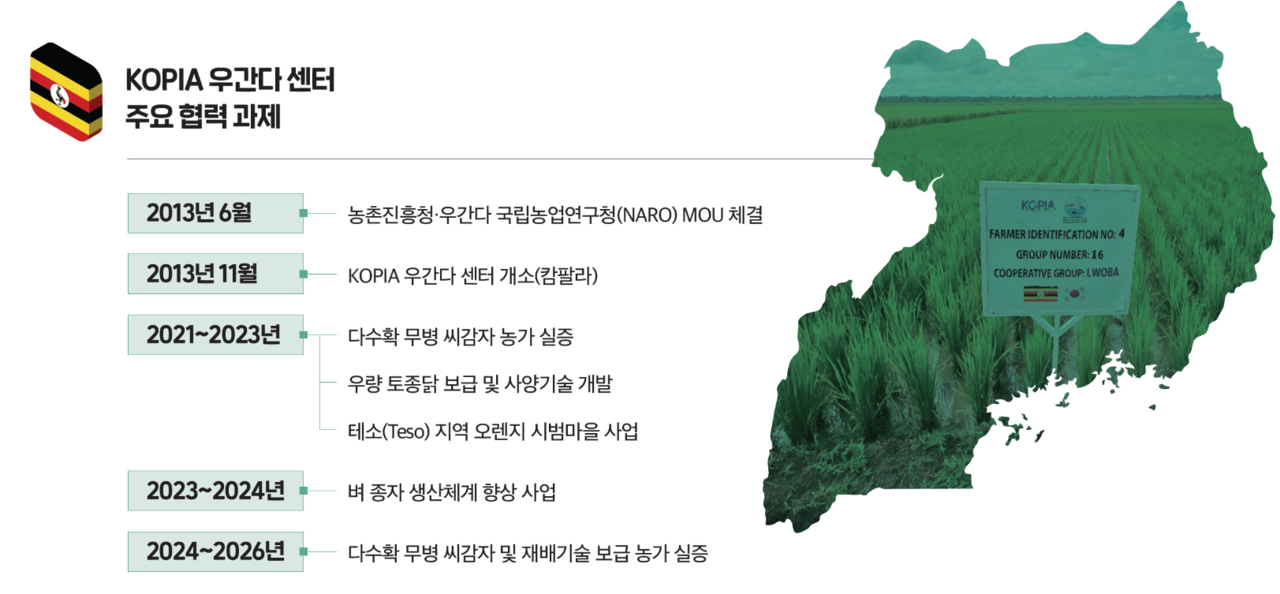
The KOPIA Uganda Center was established in 2013 through a partnership with Uganda’s National Agricultural Research Organisation, or NARO. KOPIA, the Korea Program on International Agriculture, is operated by South Korea’s Rural Development Administration to develop and distribute agricultural techniques adapted to conditions in developing countries.
Since its establishment, the center has conducted 14 cooperative projects, dispatched 22 agricultural experts and trained 8,666 Ugandan farmers. It has also published 29 agricultural education manuals. The figures show that the initiative has combined field trials with farmer training and systems intended to allow communities to reproduce seeds and disseminate techniques independently.
Aromatic rice delivers higher harvests and income
The rice program focused on aromatic varieties that sell at higher prices than ordinary rice. The center introduced Korean-style manual transplanting and cooperative cultivation methods, while establishing a system for seed production and technology sharing.
Participating farm households subsequently more than doubled their rice harvests, according to the Rural Development Administration. Their income from rice rose 132%. The results reflect both higher physical output and the market advantage of aromatic varieties, although the source did not provide absolute production volumes, prices or household income levels for the rice project.
The seed-production component is particularly important for the program’s durability. The stated objective is to enable farmers to produce planting material locally and pass cultivation knowledge to other growers, reducing dependence on repeated external distribution of inputs or technical assistance.
Orange yields rise in drought-prone Teso
In the Teso region of northeastern Uganda, a major orange-producing area, the program addressed recurring drought and pest-related losses. Field surveys identified orange spot disease as an important cause of reduced yields. The center responded with disease-control methods and a “one tree, one reservoir” system designed to store rainwater efficiently for individual trees.
Across 140 households in the orange demonstration villages, productivity increased from 5.9 metric tons per hectare to 17 metric tons, a rise of 186%. Average farm income increased from $773 to $3,162, equivalent to 309%. The program is now spreading beyond the initial villages to about 12,000 farm households across Teso, while approximately 1,500 farmers have received training in the cultivation techniques.
Farmer organization supports wider adoption
The Rural Development Administration attributed the results not only to technology but also to farmer organization. Individual plots received name plates to strengthen accountability, while annual productivity assessments awarded incentives to high-performing households and villages. Officials said these measures encouraged voluntary participation and competition.
Wi Chi-do, an agricultural researcher in the administration’s Overseas Agricultural Technology Division, said the community-led approach would be expanded to other developing African countries where government capacity is relatively limited. For Ugandan producers, the next test will be whether the gains recorded in demonstration households can be maintained as adoption expands to thousands of farms with different access to water, seed, training and markets.