South Korean Aesthetic-Medicine Firms Build Production and Distribution Networks Abroad
South Korean aesthetic-medicine companies are replacing distributor-led exports with directly controlled production, sales and distribution operations. Pharmaresearch, Classys and Jeisys Medical are expanding their presence across the United States, Latin America, Europe and China.
From exporting products to controlling local operations
South Korean aesthetic-medicine companies are moving beyond conventional exports and building directly controlled production and distribution networks in overseas markets. According to Seoul Economic Daily, companies that previously supplied products through foreign distributors are establishing local subsidiaries or acquiring manufacturers and distributors as international demand for Korean aesthetic products grows.
The shift gives manufacturers greater control over prices, inventories, marketing and customer data. Using independent distributors can limit costs and risk when overseas sales are small, but direct operations become more attractive as revenue rises. The model is particularly relevant for aesthetic-medical devices because clinics repeatedly purchase consumables, making direct relationships with healthcare providers potentially valuable for long-term profitability.
Pharmaresearch adds US manufacturing capacity
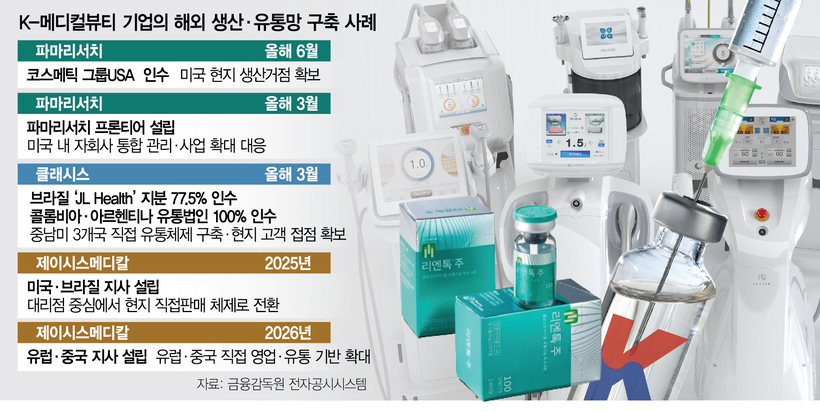
Pharmaresearch established Pharmaresearch Frontier as a wholly owned subsidiary in Irvine, California, in June, investing KRW 24.6 billion. The company said the new entity would help manage its expanding portfolio of US subsidiaries, which already included Dr. J Skinclinic and Pharmaresearch USA.
Also in June, Pharmaresearch signed an agreement to acquire local cosmetics manufacturer Cosmetic Group USA. Seoul Economic Daily reported that growing sales of Rejuran cosmetics through Amazon Prime Day, Sephora and other online and physical retail channels had increased the need for a US production base. The acquisition is intended to support a supply chain spanning local manufacturing, logistics and distribution.
The company recorded more than KRW 10 billion in US sales during the second quarter, its highest quarterly result in the market. Direct oversight of manufacturing and distribution could allow Pharmaresearch to respond more quickly to demand while reducing reliance on external partners. The company described Pharmaresearch Frontier as a management platform for its growing US operations rather than simply another sales subsidiary.
Classys and Jeisys expand direct distribution
Aesthetic-device manufacturer Classys is also replacing indirect sales through overseas distributors with owned distribution networks. In March, it completed the acquisition of a 77.5% stake in JL Health, described by Seoul Economic Daily as Brazil’s largest aesthetic-medical-device distribution group. During the same period, Classys acquired 100% of distribution companies in Colombia and Argentina.
Those transactions converted several major Latin American markets to direct operations and gave Classys access to more than 15,000 local customer contact points. The company plans to use that network to expand market share when launching new products. Ownership of the distribution channel also provides closer contact with clinics that buy equipment and recurring consumables.
Jeisys Medical is following a similar route. After establishing subsidiaries in the United States and Brazil last year, it opened entities in France and China this year. The additions are designed to increase direct sales and distribution capabilities in major markets previously served largely through external dealers.
Direct control raises both potential returns and exposure
The three companies are applying different versions of the same strategy: Pharmaresearch is combining manufacturing, logistics and retail access in the United States, while Classys is buying established distribution networks in Latin America and Jeisys is creating subsidiaries across several regions. Their investments indicate that overseas revenue has reached a scale at which controlling the route to market may justify higher fixed costs.
For manufacturers, direct operations can retain distribution margins and improve product-launch coordination. They also bring responsibility for local inventories, staffing, regulatory compliance and channel performance. Seoul Economic Daily cited an industry representative who expected more South Korean companies with established sales foundations to consider local subsidiaries or distributor acquisitions as the global profile and overseas revenue share of Korean aesthetic-medical devices continue to increase.