Korea plows under cabbage for a second season as summer crop enters market isolation
South Korea's cabbage growers are destroying fields in two consecutive seasons for the first time, after the agriculture ministry placed 3,000 tonnes of the summer crop into market isolation. Spring and summer output ran 9.6% and 15.3% above the multi-year average, keeping Garak market auction prices below both year-earlier and normal levels since March. Producers and traders are calling for regional and national bodies to manage planted supply from the transplanting stage.
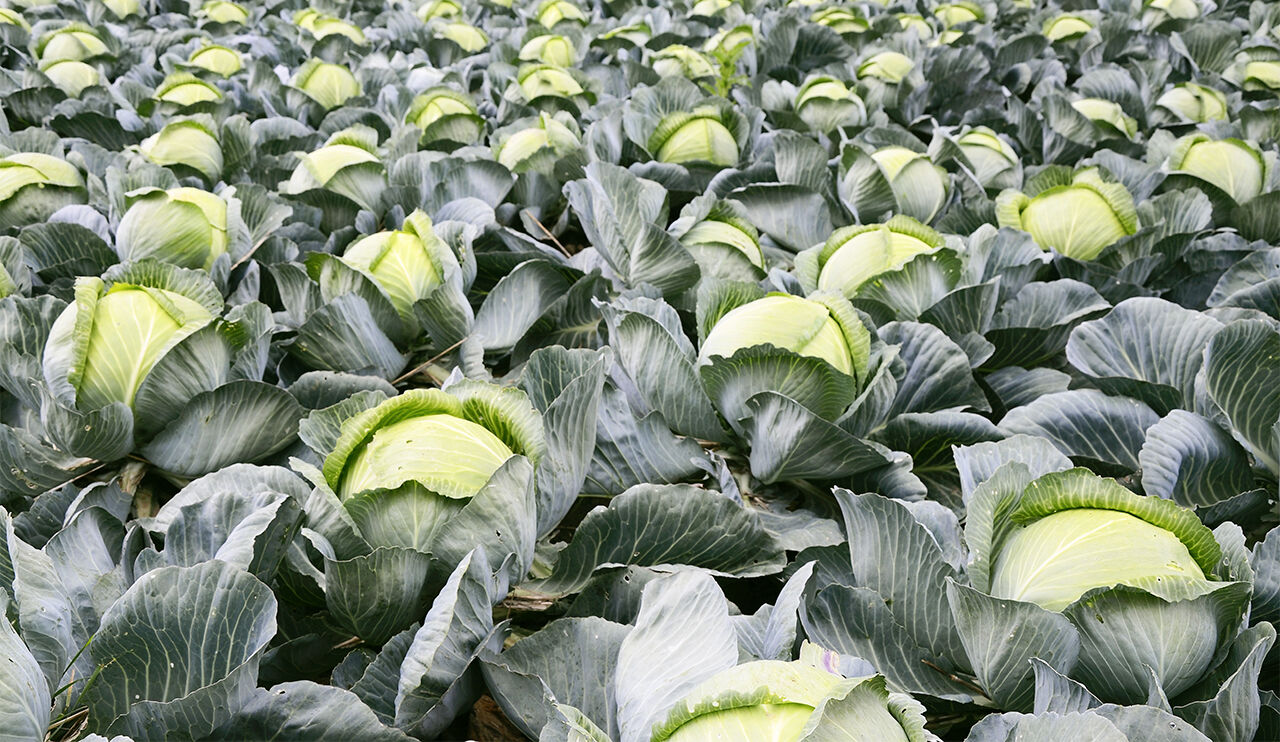
South Korea's cabbage market is in what the farm trade paper Nongmin Shinmun calls an off-season price winter. After the summer crop was added to the government's market isolation programme, growers are destroying fields in two consecutive seasons — an unprecedented sequence for this crop. Production areas and buyers alike are now pressing for industry bodies, organised by main growing region and eventually nationwide, that would manage supply from the transplanting stage rather than react once the harvest reaches the auction floor.
Auction prices below both benchmarks
Figures from Seoul's Garak wholesale market, cited by Nongmin Shinmun, show that the monthly average auction price for cabbage did not once exceed the year-earlier level in any month through September. From March onwards it sat below both the year-earlier figure and the multi-year average.
On 30 September, top-grade cabbage cleared at 7,437 won for an 8 kg net in Garak. That is 8.0% above the September average of the previous year (6,888 won) but 3.8% below the normal September level (7,730 won). Market participants largely read the move as a temporary bounce immediately after the Chuseok holiday rather than a turn in the trend. At the end of September, considerable volumes were still waiting to ship, mainly from Jeongseon and Taebaek in Gangwon province.
Oversupply meets weak consumption
Industry participants attribute the slump to oversupply combined with sluggish demand. Data from the Korea Rural Economic Institute (KREI) put both crops above the two standard benchmarks:
- spring cabbage: 68,000 tonnes, up 4.5% year on year and 9.6% above the multi-year average;
- summer cabbage: 102,000 tonnes, up 4.5% year on year and 15.3% above the multi-year average.
Cropping choices reinforced the build-up. An official at the Daehwa branch of the Nonghyup cooperative in Pyeongchang said summer cabbage handles abnormal weather better than summer napa cabbage: even where damage occurs, stripping the outer leaves usually leaves the head intact, so many farms plant summer cabbage rather than risk losing an entire season.
Two rounds of destruction
In March, growers in Muan, in the Jeonnam and Gwangju area, and on Jeju carried out large-scale voluntary disposal without public funding. The destroyed area covered 990,000 m2 (300,000 pyeong) in Muan and 1.98 million m2 (600,000 pyeong) on Jeju, for a combined 2.97 million m2 (900,000 pyeong). It was the first time the two regions had coordinated a privately financed disposal of this kind.
The intervention did not lift the market. Between April and June, an 8 kg net of top-grade cabbage never escaped the 3,000-won range. With a net typically holding three heads, that works out at roughly 1,000 won per head at wholesale. The weakness persisted through the summer.
The second round is government-led. Just before Chuseok, the Ministry of Agriculture, Food and Rural Affairs decided to isolate 3,000 tonnes from the market, centred on Jeongseon and Taebaek. Volumes withdrawn from shipment are to be destroyed in the field in sequence.
Missing coordination and the China option
An official at Garak market noted that despite rising cabbage consumption there is no national body able to represent growing regions, and that at regional level only Jeju has one. Main production areas that dominate specific windows of the calendar, such as Jeonnam and Gwangju or Gangwon, also need bodies that discuss cultivation trends from the transplanting stage and adjust that year's volume pre-emptively.
A shipper based in the production areas pointed out that importers handling foreign broccoli and carrots maintain standing supply chains in Chinese growing regions, so even a modest rise in Korean prices can translate immediately into imports of Chinese produce. That caps the upside for domestic growers and strengthens the case for regional and nationwide coordination.