Khánh Hòa allocates 200 billion đồng to build Halal goat and sheep chain by 2030
Khánh Hòa plans to invest 200 billion đồng in Halal-certified goat and sheep production, including 50 billion đồng in public funding. The province aims to establish 14 farming zones, reach a herd of 500,000 animals and develop an integrated slaughter and processing chain by 2030.
Province sets targets for Halal-certified production
Vietnam’s Khánh Hòa province has approved a 200 billion đồng program to develop goats and sheep into Halal-certified products by 2030, according to Dân Việt. The plan combines 50 billion đồng in state support with 150 billion đồng from private and other mobilized sources.
During 2026-2027, the province intends to establish five Halal-compliant goat and sheep farming zones covering about 500 hectares. It aims to increase the combined herd to 350,000 animals and build at least one centralized slaughterhouse capable of processing 200-300 animals per day. Traceability and slaughter procedures aligned with Halal requirements will be central to the facility’s operation.
Khánh Hòa plans to expand the system to 14 farming zones covering approximately 1,735 hectares during 2028-2030. The province is targeting a herd of 500,000 animals by 2030 and wants to connect livestock production with slaughtering, processing and sales. The stated objective is to position Khánh Hòa goat and sheep products in both domestic and international markets.
New breeds improve yields and shorten production cycles
The export-oriented plan builds on breeding and husbandry programs already tested by the provincial agricultural extension service. Nguyễn Văn Dũng, director of the Khánh Hòa Agricultural Extension Center, said local herds had traditionally relied on indigenous breeds and natural grazing, resulting in slow growth, low productivity and limited carcass yields.
The center introduced meat-focused Boer goats and crossbred Dorper sheep. Dân Việt reported that offspring birth and weaning weights increased by 20-30%, while adult animals became 10-15 kilograms heavier. Carcass yield rose from 35% to 45-48%, and the production cycle shortened from 10-12 months to 6-7 months. These changes reduce feed expenditure and allow farmers to turn over capital more quickly.
At Tạ Phượng’s farm in Mỹ Sơn commune, a shift from local sheep to crossbred Dorper animals and a more controlled fattening process helped expand the flock to about 450 head. Market age declined from 7-8 months to around five months, while sale weight reached 35-40 kilograms per animal, 3-5 kilograms above the previous breed. At prices of 120,000-130,000 đồng per kilogram, the farm earns a stable monthly profit of about 30-35 million đồng.
Feed security and biosecurity underpin expansion
Feed availability remains a critical constraint in drought-prone areas including Cam Lâm, Cam Ranh, Ninh Hòa, Khánh Sơn and Khánh Vĩnh. The extension center has promoted high-yield VA06 and Ghine grasses and the ensiling of agricultural by-products, allowing farms to hold feed reserves for five to six months. Combined with biosecure husbandry, these measures reduced dry-season herd losses from more than 10% to below 1.5%.
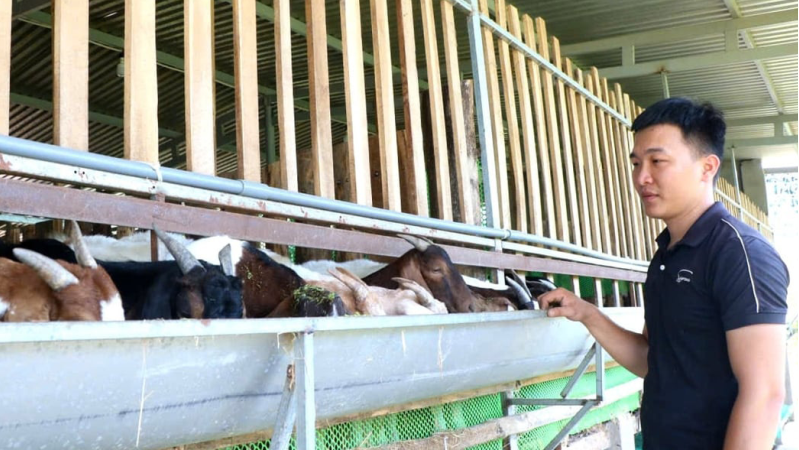
Đào Văn Cường’s goat farm in Tây Khánh Vĩnh illustrates the model. He entered an extension project in 2025 with 42 Boer and Bách Thảo breeding goats; after one year of semi-industrial husbandry, the herd had grown to 68. The farm cultivates about 7,000 square metres of VA06 and Ghine grass, supplements it with agricultural by-products and uses raised-floor housing, waste collection and a biogas system. Breeding goats sell for about 250,000 đồng per kilogram, while manure provides an additional source of income.
The provincial targets create potential scale, but Halal certification alone will not guarantee export sales. Khánh Hòa must maintain compliant practices across farms, transport, slaughtering and processing while developing reliable buyers. The planned centralized facility and traceable production zones are therefore essential links between the improved farm economics already demonstrated and access to Muslim consumer markets.