Kazakhstan Shifts Farm Output Toward Processing as Canned Meat Production Jumps 48.3%
Kazakhstan is redirecting its agricultural sector from sales of unprocessed commodities toward processing and value-added goods, the government press service said. The oils and fats industry runs about 90 plants with combined capacity above 4.5 million tonnes of raw material a year, and more than 90% of the domestic sunflower crop is crushed inside the country. Canned meat output rose 48.3% in 2025.
Kazakhstan is moving the centre of gravity of its agricultural sector away from sales of unprocessed commodities and towards processing and higher value-added goods. The shift spans several chains at once — meat, dairy, oilseeds, wool, fruit and vegetables, and animal feed — according to the Kazakh government press service, cited by inbusiness.kz.
Oilseed processing sets the pace
The oils and fats industry remains one of the core segments of the strategy. Around 90 enterprises operate in the sector, with combined capacity exceeding 4.5 million tonnes of raw material per year, the government said. More than 90% of the sunflower grown in Kazakhstan is now processed inside the country rather than shipped out as seed.
The government describes the next stage as moving beyond primary crushing. The task is no longer only to process the raw material grown domestically, but to expand output of finished products that can go straight to the domestic market or be supplied for export.
Meat and dairy plants widen the product mix
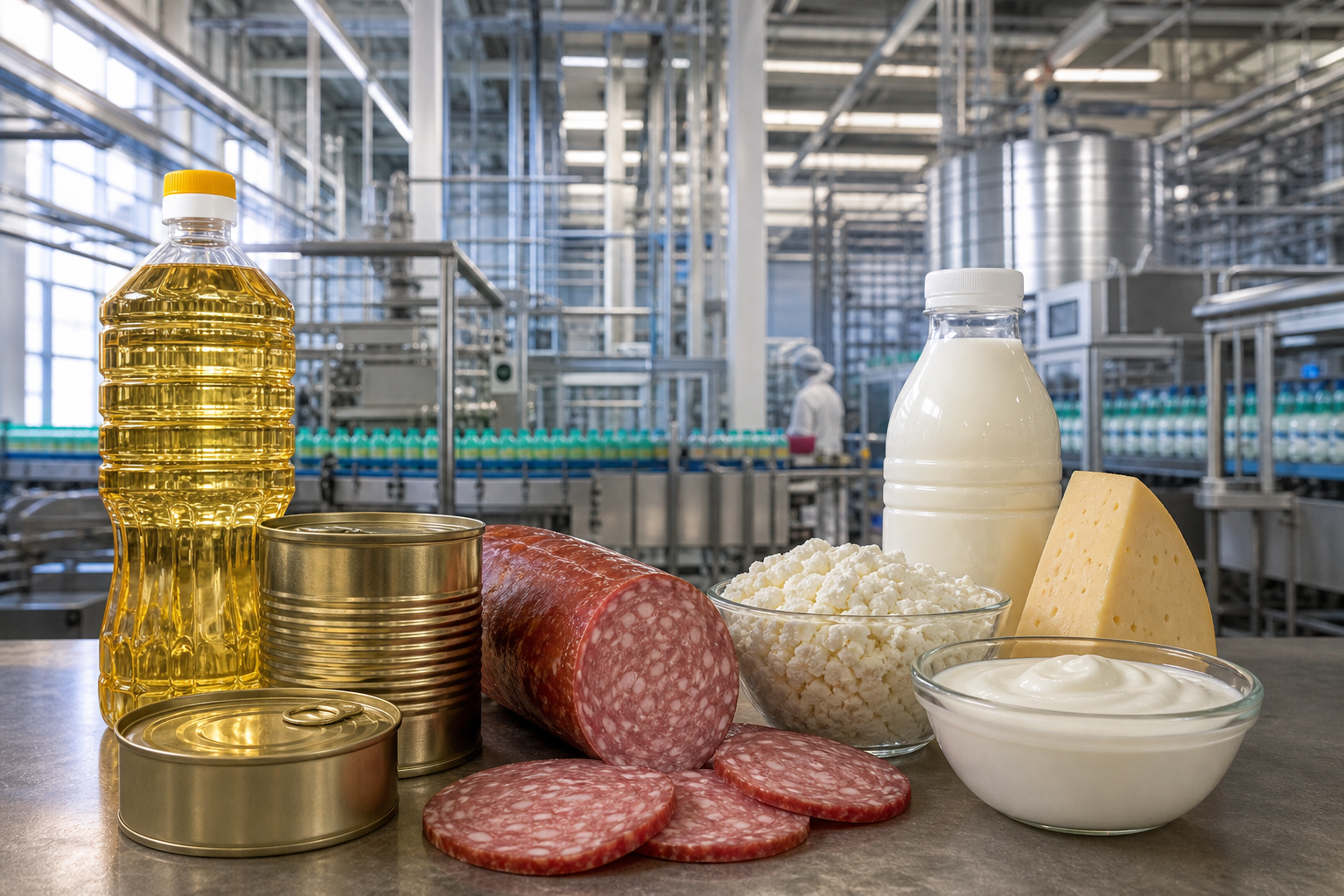
Kazakhstan has some 210 meat processing enterprises and 180 dairy processing enterprises, according to the government. Plants are broadening their assortment and raising output of sausages, canned meat, semi-prepared foods, fermented milk products and other ready-to-eat lines.
The sharpest movement is in canned meat, where output rose 48.3% in 2025, the government press service said, without publishing volumes or a value figure. The government links the increase to a wider pattern: processing is drifting towards goods with a longer shelf life that can be supplied beyond local markets.
That distinction matters for market access. Chilled and fresh product ties a landlocked producer to nearby buyers, while shelf-stable canned goods travel further and tolerate slower logistics.
Wool, horticulture and feed next in line
Several further segments are under consideration for development, the government said:
- wool processing;
- fruit and vegetable processing;
- compound feed production.
Feed is treated as the connective tissue of the system. Compound feed production gives grain and other farm raw materials an additional domestic outlet, while livestock and poultry operations receive finished feed for rearing and fattening animals and birds.
Longer chains, value retained at home
For the farm sector the practical effect is a longer production chain. A farm supplies the raw material, a processing plant turns it into a finished product, and the subsequent logistics and trade generate additional value inside the national economy, the government said. The more stages of the cycle that remain in the country, the broader the base for enterprise development, employment, logistics and export shipments.
In a related report, inbusiness.kz said processing of agricultural raw materials in Kazakhstan has almost doubled. The government statement does not attach a baseline or a period to the capacity figures beyond the 2025 comparison for canned meat, and it gives no investment totals for the programme.
The stated priority for the next phase is not simply a larger volume of primary processing but expansion of deeper processing stages — tying agriculture more closely to industry and building a more resilient chain from the farm producer to the final consumer.
Full market analysis