Kazakhstan meat prices rise despite record output, with lamb up 27.9%
Kazakhstan’s meat prices rose 15.8% year on year in July 2026 despite record January–July production. Lamb led the increase at 27.9%, while per-capita consumption remained broadly stable.
Output reaches a January–July record
Kazakhstan produced 48,200 tonnes of fresh and chilled meat from cattle, pigs, sheep, goats, horses and other equines in January–July 2026. According to Lada.kz and Kokshetau.asia, output increased 9.3% from 44,100 tonnes in the same period of 2025 and reached the highest January–July level since the statistical series began in 1999.
The record offers only a limited sign of long-term capacity growth. Production stood at 47,200 tonnes in January–July 2016, meaning output expanded by just 2.1% over a decade. It fluctuated substantially during that period and fell to 37,100 tonnes in the first seven months of 2021.
Household demand has meanwhile changed little. Data cited from Kazakhstan’s Bureau of National Statistics show average consumption of meat and meat products at 20.7 kilograms per person in the first quarter of 2026, compared with 20.6 kilograms a year earlier. Beef consumption remained at 6 kilograms per person, equal to the first-quarter level recorded five years earlier. Lamb consumption slipped to 1.1 kilograms from 1.2 kilograms, while pork remained near 0.8 kilograms.
Lamb drives broad-based meat inflation
Despite higher production and stable consumption, average meat prices were 15.8% higher in July 2026 than a year earlier. Kokshetau.asia reported that the annual increase exceeded overall inflation. Lamb recorded the sharpest rise, gaining 27.9%, compared with 15.1% for beef, 14.4% for horsemeat and 11.3% for pork.
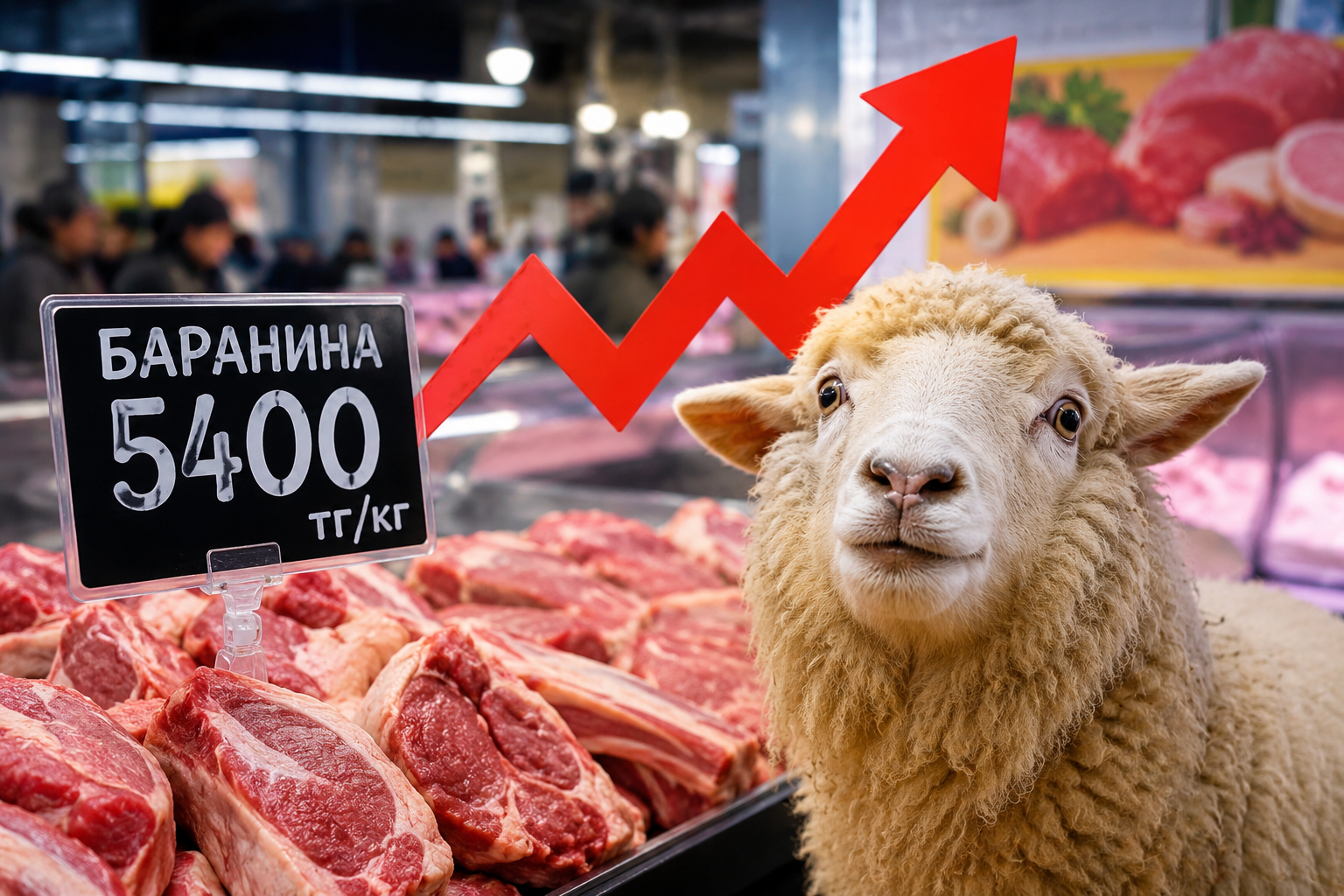
Lamb inflation accelerated in spring and early summer. Prices rose 4.7% month on month in May, the largest monthly increase since the series began in 2011, followed by 4.2% in June and 2.3% in July. Kazakhstan’s Agriculture Ministry attributed the April and May increases to seasonal demand ahead of Kurban Ait and said there was no shortage in the domestic market. Prices nevertheless continued rising after the holiday period.
International conditions provided additional pressure. Lada.kz and Kokshetau.asia reported that global lamb prices reached a new record in July amid limited export supply from Oceania and strong import demand. This contrasted with the broader FAO Meat Price Index, which declined 2.8% from June.
Regional and retail gaps remain wide
Every region recorded double-digit annual meat inflation. Prices rose most in the Jetisu region, by 21.9%, followed by Akmola and Ulytau at 19.6%. Even the smallest increase, recorded in East Kazakhstan, reached 12.2%. The geographic spread suggests that the pressure is not confined to one production centre or retail market.
Retail prices also varied sharply between cities. Lamb, including boneless cuts, averaged about 4,500 tenge per kilogram in July. It cost approximately 5,400 tenge in Astana and 3,800 tenge in Kokshetau, a gap of almost 1,700 tenge. Bone-in beef averaged 3,800 tenge per kilogram nationally, ranging from 4,200 tenge in Almaty to 3,400 tenge in Aktobe.
Horsemeat averaged 4,300 tenge per kilogram, compared with 3,000 tenge for pork. Horsemeat consumption has also shown the clearest demand growth: it increased from 1.8 kilograms per person in the first quarter of 2021 to 2.2 kilograms in the same period of 2026, including a 5.5% rise over the latest year.
The data indicate that a one-year production rebound has not translated into lower retail prices. With ten-year output growth limited to 2.1%, stable headline consumption does not exclude supply constraints in particular cuts, regions or seasons. For producers, processors and retailers, the widening gap between aggregate output and consumer prices makes costs, logistics, product mix and seasonal availability central to the market outlook.