Japanese companies propose carbon-credit project for 100,000 hectares of Vietnam’s coconut belt
Jizoku Inc. and Kansai Electric Power have proposed studying a low-emission coconut project covering about 100,000 hectares in Vinh Long under the Vietnam-Japan Joint Crediting Mechanism. The plan remains unapproved and must establish measurable additional emission reductions, legal compliance and a transparent benefit-sharing system.
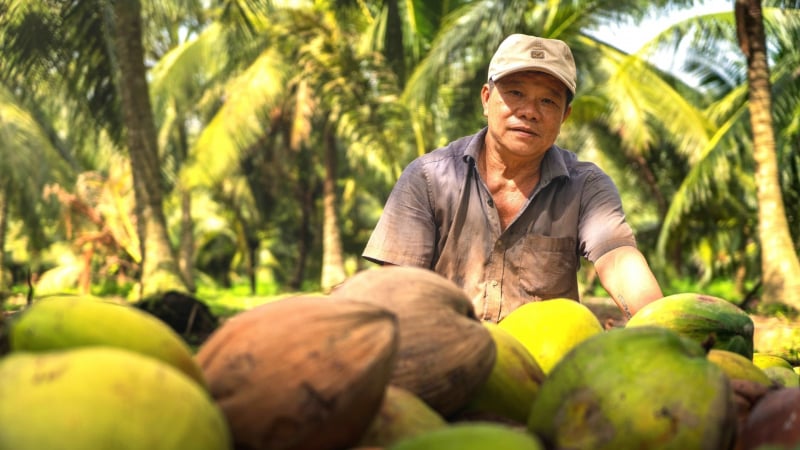
Japanese groups target a 100,000-hectare study
Japanese startup Jizoku Inc. and Kansai Electric Power have proposed studying a low-emission coconut production and carbon-credit project covering about 100,000 hectares in Vietnam’s Vinh Long province. The companies presented the proposal at a meeting with the provincial People’s Committee on September 17, according to Agriculture and Environment Newspaper.
The proposed program would operate through the Joint Crediting Mechanism between Vietnam and Japan. Jizoku’s research would examine more efficient fertilizer use, conversion of coconut residues into biochar, soil improvement and the creation of systems to measure, report and verify emission reductions. The company also proposed soil sampling, remote sensing, satellite data and artificial intelligence to monitor emissions.
The proposal is still at the research stage and has not been approved. A cultivated area cannot automatically be converted into carbon credits. Any project would have to demonstrate additional emission reductions or carbon storage against a baseline, meet measurement and verification requirements, comply with Vietnamese law and international commitments, align with Vietnam’s nationally determined contribution and prevent double counting.
Large production base supports the investment case
Vinh Long has 122,870 hectares of coconut plantations, more than 50% of Vietnam’s total and the country’s largest growing area. Of that land, 30,708.3 hectares is certified organic. Average production is about 337.8 million coconuts a year, according to the provincial Department of Agriculture and Environment.
The province has 187 growing-area codes covering 19,439.79 hectares for exports of fresh coconuts to China, as well as 24 approved packing-facility codes. Its coconut-processing industry includes about 151 companies producing desiccated coconut, coconut milk, coconut oil, packaged coconut water, activated carbon, coconut fiber, coco peat and handicrafts.
Processing output value is estimated at VND8.15 trillion in 2025, up 5.84% from the previous year, while exports of coconut products reached about $600 million. Provincial plans call for coconut acreage to rise to about 132,000 hectares and output to 1.72 million tonnes by 2030. By 2045, the targets are around 140,000 hectares and 2 million tonnes.
For 2026, Vinh Long expects to add 13,369 hectares of organic coconut production, taking the certified organic area to about 44,077 hectares, or nearly 36% of the province’s coconut land. The expansion is intended to combine organic certification with traceability, emission reductions and closer supply-chain coordination.
Residues could become a second revenue stream
Provincial authorities are testing biochar production from coconut residues to improve soil, retain water and nutrients, and store carbon. Husks, fiber, coco peat and shells could supply biochar, organic fertilizer and other circular-economy products. Jizoku also wants to assess residue collection, reuse, processing-site logistics and the ability to aggregate raw material.
Kansai Electric expressed interest in purchasing eligible credits generated by JCM projects in Vietnam. Its representative said the company aims to cut emissions by 50% by 2030, equivalent to about 44 million tonnes of CO₂ annually, under its Zero Carbon Vision 2050. The company indicated that it would purchase all credits produced by qualifying Vietnamese projects, although the Vinh Long proposal has yet to establish how many credits could be generated.
Approval depends on verification and benefit sharing
For farmers, cooperatives and processors, the commercial outcome will depend on project design. Producers would be responsible for changing cultivation practices and managing residues, while investors and technical partners would operate data, verification and credit systems. Authorities said any benefit-sharing mechanism must clearly define the rights and obligations of each group.
Vice Chairman of the Vinh Long People’s Committee Nguyen Quynh Thien said cooperation must be legal, transparent and effective, with balanced benefits for the state, residents, cooperatives, businesses and partners. The provincial Department of Agriculture and Environment will coordinate a comprehensive review of the objectives, scale, timetable, investment resources, technical requirements and carbon-credit mechanism. The Japanese companies were asked to provide documentation, methodologies, scientific evidence and a legal basis before officials consider further steps.