Japan’s shrinking kiwifruit harvest leaves a ¥10 billion monthly off-season gap
Japan consumes about 120,000 tonnes of kiwifruit annually, but domestic production has fallen to roughly one-third of its peak. President reports that limited winter and spring supply leaves an estimated monthly gap of 7,500 tonnes, worth about ¥10 billion at retail prices.
A market divided by season
Japan’s kiwifruit market supports annual consumption of about 120,000 tonnes, even as domestic production has fallen to approximately one-third of its peak. According to President, this contraction has not resulted from imported fruit directly displacing Japanese growers. The market is instead divided into two largely separate supply seasons.
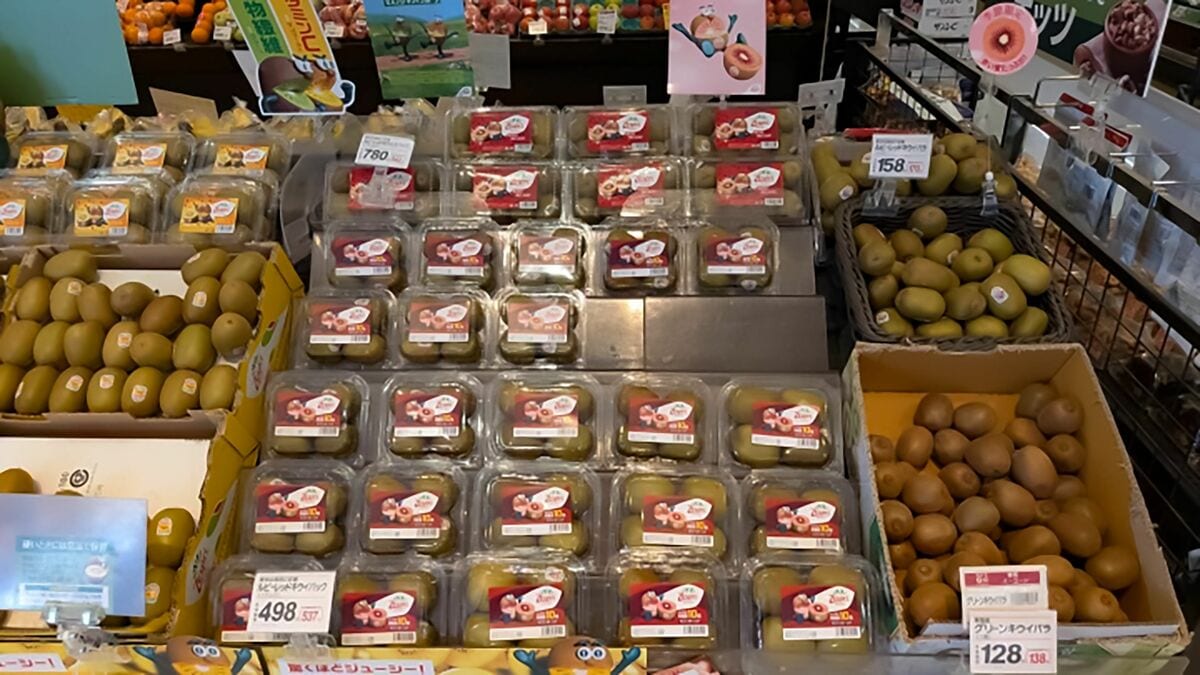
Imports, led by New Zealand, dominate supermarket distribution from April through November. Japanese-grown fruit supplies the market mainly from December through March. The two origins therefore do not usually compete for shelf space at the same time, although both help determine whether retailers can maintain a continuous year-round category.
The April-November segment has expanded sharply, supported by New Zealand’s production strategy and marketing. The domestic winter and spring segment has moved in the opposite direction. President attributes the decline in Japanese output to an ageing grower population and a shortage of successors, leaving local production unable to keep pace with rising demand.
A 7,500-tonne monthly shortfall
About 100,000 tonnes of Japan’s annual kiwifruit consumption occurs during the eight months when imports, principally New Zealand fruit, are available. Spread evenly across that period, demand is equivalent to about 12,500 tonnes per month. This provides a benchmark for the potential size of the market during the rest of the year.
Japan produces about 20,000 tonnes domestically. Even if that entire volume were marketed during the four-month domestic season from December through March, average supply would reach only about 5,000 tonnes per month. Against monthly demand potential of 12,500 tonnes, the implied deficit is approximately 7,500 tonnes.
President estimates that this unmet demand is worth about ¥10 billion per month at retail prices. The figure represents a calculated opportunity rather than recorded lost sales: actual consumption during the domestic season is constrained because fruit becomes less available and supermarket displays shrink.
Continuity matters for growers and suppliers
The shortage has consequences beyond the four-month domestic window. When kiwifruit disappears from stores or receives less shelf space during winter and early spring, consumers lose the habit of buying it regularly. President reports that purchases do not recover immediately when New Zealand supplies return in spring, creating a lag that limits growth across the whole category.
Domestic fruit also sells at a considerably lower unit price than New Zealand kiwifruit. President links this discount to inconsistent quality between Japanese production areas and less advanced ripening practices. Increasing tonnage alone may therefore be insufficient: growers and processors would also need more consistent grading, post-harvest handling and ripening performance to capture more of the available retail value.
For New Zealand and other potential foreign suppliers, the figures identify a substantial seasonal opening, but access depends on delivering fruit when Japan’s domestic crop is marketed rather than merely adding volume during the already developed import season. For Japanese producers, the same gap represents protected seasonal demand that is currently going unserved. The commercial issue is not simply import competition, but whether the supply chain can keep kiwifruit consistently available for twelve months.