Drought Stalls Jamaica's Coconut Recovery After 73% Output Rise Since 2021
Jamaican coconut production reached 209.6 million nuts in 2025, 73 per cent above 2021 levels, after a replanting drive led by the Coconut Industry Board. Drought is now cutting yields, with one St Thomas grower reporting output down by half and his oil factory running two to three days a week instead of five.
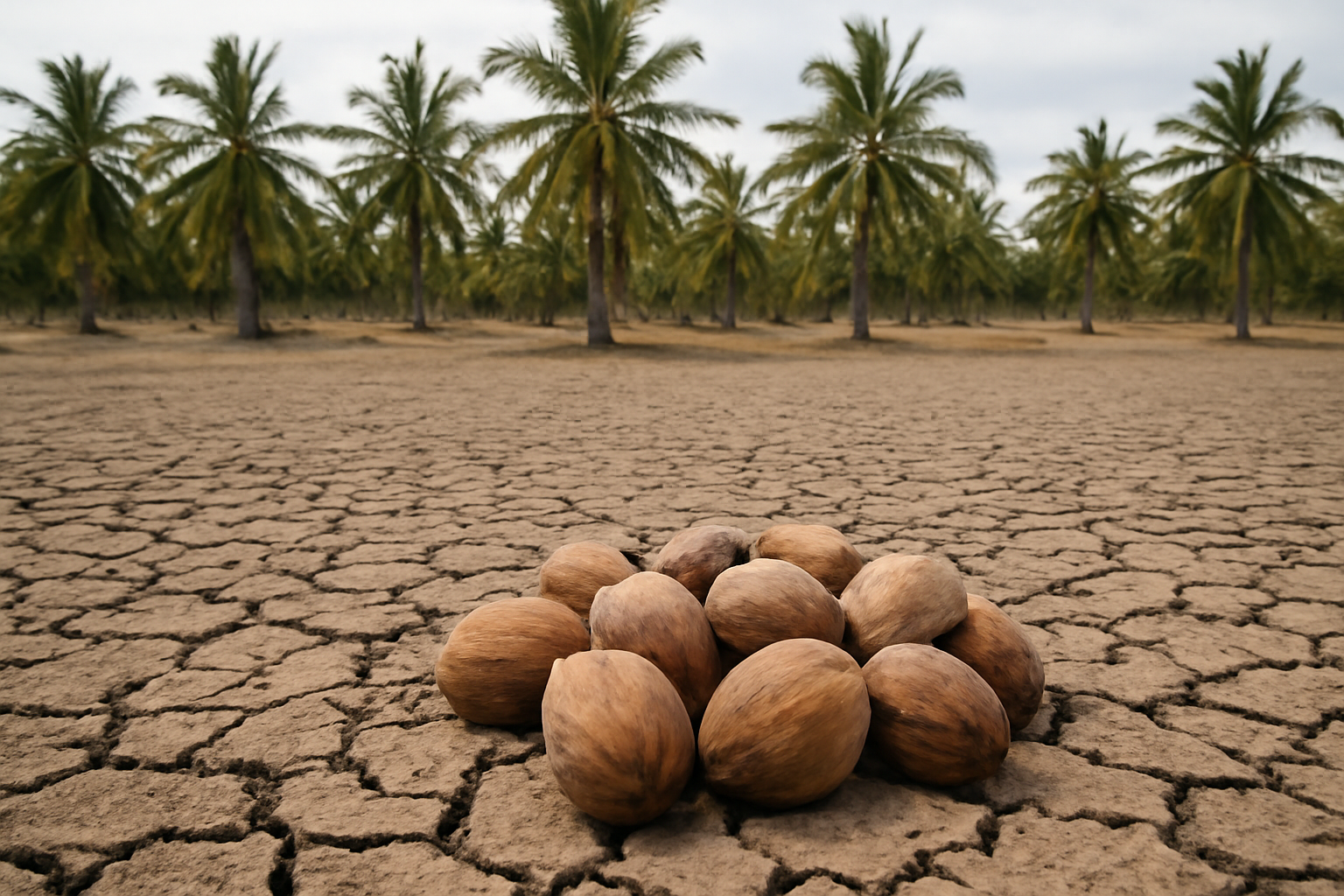
Jamaica's coconut production has climbed 73 per cent since 2021 on the back of a sustained replanting drive, but drought is now interrupting that recovery, with one St Thomas grower reporting output down by half this year, the Jamaica Gleaner reported.
Islandwide production rose 22.7 per cent to 209.6 million nuts in 2025, from 170.8 million in 2024, according to the Planning Institute of Jamaica's 2025 Economic and Social Survey of Jamaica (ESSJ). The 2025 figure is 73 per cent higher than the 121.2 million nuts harvested in 2021.
Replanting programme behind the gains
The ESSJ credited the expansion to rehabilitation work by the Coconut Industry Board (CIB). “Guided by a strategic five per cent annual growth objective, the CIB supported registered farmers through the distribution of free fertilisers, weed control grants, and high-yielding, disease-resistant seedlings. These interventions strengthened resilience within the industry and contributed to the sustained increase in output,” the survey stated.
CIB General Manager Shaun Cameron traced the turnaround to a replanting and farmer-support programme launched after decades of losses. “We lost nine million coconut trees from the 1970s up to the 2000s due to lethal yellowing and Hurricane Gilbert. In order to save the industry, we implemented a planting programme. It was challenging initially because no farmer wanted to invest where there was this particular rampant disease that was killing the sector,” he said.
Lethal yellowing, a fatal phytoplasma disease, kills coconut palms and other palm species within three to six months of the first symptoms. Hurricane Gilbert, which struck in 1988, flattened most of the standing coconut trees in the eastern parishes. Disease-resistant varieties, technical support, marketing and farmer training have since rebuilt the sector, Cameron said.
The lag between planting and first harvest explains the timing of the current upswing. “It takes three to five years for a coconut tree to start to fruit, so you can see the trees that were planted in 2021 are starting to fruit now,” Cameron said. The board has also courted a new class of grower, reaching out to business people and retired professionals with land, presenting coconut as a low-maintenance crop supported by CIB expertise.
Cameron named St Catherine as an emerging coconut parish, while growers in St Elizabeth now plant to supply fresh coconut water to the western tourism belt. Hurricane Melissa, which devastated the island last October, destroyed a coconut nursery at Barton Isle in St Elizabeth, but had limited impact on St Thomas, St Mary, Portland and St Ann, the parishes that produce most of the country's coconuts, according to the ESSJ. A large landowner in the west has also begun establishing a coconut orchard with CIB support.
Drought squeezes processing
The drought has hit Michael Black Farms Limited even as the company expands. “The factory is working two to three days per week now, as against five days per week normally, and we have big orders to fulfil,” Noah Black of Michael Black Farms told the Financial Gleaner.
The company has secured a 50-year lease on 250 acres beside its original farm at Nutts River, St Thomas, bringing its holdings to about 950 acres, 800 of them planted in coconuts. It employs about 150 people. The farm planted about 4,000 coconut seedlings over the past year but halted planting as water ran short, and has cut back herbicide spraying to reduce fire risk.
Michael Black Farms specialises in dry coconuts for oil production and sells 3,000 to 5,000 nuts a week to vendors. Its Miss Dawn coconut oil is distributed through Massy, the CIB, and the company's outlet in Morant Bay.
Demand running ahead of supply
Black said the market outlook remains positive. “Coconut is one of the new faces of agriculture. Every part of the coconut can be used to make something. As for the jelly coconuts, nobody can produce what the market needs now,” he said.
At Coronation Market in downtown Kingston, jelly coconuts sell for J$300 to J$450 each, and many shoppers fill recycled bottles of up to five gallons with fresh coconut water. The National Compliance and Regulatory Authority, which enforces compulsory national standards on local and imported goods, listed 21 registered packaged coconut water manufacturers on its website as at August 2025.