Italy Faces Olive Oil Oversupply as Origin Prices Fall 46.7% Before a Smaller Harvest
Italian storage still held close to 200,000 tonnes of olive oil in early September, while the average origin price for extra virgin fell to €5.12 per kilogram in July, down 46.7% year on year. Italia Olivicola expects the new crop at 260,000-280,000 tonnes against 325,000 tonnes in 2025/2026, with the south contracting and the centre-north recovering.
Italy is entering the new olive oil campaign with a smaller crop and warehouses that still hold large volumes of last season's oil, a combination that has cut producer prices almost in half over twelve months.
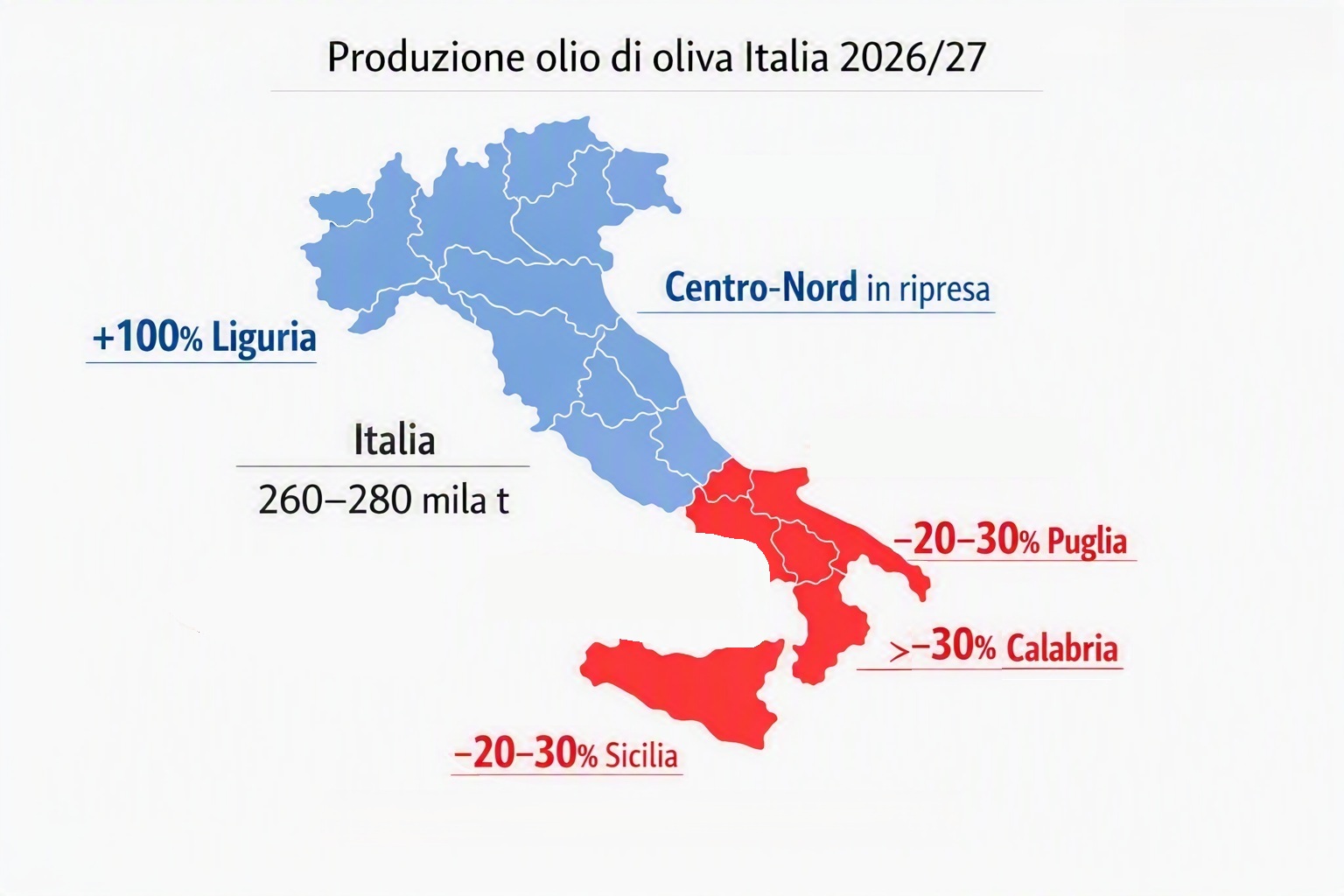
The research centre of Italia Olivicola expects national output of 260,000 to 280,000 tonnes, depending on weather in the coming weeks, plant health developments and mill yields, agricolae.eu reported. That compares with the 325,000 tonnes recorded in the 2025/2026 season. The organisation describes the year as an off year in the olive tree's natural alternate-bearing cycle.
Stocks remain heavy on the eve of the harvest
Data from the national agricultural information system, cited by greenme.it, show Italian storage well above year-earlier levels. At the end of June, total holdings stood at 258,480 tonnes. By the end of July they had fallen to 233,377 tonnes — still 43.9% more than at the same point in 2025, according to the latest "Frantoio Italia" report from ICQRF, the Agriculture Ministry's central inspectorate for quality protection and fraud repression.
By early September, Italian silos held close to 200,000 tonnes, of which roughly 88,000 tonnes were extra virgin, according to figures presented by Felice Assenza, head of the ICQRF department at MASAF, during the conference "L'Isola del Tesolio". Stocks are moving, but slowly: a substantial share of the previous campaign's oil still occupies tank space that the new crop will also need.
Origin prices down 46.7% year on year
The second pressure point is price. ISMEA data show the national average origin price for extra virgin olive oil at €5.12 per kilogram in July 2026, down 15.2% from June and 46.7% from July 2025. greenme.it stresses that this is an average producer-level price rather than a retail price, and that quotations vary by area, quality, origin and denomination.
Lower origin values may eventually reach buyers, but for growers and mills the cost side has not moved in the same direction. Harvesting, labour, energy, transport and grove management costs remain in place when the oil price falls. The squeeze is sharpest for operations built on small plots and traditional groves, where mechanised harvesting is harder to deploy.
A widening gap between south and centre-north
The production decline is concentrated in the south. The survey by Italia Olivicola points to:
- Puglia down 20-30% year on year;
- Sicily falling in line with Puglia;
- Calabria contracting more sharply;
- recovery across the centre-north, led by the Tyrrhenian coast;
- Liguria expected to double its output.
The centre-north rebound will not offset the southern shortfall, the organisation said. Gennaro Sicolo, president of Italia Olivicola, said the contraction was widely expected given alternate bearing, and that professional growers increasingly use agronomic tools, irrigation first among them, to soften it. His stated concern is abandonment: the biggest risk for Italy, he said, is that hobby growers walk away from their groves, particularly where prices are misaligned with production costs, creating disaffection towards family and national assets that should be protected.
Sicolo advised producers to rely on cooperatives and producer organisations, which collect olives and oil and also try to defend their value. He said Italia Olivicola had expanded storage capacity and tightened its strategic commercial relationship with Finoliva, the trading company of Italian olive growers and a shareholder in Alce Nero, in order to secure fair returns for members.
Producers press the government for support
The "Orgoglio Olivicolo" committee has taken the issue to government. On 6 September in Taranto, a delegation met agriculture undersecretary Patrizio La Pietra to discuss conditions for producers and mills, financial strain along the supply chain and possible support measures. The committee is asking for a permanent forum with the main large-scale retail chains, measures to help clear existing stocks, and a purchase price that at least covers farmers' costs. It also argues that current market conditions penalise domestic oil against imported product and points to oil entering at particularly low prices.
Italian oil competes in a European market where quotations have fallen broadly, with Spain and Greece the main alternative origins. greenme.it cautions against reducing the issue to a domestic-versus-foreign contrast: price differences reflect production costs, yields, farm size, supply chain organisation, grove characteristics and market conditions. The balance over the coming months will depend on how much old oil clears before the new crop arrives, how large that crop turns out to be, and where quotations settle.