Italy bars the extra virgin label on blends with virgin olive oil
A joint circular signed on 16 July by three departments of Italy's agriculture ministry, MASAF, rules that blends of extra virgin and virgin olive oil can no longer be sold as extra virgin and must be labelled virgin olive oil. The practice had been lawful until then and was upheld by a 2023 ruling of the Court of Perugia. The ministry cites Article 7 of Regulation (EU) No 1169/2011 and concerns raised by the European Court of Auditors in Report 01/2026.
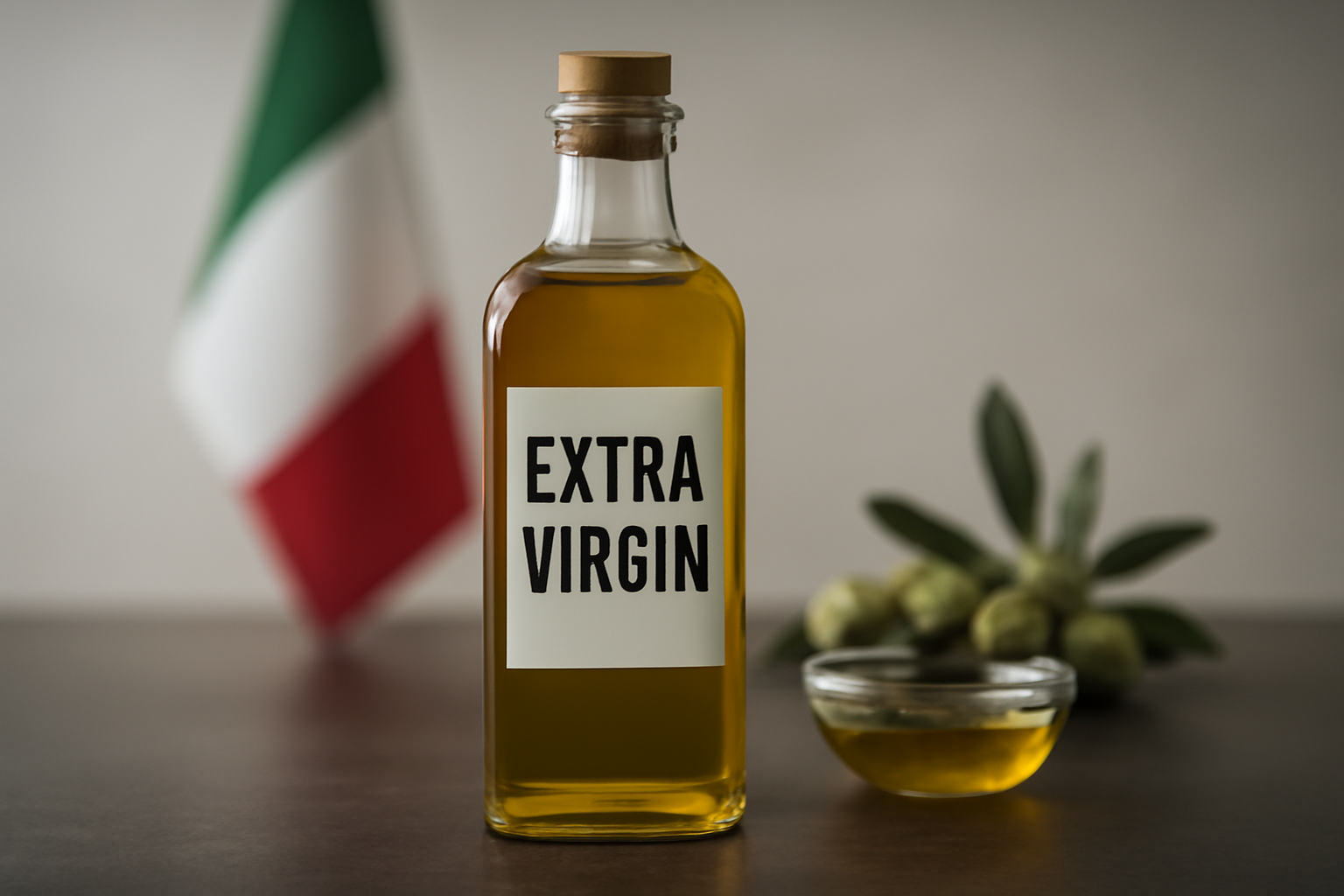
Italy has closed a labelling loophole that allowed blends of extra virgin and virgin olive oil to be sold as extra virgin. According to Corriere della Sera, a joint circular signed on 16 July by three departments of MASAF, the agriculture ministry, establishes that such blends may no longer be marketed as extra virgin olive oil and must be labelled as virgin olive oil instead.
Until that date the practice was entirely lawful. Virgin olive oil is also obtained by purely mechanical means, but it does not match the sensory quality of extra virgin and its acidity is higher. Corriere della Sera reports that mixing the two categories while keeping the superior name on the label had been confirmed as legitimate by a 2023 ruling of the Court of Perugia, which pointed to the absence of an express European prohibition.
Why the interpretation changed
The reversal follows the concerns raised by the European Court of Auditors in its Report 01/2026 and the ministry's stated aim of market transparency. MASAF now holds that describing a blend containing virgin oil as extra virgin is misleading and incompatible with the fair information principles set out in Article 7 of Regulation (EU) No 1169/2011, the core EU rule on the labelling of food.
The ministry's reading is categorical: mixing a higher category with a lower one turns the whole blend into virgin oil, and any reference to the higher category on the label becomes an offence. The circular settles a long-standing ambiguity over how the EU framework on mixing oils of different categories should be applied in Italy.
Sanctions and record-keeping
The interpretation matters above all because it opens the way to enforcement. Corriere della Sera notes that operators who continue to use the name of the superior category fraudulently can now be sanctioned under Legislative Decree 231/2017. The circular also carries traceability obligations:
- Blends of extra virgin and virgin oil must be sold and declared as virgin olive oil.
- Fraudulent use of the extra virgin name on such blends exposes operators to the penalties of Legislative Decree 231/2017.
- Mills, producers and traders must update the telematic oil registers they are required to keep, so that authorities can run accurate checks.
What changes on the shelf
Once stocks labelled under the old interpretation are sold through, bottles of virgin olive oil are expected to appear on Italian shelves as a visible retail category, with the extra virgin designation left to oils of genuinely higher quality and, correspondingly, higher price. Corriere della Sera describes the change as a gain in clarity for consumers and voices the hope that other producing countries will adopt the same approach.
For bottlers the consequence is direct: a product built on a blend either has to be reformulated with extra virgin oil alone or accept a lower category on the label. Entry-level and private-label lines are the most exposed, because blending was most useful where price positioning is tightest. And because the circular is a national interpretation of an EU regulation rather than new European law, Italian operators now work to a stricter standard than competitors in other producing member states selling into the same single market.