Rial Slide Fuels Inflation Bets on Iran's Commodity Deposit Certificate Market
A roughly 3.5% weekly drop in the rial's free-market rate revived inflation expectations in Iran, driving gains across eight of nine deposit certificates traded on the Iran Mercantile Exchange. Bitumen led with a 17% jump, partly on Brent crude volatility, while gold bullion and gold coin certificates rose 5% and 4% as global gold held near $4,100 an ounce. Zinc ingot was the sole decliner, down 1%, amid global oversupply and weak Chinese construction demand.
Rial Slide and Global Volatility Push Inflation Bets Back Onto Iran's Commodity Exchange
Iran's commodity deposit certificate market, traded on the Iran Mercantile Exchange (IME), booked a broadly positive week as a fresh drop in the rial revived inflation expectations among domestic investors, according to Donya-e-Eqtesad. Of the nine deposit certificates traded in the week ending 17 Tir on the Iranian calendar, only the zinc ingot certificate closed lower, while the remaining eight posted gains.
Global Commodities: Oil, Gold and Copper Set the Tone
Global commodity markets themselves were volatile last week, shaped by Middle East geopolitical tensions, central bank policy expectations and the outlook for Chinese demand, Donya-e-Eqtesad reported. Brent and WTI crude swung sharply, with prices pushed toward the $80-a-barrel range early in the week on fears of a Middle East supply disruption before partially retracing as tensions eased; falling commercial inventories at some consumption hubs and expectations of seasonal summer demand kept the market supported. Gold extended its role as a safe haven, returning to the $4,100-an-ounce range as investors weighed uncertainty over the path of U.S. interest rates, persistent services-inflation concerns, dollar swings and geopolitical risk; silver moved in tandem, climbing back above $60, though its range was also driven by industrial and technology-sector expectations. Copper drew particular attention as a bellwether for global growth, supported by hopes for a demand recovery in China and rising investment in AI-related infrastructure and power grids, though concerns over a slowing Chinese construction sector and elevated warehouse stocks capped gains; aluminum and zinc traded cautiously in similar, largely defensive ranges. Iron ore stayed under pressure as Chinese steelmakers' margins narrowed and doubts persisted over the pace of a domestic demand recovery, while wheat and corn found support from climate concerns and unfavorable conditions in some producing regions, tempered by an improving global supply picture.
Deposit Certificates: Bitumen Leads, Zinc the Lone Decliner
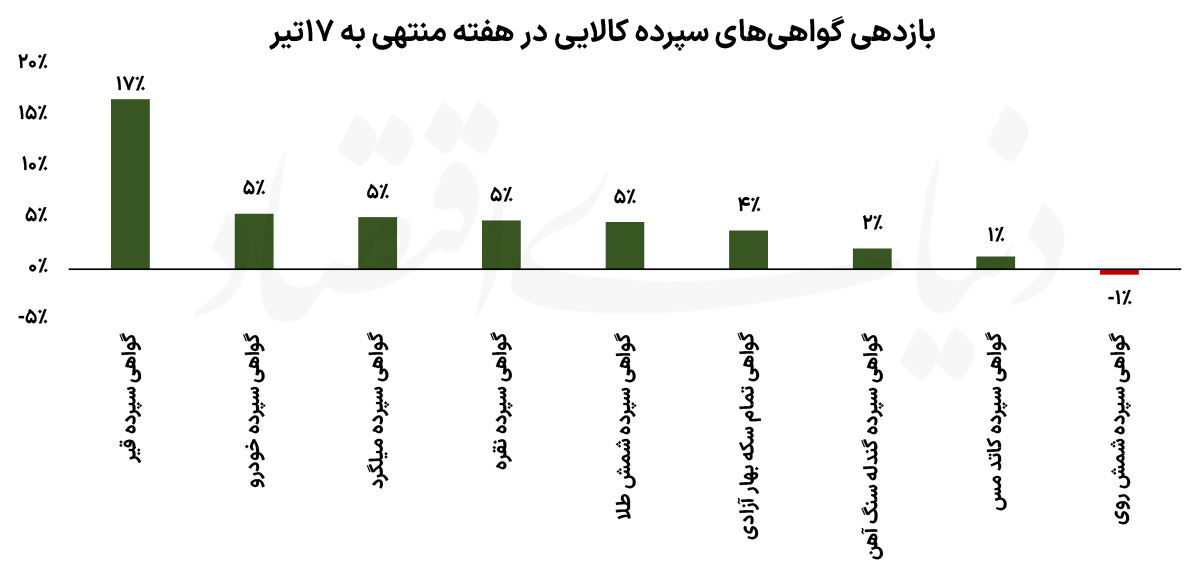
On the IME deposit certificate market, the bitumen (qir) certificate topped the returns table with a 17% gain. It was followed by the auto, rebar (miladgard), silver and gold bullion certificates, each up 5% - outperforming the broader market. The Bahar Azadi gold coin certificate rose 4%, iron ore gained 2% and copper cathode added 1%. Only the zinc ingot certificate lost ground, ending the week down 1%.
- Bitumen certificate: +17%
- Auto, rebar, silver and gold bullion certificates: +5% each
- Bahar Azadi gold coin certificate: +4%
- Iron ore certificate: +2%
- Copper cathode certificate: +1%
- Zinc ingot certificate: -1%
Currency Depreciation Was the Main Driver
Donya-e-Eqtesad identified the roughly 3.5% rise in the U.S. dollar's free-market rate against the rial as the week's most important driver. A weaker rial traditionally strengthens inflation expectations in Iran and pushes investors toward assets seen as able to preserve purchasing power, channeling demand into commodity-backed certificates. The 5% rise in the gold bullion certificate and the 4% gain in the gold coin certificate were also tied to global gold prices, which stayed elevated on geopolitical uncertainty, energy-market volatility and investor caution over central bank policy; the relatively stable dollar globally did not stop demand for safe-haven assets, and the domestic currency's depreciation doubled the effect of higher world gold prices for Iranian investors.
Base-metals certificates sent mixed signals. While global copper prices drew support from hopes of an industrial demand recovery and AI-related infrastructure investment, the zinc market remained under pressure from oversupply and weak construction demand, particularly in China - a dynamic that helps explain the 1% decline in the zinc ingot certificate, which, unlike other assets, lacked simultaneous support from both domestic and external variables. The week's most striking move, however, was the bitumen certificate's 17% jump: alongside the currency effect, volatility in energy markets, particularly Brent crude, triggered a buying queue for the certificate on Wednesday.
Donya-e-Eqtesad noted that the deposit certificate market continues to respond simultaneously to domestic and external variables - currency depreciation, relative stability in global gold prices, commodity-market volatility and rising inflation expectations all created favorable conditions for most certificates last week. Should the dollar's uptrend persist on the free market and global markets avoid fresh negative shocks, the report said, the deposit certificate market could remain an attractive destination for investors seeking to hedge against inflation and diversify portfolios.