Indonesian crude price falls to $81.68 a barrel as global oil supply recovers
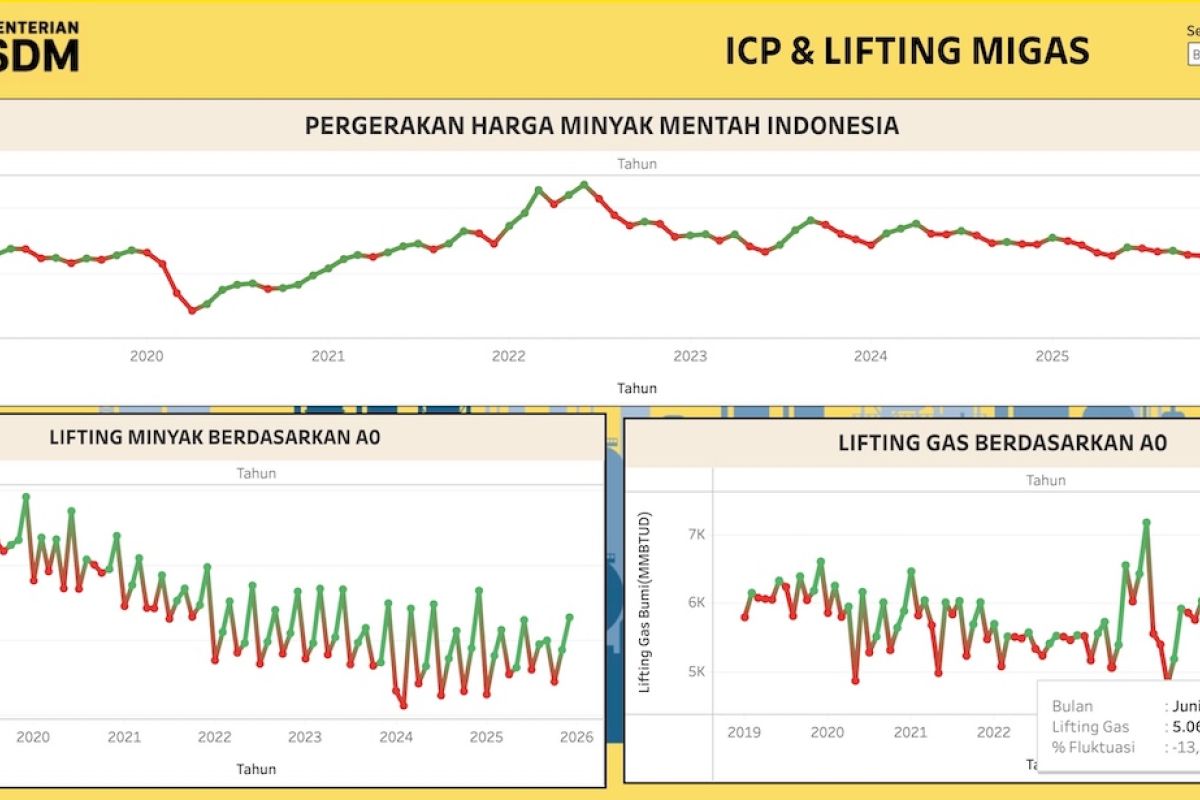
Indonesia set its July 2026 crude oil benchmark at $81.68 a barrel, down $1.77 from June. Easing Middle East tensions and a recovery in global supply reduced the risk premium across major oil benchmarks.
Indonesia lowers July crude benchmark
Indonesia set the average Indonesian Crude Price, or ICP, at $81.68 a barrel for July 2026, down $1.77 from $83.45 in June. The benchmark was established under Energy and Mineral Resources Ministerial Decree No. 319.K/MG.03/MEM.M/2026, according to ANTARA and Liputan6.
Laode Sulaeman, director general of oil and gas at the Ministry of Energy and Mineral Resources, said the new level reflected an adjustment in the global crude market as geopolitical tensions in the Middle East eased and international oil flows gradually recovered. The government uses the ICP as an official reference for state finances and Indonesia's upstream oil and gas business.
The decline leaves the Indonesian benchmark below both ICE Brent and Dated Brent for July, but above WTI. For producers and upstream investors, the lower ICP reduces the value assigned to domestic crude output compared with June. For refiners and other crude buyers, it points to some relief in feedstock costs, although the government said international uncertainty remained.
Major international benchmarks also decline
The adjustment was part of a broader retreat in global crude prices. ANTARA reported that average ICE Brent fell by $0.46 a barrel, from $84.43 to $83.97. WTI on Nymex dropped by $2.57, from $81.79 to $79.22, while Dated Brent declined by $2.06, from $85.47 to $83.41.
The OPEC Basket recorded the largest fall among the benchmarks listed by the Indonesian government. It declined by $7.00 a barrel, from $89.75 to $82.74. Liputan6 reported the latter value as of July 30, 2026. The different scale of the declines shows that the July correction was not uniform, even as the direction was broadly lower.
Indonesia attributed the movement to a combination of geopolitics, supply conditions and global demand. In particular, de-escalation between the United States and Iran, followed by a ceasefire and greater scope for bilateral and multilateral diplomacy, reduced market concern over a disruption to international oil shipments.
Hormuz traffic and supply shape the outlook
Improving shipping conditions through the Strait of Hormuz also supported market confidence. Citing International Energy Agency data, ANTARA and Liputan6 said a temporary recovery in traffic helped increase world oil supply by as much as 4.1 million barrels per day in June 2026. Total global supply consequently reached 98.8 million barrels per day.
The change is significant for oil producers, traders, refiners and import-dependent economies because the Strait of Hormuz is a strategic route for global petroleum distribution. A more reliable flow through the waterway reduces immediate concern about physical shortages and can narrow the geopolitical premium embedded in crude prices. July's lower ICP and declines in the international benchmarks indicate that this reassessment was already passing through to official and commercial price references.
Risks have not disappeared. The Indonesian government identified the possibility of limited military escalation, changes in United States crude inventories and shifts in global energy demand as factors that could affect prices in subsequent periods. These variables may reverse part of the July decline if supply risks intensify or inventories tighten.
The government said it would continue monitoring international supply, geopolitical developments and energy markets to support domestic price stability and energy security. It also plans to retain a transparent and accountable ICP formula designed to track global market conditions while serving state financial management and upstream oil and gas activity.