Indonesia Weighs Tougher SNI Palm Oil Standards, Putting Smallholder Compliance in Focus
Indonesia is preparing to raise the requirements of its national SNI standard for palm oil, according to tirto.id. The reporting frames the debate around cost distribution rather than technical merit, since any new obligation adds to the compliance load the sector already carries. Smallholders, who supply a structural share of the country's fresh fruit bunches, are the pressure point.
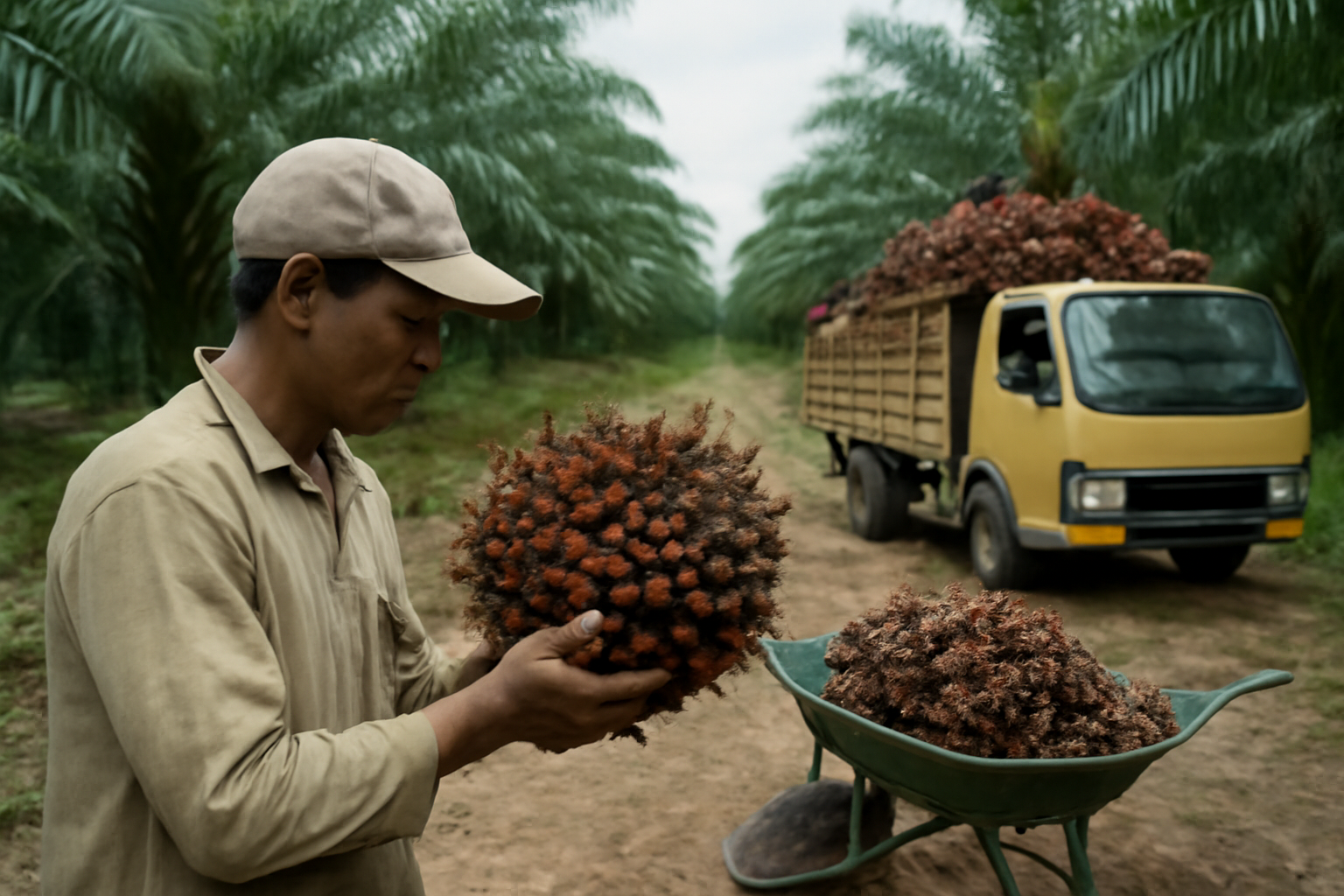
Indonesia is preparing to tighten the requirements of its national standard for palm oil, known as Standar Nasional Indonesia or SNI, a plan that has revived the question of whether the country's smallholder growers can carry the additional compliance load, tirto.id reported.
The outlet framed the issue as one of burden rather than of technical merit: any additional standardisation or new obligation has to be weighed against the costs that palm oil industry players already bear. The reporting does not set out the final technical parameters of the revised standard, the implementation timetable, or which segments of the chain would be covered first.
A standard with a cost attached
Raising SNI requirements for palm oil means moving beyond product specification into the machinery that proves compliance: sampling, laboratory testing, documentation, audits and the record keeping that supports them. Those functions are routine for integrated groups that already operate their own laboratories and quality departments. They are not routine for an independent producer selling fresh fruit bunches to the nearest collection point.
The burden argument rests on the fact that the sector already carries a stack of obligations, including ISPO certification, export levy payments and the sustainability documentation demanded by overseas buyers. Another layer changes the arithmetic for the smallest participants first.
That asymmetry is the core of the debate described by tirto.id. A standard that is technically reasonable at mill level can become a barrier at plantation level, not because growers cannot meet the physical parameters but because they cannot document that they meet them.
Why smallholders are the pivot
Smallholders are a structural part of Indonesia's palm oil supply base rather than a marginal one, and mills draw a meaningful share of their fruit from growers outside their own estates. The practical questions raised by a tighter standard are consistent across certification schemes:
- who pays for testing, auditing and certification, and whether the cost falls on the grower, the mill or the state;
- whether group or cluster certification is permitted, or whether every holding must be certified individually;
- how long the transition period runs before non-compliant fruit loses market access;
- how the requirement interacts with ISPO and with the documentation export buyers already require.
Where those questions are answered with funded, collective mechanisms, tighter standards tend to consolidate quality without removing supply. Where they are not, the predictable outcome is a two tier market: compliant fruit moving to certified mills at the reference price, and uncertified fruit moving through intermediaries at a discount.
Implications for mills, refiners and buyers
For mills and refiners, a stronger SNI is a sourcing question before it is a quality question. Tighter parameters raise the value of a documented, traceable supply base and increase the incentive to contract directly with grower groups rather than to buy through agents. For exporters, alignment between the domestic standard and buyer side requirements can cut duplicated auditing, but only if the standards are recognised as equivalent rather than stacked on top of one another.
The immediate market effect depends entirely on parameters that have not been published. A standard applied to refined products at the point of sale touches a narrow group of processors. One applied upstream to fresh fruit bunches touches every grower in the country.
What to watch
The decisive details are the scope of the revised standard, whether compliance is mandatory or voluntary, the length of any transition window, and whether the state or the industry funds smallholder certification. Until those are set out, the effect on Indonesian supply, on domestic fruit prices and on export volumes cannot be quantified.